Do you write poetry? Try submitting your poems to The Passionate Transitory, my online poetry journal.

Wednesday, 29 December 2010

Getting-To-Know-You Quiz

Anyone for an end of year getting-to-know-you quiz, or are we all totally sick of games, quizzes, crossword puzzles, paper hats, mince pies, family arguments and all other things Christmassy by now? You must answer quickly, without too much reflection, and you must give one answer only - no hedging, or giving several alternatives etc! (Of course, it goes without saying that many of the answers will change every time we do the quiz.) 

1.  Best band/rock 'n' roll band?
2.  Favourite pop/rock/whatever single?
3.  Greatest classical composer?
4.  Best novel?
5.  Favourite poem?
6.  Greatest painting?
7.  Just one meal before you die - what would it be?
8.  Cats or dogs?
9.  Town or country?
10. Blogging or jogging?
11. If a famous contemporary or historical figure could accompany you on a long walk, whom would you like that person to be?
12. Favourite film?
13. If you could visit just one country you hadn't been to before, what would that country be?
14. Most sympathetic religion/philosophy of life?
15. Favourite city?
16. The dark wood or the airy hill?
17. Most compelling actor/actress?
18. Most memorable holiday?
19. Solitary walks or walks with a companion?
20. Christmas or Easter?

For what it's worth, my own answers are these:

1. The Rolling Stones 2. Big Yellow Taxi (Joni Mitchell) 3. Beethoven 4. The Rainbow (Lawrence) 5. The Prelude (Wordsworth) 6. Starry Night (Van Gogh) 7. Thai curry 8. Cats 9. Country 10. Blogging (are you serious?) 11. Krishnamurti 12. The Enigma of Kaspar Hauser (Herzog) 13. India 14. Buddhism 15. Rome 16. The airy hill 17. Vanessa Redgrave (oh, please let me have Nastassja Kinski too!) 18. Rome over Christmas and the New Year - lovely and quiet! 19. Solitary walks 20. Easter (mainly because of the promise of Spring)     

Walking As Therapy (2)

Camino, Spain

If you watch how nature deals with adversity, continually renewing itself, you can't help but learn. DR BERNIE SEIGEL

Walking has saved my life. This may sound like hyperbole, but I happen to believe it to be true.

At a time when I drove the length and breadth of England as a sales executive, walks in Derbyshire's Peak District, or climbs in the Lake District, or strolls along the Grand Union canal were absolutely essential to me - welcome and necessary escapes from the confines of the car and a pressurised job. Walking saved my life.

When my father died I spent months alone at the old, family home, sorting out his things and preparing the house for sale, I was also working six days a week. On the Saturday, the day I had off, I used to roam the fields and woods nearby, and hike the disused railway embankment - all former childhood haunts. Walking saved my life.

My three Caminos in France and Spain were a direct response to mental turmoil and huge, seemingly intractable personal problems. These pilgrimages may not have taken the problems away, but they gave me relief, and insight into a different way of looking at things. Walking saved my life.

I find walking to be one of the best therapies. This is an approximation of a conversation I once had with the Camino ...

Camino: Buenos dias, mi amigo! Welcome to the Path. You know, there are so many pilgrims who walk along me praying I'm going to give them enlightenment and strew epiphanies at their feet like poppy petals. They want to find God instantly, or at least when they reach Santiago. And when they arrive at the end of the trail, and don't realise it's just the beginning of another, different trail, and when they find that great cathedral just alienates them, because it's too crowded, or because they're too tired, or because they're lonely and pining for the pilgrim friend they met in Burgos whom they've never seen again - they return home deflated and disappointed. Now, are you this kind of pilgrim, my serious friend?

Solitary Walker: Well, I don't know. It's too early to say. I've only just reached Hontanas, and I've other things to think about, such as the hole in my sock, the water in my boots, the pain in my knee and whether my stomach will protest about the oily fried eggs and rough, tongue-curling wine I'm about to consume in this albergue. And whether those bloody pilgrims are going to keep me awake for yet another night with their snoring and grunting and being sick from smoking too much weed. However, I did think you might stick around and provide some psychotherapy for me from time to time, my wise Camino guide?

Camino: Oh dear. Big mistake, peregrino! I'm afraid I'm not much of a psychotherapist, though a lot of people seem to think I am. Can't you see, dammit, that I'm simply a track? A little muddy, a little worn round the edges, a bit rocky here and there, it's true. But I'm not the most difficult track in the world, and I'm always well signposted. In fact in some places you'll find a scallop shell or a yellow arrow or a graffitied 'Ultreia!' every few metres. Sometimes all together. You'd have to be blind to get lost. (Though a surprising number of blind pilgrims do walk me. And actually they never get lost.) I think you'll have to look to those American new-age gurus for psychotherapy, mi amigo - you know, the ones you see on Oprah with names like Star and Heartsblessing. As I say, I'm no therapist. I can only trip you up, torture your feet, exhaust your limbs, graze your skin and, occasionally, bring you moments of such enormous joy that you feel radiant with hope, love and well-being. For true therapy look within yourself, my tired pilgrim.

Solitary Walker: Thanks anyway, Camino. I think we're getting used to each other's company, even if your answers do sometimes disappoint. I'm also getting used to your annoying habit of answering my questions with another question. What kind of answer is that? For instance, the other day I asked you how far it was to my destination, and you replied: don't you think your destination is right here and now? And recently, when I asked you how many more kilometres were left to walk along the path, you answered: you think there's a path

Camino: Well, as I've told you, my questing friend, I'm no sage. Though you'll discover a little sage - and thyme, and rosemary too - growing along my verges. Now, why don't you gather some and add these herbs to your instant packet soup tonight?

Solitary Walker: I've already said - I'm eating the hospitalera's fried eggs soon. Then I'll feel so tired I'll be crawling into my sleeping bag by nine. I'll rejoin you tomorrow, my twisting, winding, enigmatic friend.

Camino: Till tomorrow. Just remember what John Muir once wrote, that  In every walk with nature one receives far more than he seeks. And sleep tight.

Tuesday, 28 December 2010

Walking As Escape And Exercise (1)

Camino, Spain

I have two doctors, my left leg and my right. GEORGE TREVELYAN

I've never been one for sitting around too long. I like to be up and about. As someone once said: We sit at breakfast, we sit on the train on the way to work, we sit at work, we sit at lunch, we sit all afternoon, a hodgepodge of sagging livers, sinking gall bladders, drooping stomachs, compressed intestines, and squashed pelvic organs. And as someone else said: If it weren't for the fact that the TV set and the refrigerator are so far apart, some of us wouldn't get any exercise at all.

Of course I'm sedentary much of the time like many of us. I sit at the computer, I sit at the dining table, I sit and read a book, I sit and watch TV. It's just that I can't sit down for long without getting terrible itchy feet. In fact I don't think we're meant to live overly sedentary lives. I know for a lot of us this is unavoidable at our place of work. That's why it's so important to try and balance things out by using our own two feet as much as we can during our leisure time.

The one thing I can't endure now is sitting for hours and hours in the car. This dates from a time when I used to drive 40,000 miles a year criss-crossing England as a freelance publishers' agent. I just couldn't go back to driving hundreds of miles each day. I have a phobia about it. (Sometimes, when I had a few free hours, I would turn off the motorway and take a walk in the countryside - carrying an umbrella, and dressed in a suit and smart shoes! I must have looked a trifle odd to other walkers passing by in cagoules, waterproof trousers and leather boots. But for me it was a necessary escape valve.)

The other sedentary activity I find difficult is sitting at dinner parties and social gatherings, or in circles of acquaintances or colleagues, and having to make polite conversation for hours on end. I'm not anti-social - but I'm not particularly effusively sociable either. When the boredom sets in and the gossip becomes too much to bear, my feet start tapping and my gaze turns to the world outside beckoning from beyond the window. How I would so love to be running in freedom out there! 

Jean-Jacques Rousseau would have identified with this. In a passage from the Eighth Walk in The Reveries Of The Solitary Walker Rousseau reminds us that, in order to appreciate a walk in nature with all its charms, you must leave behind the disturbance of the vain ideas of the drawing room, the fumes of self-love and the tumult of the world, and social passions and their sad retinue:

I remember perfectly that during my brief moment of prosperity these same solitary walks which are so delightful for me today were insipid and boring. When I was at someone's house in the country, the need to get some exercise and to breathe fresh air often made me go out alone; and sneaking away like a thief, I would go walk about the park or the countryside. But far from finding the happy calm I savor there today, I took along the disturbance of the vain ideas which had preoccupied me in the drawing room. Memory of the company I had left followed me into solitude. The fumes of self-love and the tumult of the world made the freshness of the groves seem dull and troubled the peace of the retreat. I fled deep into the woods in vain; an importunate crowd followed me everywhere and veiled all of nature to me. It is only after having detached myself from social passions and their sad retinue that I have again found nature with all its charms.

As well as being an escape from stress, boredom and social passions and their sad retinue, walking is also excellent for our health and well-being. It reduces the risk of high blood pressure, high cholesterol levels, coronary heart disease, type 2 diabetes and cancer. It keeps joints fluid, and bones and muscles strong. It's also a strong antidote to depression and other mental health problems. And it's actually pleasurable too! These are wonderful benefits from such an easy, innocuous, free and democratic activity. 

Walking is the best possible exercise. THOMAS JEFFERSON

It is remarkable how one's wits are sharpened by physical exercise. PLINY THE YOUNGER

A vigorous five mile walk will do more good for an unhappy but otherwise healthy adult than all the medicine and psychology in the world. PAUL DUDLEY WHITE

Sunday, 26 December 2010

Three Or Four Hills And A Cloud

In my room, the world is beyond my understanding. But when I walk I see that it consists of three or four hills and a cloud. WALLACE STEVENS Of The Surface Of Things

Why do we go walking? It's an interesting question. We start to walk as soon as we wake up in the morning. We walk to the bathroom. We go downstairs. We visit the shops to buy groceries. We drag the dog round the block. We walk to our friends' houses and post Christmas cards through their letterboxes. In other words, we walk all the time, without thinking about it. It's a natural, practical way of getting from A to B, and we do it automatically.

But we may also have a regular walk we take each evening, say, when we 'beat the bounds' of our neighbourhood. Or we may even have a longer 'constitutional' stroll we perform ritualistically every Sunday. Some of us may take it much further - go on more demanding two day hikes through the whole weekend, book walking holidays, or undertake strenuous, multi-week treks over difficult terrain. This type of walking is different in kind from our normal, practical, functional walking activities.

So why, in a deeper sense, do we go walking? The question is more profound than it might at first appear, and the answers sweep us up into vast realms. In fact these answers cover all subjects and all experiences. They cover the whole world, like footprints stretching endlessly through Arctic snow or desert sand. Walking can be seen as pilgrimage, therapy, exploration. It can be a means of reflection and meditation. Astonishingly it's also a path through history, philosophy, art and metaphor. Above all it's a gateway to freedom. And, as Rebecca Solnit says in her book Wanderlust: The history of walking is everyone's history. The world of walking is one of the few democracies in which we may all truly and equally share.

I'd like to take you on a ten-part journey through the limitless country of walking. This sequence will reflect on Walking as Exercise, Walking as Therapy, Walking as Meditation, the Simplicity of Walking, Walking as a Portal to Discovery and Freedom, the Spiritual Nature of Walking, Walking as Pilgrimage, Walking as Art, and the Zen of Walking.

I look forward to your company on this physical, mental and spiritual voyage ...

Wednesday, 22 December 2010

Merry Christmas!


Click on the links for some poetry and prose ...


M - ilosz
R - umi
R  - ilke
Y  - eats

H - esse
T - horeau
S - olnit


I wish a peaceful, joyous Christmas to all my wonderful blogreaders. Thanks so much for your loyalty, and for all the warm and supportive comments you've made all year. Without you this blog would be mere chaff blowing in the wind. 

Tuesday, 21 December 2010

A Walk At The Beginning Of Winter

Just when we thought it couldn't get any colder ... Last night the temperature dropped to -18 deg C in parts of the English Midlands with 15 cm of snow predicted for this evening. Tonight parts of the North may reach -20 deg C. And winter didn't even officially begin until today! Also, early this morning, there was a full lunar eclipse. (This hasn't happened on the winter solstice since 21 Dec 1638.)
    

Today I went through a secret door ...


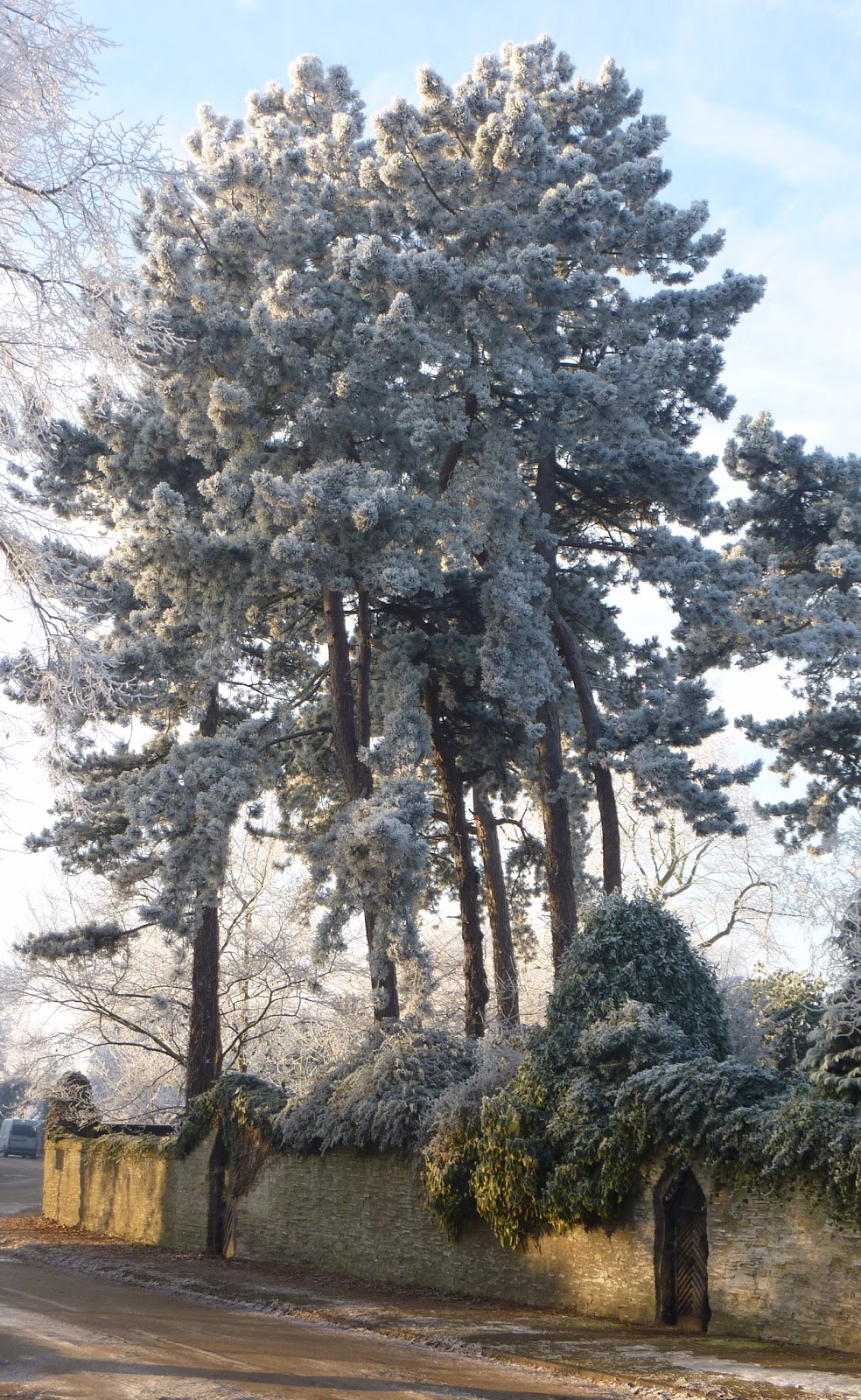
... into a magical landscape of hoar-frosted trees ...


The earth was frozen, so the going was easy along the field paths, and satisfyingly crunchy underfoot ...


I met one other soul walking her dog ...


Apart from her, the village lane was empty ...


A weak, slanting sun gloriously illuminated this tree ...


If what I say resonates with you, it is merely because we are both branches on the same tree. WB YEATS

Monday, 20 December 2010

A Fable Of Life

A Fable

We stand at the source,
the plane tree and I.
Our images reflect
off the river.
The water-dazzle
lights up the plane tree and me.

We stand at the source,
the plane tree, I and the cat.
Our images reflect
off the river.
The water-dazzle
lights up the plane tree, me and the cat.

We stand at the source,
the plane tree, I, the cat and the sun.
Our images reflect
off the river.
The water-dazzle
lights up the plane tree, me, the cat and the sun.

We stand at the source,
the plane tree, I, the cat, the sun and our life.
Our images reflect
off the river.
The water-dazzle
lights up the plane tree, me, the cat, the sun and our life.

We stand at the source.
The cat will be the first to go,
its image will dissolve in the water.
Then I will go,
my image will dissolve in the water.
Then the plane tree will go,
its image will dissolve in the water.
Then the river will go,
the sun alone remaining,
then it will go too.

We stand at the source,
the plane tree, I, the cat, the sun and our life.
The water is cool,
the plane tree spreading.
I am writing a poem.
The sun is warm.
It's great to be alive.
The water-dazzle
lights up the plane tree, me, the cat, the sun and our life.

NAZIM HIKMET, Turkish (1902-1963)

Whatever the future holds, while there is life there is joy to be found in the innocence of being alive.

Sunday, 19 December 2010

Sweet Disorder

I don't know about you, but I'm not always the tidiest, the most organised, the squeaky-cleanest of people. Don't get me wrong - I return CDs to their cases, put books back in their correct place on the shelf, take a shower every morning. I try and turn up for appointments on time. I even reluctantly wash the car now and then (a metallic black 2007 VW Golf Plus 1.6 FSI SE incidentally - referring back ironically to my previous post).

But I'm hardly a punctilious perfectionist, always smoothing, sorting, cleaning and ordering. Indeed, I always think there's something a little suspicious about those who can't stand even one hair out of place. What are they trying to hide? Over-fastidiousness can all too easily tip over into pathological neurosis. What does it matter if the washing up is left for an hour or two, if you put on again that old jumper which really was due for a wash, if the garden's a bit of a wilderness instead of some sanitised, weed-free, pet-free, kids-free zone of artificial perfection replete with serried ranks of pest-free flowers and a beautifully manicured lawn? I've much better things to do, thank you, than dusting the house plants every few minutes or vacuuming the cat (War and Peace to finish, for a start ...)

In this delightful poem Robert Herrick stands up for all of us who aren't averse to a little wanton disorder. In fact it may even be sexy ...

Delight In Disorder

A sweet disorder in the dress
Kindles in clothes a wantonness:
A lawn about the shoulders thrown
Into a fine distraction:
An erring lace which here and there
Enthralls the crimson stomacher:
A cuff neglectful, and thereby
Ribands to flow confusedly:
A winning wave (deserving note)
In the tempestuous petticoat:
A careless shoe-string, in whose tie
I see a wild civility:
Do more bewitch me, than when art
Is too precise in every part.

ROBERT HERRICK (1591-1674)

Saturday, 18 December 2010

Pink Cadillac

Despite overcrowded roads, rising fuel prices, polluting carbon emissions and horrific accident statistics, our love affair with the automobile still continues. For many of us the car we drive reflects what we wish to say about ourselves. Just as with the cut of our clothes and the size of our house, our choice of car can reflect the image we want to portray to the world.

Psychologists say this choice can betray a great deal about our politics and personality, about our insecurity, about our seeming need to project ideas of power, success, wealth and virility. Or the lack of those things. Sometimes it seems impossible to do or buy anything without that action or choice showing to the outside world a stance or viewpoint or perceived projection which we feel is maybe simplified, clichéd or just plain wrong.

I must admit I've never been much interested in cars. Nor in clothes or houses for that matter. I'd rather be anonymous, and blend into the background, rather than conciously or unconsciously make a statement. I don't want an expensive look-at-me car, a wardrobe full of fancy shirts, a posh house stuffed with burglar alarms and surrounded by fences and locked gates. I'm more of a second-hand VW Golf, jeans and tee-shirt, Victorian terrace kind of guy. (And this in itself is also making a strong statement about me. You see, we can't get away from it!)

This poem comes from The Green Book Of Poetry, edited by Ivo Mosley.

To a young man driving his own car

So you're already driving your own car
I'll bet your friends are jealous
As you were learning to drive

I thought how splendid for you
To go speeding everywhere
Getting any kind of licence is good.
I often said
Now you speed about in your car
you can't see the roadside trees changing

with the seasons
you can't see the merchants selling fruit

or fish at the roadside
you can't see the woman running along

with a sick child slung on her back
Always on the look-out for traffic-patrols

and red lights
your eyes fixed straight ahead
you speed about
your eyes have grown sharper
your mind has grown busier
and though the price of fuel

may go up even more
and exhaust fumes block your view
you drive around
and do not intend to walk anyway I'm sure
and those years of youth that people spend

walking or running
getting about by bus or subway
you are spending at over 40 mph
When I see you speeding along in your car
I feel you have isolated yourself
too lightly
and my heart grows heavy


KWANG-KYU KIM, Korean, b. 1941, tr. Brother Anthony of Taizé

Friday, 17 December 2010

Bypass Pilgrim


Diet Sheet

1

Don't tempt me towards
the grave with your 'Naughty
but nice death by chocolate' -
I'm busy walking the health
apocalypse from Alpha-linolenic
acid to Omega-3
and there's no time for dessert.

2

Rumours of scientific treatises
arrive daily in the rehab garden.
Cooling down from aerobic steps
amongst the statues and bolted
container plants we read of new
permissions and revised prohibitions.

3

Archaeo-pathological analysis of my
arterial silt revealed relics
of conviviality, boredom,
pragmatism and bohemian interludes
secreted in the strata.

4

Silver shoals of sardines
are now marked
for death to feed
my healthy maw.

5

'Skin is the enemy'
said the nurse, referring
mainly to chicken.

6

'Avoid Eating'
the visible, the excess, that of unknown origin.

7

Enjoy your meal.

ROY BAYFIELD

Roy Bayfield, a good friend of this blog, was kind enough to send me a few months ago a copy of his newly published poem-sequence Bypass Pilgrim: Writings From The Vicinity Of The Heart. I really enjoyed it. I found it a witty, original and - dare I say it - heartening collection. After being diagnosed with angina, Roy had coronary artery bypass surgery at Easter this year in the Liverpool Heart and Chest Hospital.

This book is his creative way of coming to terms with the experience. As Roy himself says in the Introduction: I ... decided to set it all down in a book, doing some breaking open and slicing up of my own to make, as best I could, a gift, love-letter, apology, self-portrait, account, waystation on a journey towards writing other things, and escape plan.

It's difficult to extract individual poems from the book, as they tend to all work together rather than stand alone. However, I've chosen Diet Sheet from the third section Rehabilitation as I find it full of incisive observation and dry wit. I also like the way the poem erodes from an initial seven line stanza down to that final killer (unfortunate word!) single line.

Roy's own blog, Walking Home To 50, can be found here.

Thursday, 16 December 2010

Watching For Dolphins

Watching for Dolphins

In the summer months on every crossing to Piraeus
One noticed that certain passengers soon rose
From seats in the packed saloon and with serious
Looks and no acknowledgement of a common purpose
Passed forward through the small door into the bows
To watch for dolphins. One saw them lose

Every other wish. Even the lovers
Turned their desires on the sea, and a fat man
Hung with equipment to photograph the occasion
Stared like a saint, through sad bi-focals; others,
Hopeless themselves, looked to the children for they
Would see dolphins if anyone would. Day after day

Or on their last opportunity all gazed
Undecided whether a flat calm were favourable
Or a sea the sun and the wind between them raised
To a likeness of dolphins. Were gulls a sign, that fell
Screeching from the sky or over an unremarkable place
Sat in a silent school? Every face

After its character implored the sea.
All, unaccustomed, wanted epiphany,
Praying the sky would clang and the abused Aegean
Reverberate with cymbal, gong and drum.
We could not imagine more prayer, and had they then
On the waves, on the climax of our longing come

Smiling, snub-nosed, domed like satyrs, oh
We should have laughed and lifted the children up
Stranger to stranger, pointing how with a leap
They left their element, three or four times, centred
On grace, and heavily and warm re-entered,
Looping the keel. We should have felt them go

Further and further into the deep parts. But soon
We were among the great tankers, under their chains
In black water. We had not seen the dolphins
But woke, blinking. Eyes cast down
With no admission of disappointment the company
Dispersed and prepared to land in the city.

DAVID CONSTANTINE

Watching For Dolphins is probably David Constantine's most celebrated poem. On the surface it seems to tell a simple, uneventful narrative about looking for dolphins while crossing by boat to Piraeus, the busy port which lies a short distance south of Athens, the Greek capital. (The harbour has a long history - stretching back into classical times.) But, as in most of Constantine's poems, this poem contains resonances, allusions and hidden depths - in this case, literal hidden depths.

All the desires, hopes and dreams of the disparate passengers are focused on one thing: to see the dolphins. Isolated as they are individually, there's a common feeling that, if the dolphins had appeared, they would have bonded together in the shared unity of their experience: ... and had they then / On the waves, on the climax of our longing come / ... We should have laughed and lifted the children up / Stranger to stranger ...

Gradually throughout the poem this personal yet common longing becomes spiritual, religious in its intensity. The fat man stares like a saint; the gulls could be a sign; everyone wants epiphany. It's interesting that Constantine says that children would see dolphins if anyone would, for children are often more naturally receptive to and accepting of the wondrous and the divine, the numinous and the miraculous, than adults.
In the end the epiphany doesn't happen, and the poem ends anti-climactically. The people disembark with eyes cast down. They wake, blinking, as if emerging from a dream, a thwarted vision, another world. Though disappointed, they hide their disappointment, and leave the shared boat as isolated individuals once again.

I know this poem reverberates on many levels, but ultimately I think it's about the difficulty of locating the spiritual and the numinous in today's world, the world of the abused Aegean, which was once a mythical place of purity, a Garden of Eden before the Fall. (Athens is well known for its smog and pollution.) Now both it and the world are corrupted by tourism, materialism, shallow 'surface' experience, polluted with the great tankers, under their chains / In black water ...

David and Helen Constantine edit the magazine Modern Poetry In Translation, which I highly recommend. You can find more details on their website http://www.mptmagazine.com/.

And you can see David Constantine himself reading Watching For Dolphins here.

Wednesday, 15 December 2010

Estuarine

Estuarine

Big river giving up what made it
It. No fighting visible
But all the colossal loss of self
Flat silent under a hemisphere
Of stillness. Then I'd only been
Three or four years on the dry land
Still wrapped in native wonder. I recall
This much: a level the lowest possible above
The sea and it
Was greening gold, sheep safely grazed, the lark
And curlew signed it differently, water
Holed and threaded it so that it blinked between
More dry than wet, more wet than dry,
An earth dissolving into steppingtufts and mud, the water
Salting. How I loved
My game of pondering a route
Dryfoot and intricate to the farthest out. I thought myself
Out there where the wavering decided on
The sea, the river,
Biggest imaginable, lapsed without any trace
And on the brink of guessing at a place
Of nowhere, nothing, no one evermore
I reached up for love's
Always waiting to be reached for hand.

DAVID CONSTANTINE

After yesterday's poetry post I'm inspired to carry on awhile with some of my favourite poems. David Constantine is a name you may not be familiar with. However, in my opinion he's one of the UK's most thoughtful and interesting poets and short story writers (in fact he's just won this year's BBC National Short Story Award). David used to be a lecturer in the German Department at my old university, and he was a constant source of inspiration to me. His quietly captivating lectures, seminars and tutorials cemented and enhanced my own natural love of literature. I owe a great debt to him. He was one of the guiding intellectual lights of my life.

His poems are understated, carefully worked, subtly suggestive, resonant with myth and allusion. Estuarine is one of my favourite poems of his, a poem I've mentioned before on this blog. There are many things I like about this poem. First of all, what a wonderfully tangible description of a river estuary - ...  a level the lowest possible above / The sea and it / was greening gold ... ; ... water /  Holed and threaded it so that it blinked between / More dry than wet, more wet than dry, / An earth dissolving into steppingtufts and mud ... Second, what an astonishingly new, pristine, innocent, unclouded vision of this watery landscape he portrays as seen through the eyes of a very young child (but recollected through an adult mind). Next, what original and beautiful language he uses to encapsulate this vision - ...  the lark / And curlew signed it differently ... ; And on the brink of guessing at a place / Of nowhere ...

But what does it all add up to, what do we take away from the poem, what's the meaning? I think that the colossal loss of self is the clue. Estuaries are places where a river loses its identity in its comingling with mudflat and salt marsh. Where does the river become the sea? It's a confusing, amorphous area, a no-man's-land (yet a beautiful land). A child, feeling a little lost in this place and in need of reassurance, can reach up to grasp the hand of a parent - I reached up for love's / Always waiting to be reached for hand. Can we find the same reassurance as adults? Whose hand can we reach for? Or can we rationalize the 'lostness', because of our greater maturity and experience, and offer a helping hand to those who may reach out to us?

This is a marvellous poem, I think. Further resonances come from the Biblical allusions ( ... sheep safely grazed ... ) and the Wordsworthian overtones (Still wrapped in native wonder ... ) In fact I can never read this poem without being strongly reminded of Wordsworth's The Prelude and its emotions 'recollected in tranquillity'.

I would love to hear anyone else's responses to this accomplished and lovely poem.

Tuesday, 14 December 2010

Stopping By Woods

Stopping By Woods On A Snowy Evening

Whose woods these are I think I know.
His house is in the village, though;
He will not see me stopping here
To watch his woods fill up with snow.

My little horse must think it queer
To stop without a farmhouse near
Between the woods and frozen lake
The darkest evening of the year.

He gives his harness bells a shake
To ask if there is some mistake.
The only other sound's the sweep
Of easy wind and downy flake.

The woods are lovely, dark, and deep,
But I have promises to keep,
And miles to go before I sleep,
And miles to go before I sleep.

ROBERT FROST

It's a good time of year to enjoy and reflect on this lovely poem, I think. The snow's still lying all around. And, as we approach the end of one year and the beginning of another, it's a time when many of us look both backwards and forwards, and consider paths taken and not taken, choices made and not made.

I suppose this and The Road Not Taken are two of Frost's most well-known poems, constantly cropping up in anthologies and in lists of people's favourite verses. Both seem artlessly simple, yet are crafted with enormous skill. Both contain deeper mysteries and have half-hidden undercurrents. Both are about the choices we make in life.

In Stepping By Woods we are confronted with a choice: to succumb to the deep, dark, alluring wild wood or to carry on with the journey on which we have embarked. There's no doubt what the horse wants to do. He gives his harness bells a shake as if to say: onwards! There's still a long way to go! To which reminder the rider responds, shakes off his reverie, and realises there are still many miles to cover, much life still to pursue.

There's always a choice we have to make: between society's safe village and the individual's lonely, risky journey; between the snowy track and the dark, dangerous but strangely enticing forest; between, if you like, the rational and the irrational, between life and death. But actually it's not clear if the choice is as clear-cut as that, if it's really a straightforward choice between one path or the other.

This ambiguity, this mystery, lies at the poem's heart, I believe. What a wealth of meaning in such a deceptively simple poem!

Monday, 13 December 2010

War And Peace

The one thing necessary, in life and in art, is to tell the truth. TOLSTOY

With the temperature hovering around the freezing mark here in the UK, it may seem masochistic of me to be reading about Russian winters - but that's what I'm doing. I'm five hundred pages into War and Peace. I've been wanting to read it for a long time but somehow have never got round to it. Tolstoy wrote his master work between the years of 1862 and 1867 and, of course, it's considered one of the greatest, if not the greatest, novel ever written. I would not disagree. It's an extraordinary book.

In War and Peace Tolstoy paints a huge canvas depicting Russia in the early years of the nineteenth century, the time of the Napoleonic Wars. There are three main foci in the book: the households of the Rostovs and the Bolkonskys, and the figure of Pierre Bezuhov. (You can clearly see Tolstoy himself in this character. Like Pierre, Tolstoy had led a dissolute life of drinking, gambling and womanizing until, at the age of thirty four, he married and transformed his life into one of helping others, and striving towards the infinite, the eternal and the absolute.)

Tolstoy's psychological penetration into all his characters is remarkable; he explores moralistically their foibles, delusions and idiosyncrasies - as well as their bravery, compassion and common humanity - with skill and insight. Yet he never rushes to condemn, and remains the objective, dispassionate novelist, portraying life in all its chaos, misery and glory.War is a major theme in the novel, and he writes realistically about war and its horror, describing it as the vilest thing in life. In the introduction to my Penguin Classics' edition the translator, Rosemary Edmonds, states: War and Peace is a hymn to life. It is the Iliad and the Odyssey of Russia. 

I wonder if you have a book, or several books, you've always been intending to read, but have never taken down from the shelf? Classics, perhaps, which you feel you really should read one day, but in your bones you know you probably never will? Sometimes the prospect of a long, what we may perceive as a 'heavy' classic, may seem a little daunting, so we turn to something shorter and more contemporary. What I would say is this: dive in! In my experience the perceived 'difficult' books, those formidably towering landmarks of literature, are often the most rewarding, readable and engrossing of all books. (I found this with Cervantes' Don Quixote. Edith Grossman's 2003 translation reads like a dream. Even my daughter read the book in one go, and she doesn't normally read major classics.)

I'll end with this sobering, yet strangely liberating quotation from War and Peace. Pierre Bezuhov, at a turning point in his life, says, All we can know is that we know nothing. And that is the sum total of human wisdom. (I often feel myself that the more I know, the less I know, and the more there is to know. In our lifetimes we can only ever absorb, in the vaguest and most inadequate way, one millionth of the total sum of knowledge.)    

Saturday, 11 December 2010

Silent Summer

Remember Rachel Carson's seminal book, Silent Spring, about the disastrous effect of chemical pesticides on the environment? This book, which came out in 1962, helped launch the whole environmental movement. Have things improved since then? Certainly Silent Spring was instrumental in the banning of DDT. But the use of pesticides is still a major factor in the destruction of our fragile ecosystems, as a new book, Silent Summer, edited by Norman Maclean, makes clear.

The book's subtitle is: The State Of Wildlife In Britain and Ireland. And it's evident from its pages that the state of our wildlife is parlous and gives much cause for concern. Populations of bees, flies, snails, butterflies and moths are in severe decline. These smaller creatures form the very basis of our ecosystems. Without them populations of larger animals - fish, birds, mammals, reptiles and amphibians - will also decline. It's happening already. Numbers of starlings and swallows, for instance, both insect eaters, are down by two-thirds since the mid-1970s. And hedgehogs are disappearing so quickly that they could be extinct by 2025. Fish stocks are also under threat because of overfishing and the destruction of seabed habitats by trawl nets.

I was brought up in the Lincolnshire countryside and remember flower-rich hay meadows teeming with insects, hedges alive with songbirds, ponds full of pike and roach. On a recent revisit I found this area completely dead, hedgeless and pondless, the small hay meadows now large arable fields. I'm painting a gloomy, one-sided picture, of course. To balance things out: birds of prey are on the increase, which shows that something must be OK along the food chain. And a number of farmers  are now protecting our diverse landscape heritage under the Countryside Stewardship Scheme. But will this be enough? 

Relentless urbanisation, intensive farming, the use of pesticides and the extraction of water from rivers - all these human activities are transforming huge swathes of the British countryside and wiping out wildlife faster than we think. It's time to act now or many species will be lost to us forever.          

Friday, 10 December 2010

Boxing Day Madness

I was doing some Christmas shopping in town yesterday. Chatting to an assistant in a branch of a well known high street chain, she told me ruefully that she would have to work on Boxing Day. Boxing Day! I was horrified. I would never dream of going shopping on Boxing Day.It's the day after Christmas. It's a public holiday. It's a day for relaxing, for entertaining, for visiting family and friends, for doing a million happy things which don't include working, buying and selling. Year on year more and more shops are opening on Boxing Day. I vote we start a movement to boycott all shopping on Boxing Day, so that shops will be forced to close through lack of trade. Commerce on Boxing Day? No thanks! (Increasingly, many stores are opening on Christmas Day too.) 

Thursday, 9 December 2010

The Tesco-isation Of The Land

I've written recently about global warming and climate change. Other environmental concerns which are never far from my mind are the gradual disappearance of our small-scale retailers (and the corresponding rise of out-of-town shopping malls and retail parks), and the shrinking of natural habitats and the homogenisation of the countryside. Earlier this year The Guardian's Nicholas Lezard highlighted a newly published book on the changing face of England, Paul Kingsnorth's The Battle Against The Bland. Here are some disturbing statistics from this book:

The UK has lost nearly 30,000 independent food, beverage and tobacco retailers over the past decade ... 13,000 independent newsagents closed ... between 1995 and 2004. Fifty specialist shops closed every week between 1997 and 2002 ...  The number of second-hand bookshops halved from 1,200 to 600 in the three years between 2002 and 2005. Meanwhile, the number of out-of-town shopping areas increased four-fold between 1986 and 1997 ... Since the end of the second world war we have lost - no, not lost, destroyed - 95 per cent of our wildflower meadows, 50 per cent of our chalk grasslands, half of our ancient lowland woodlands, half of our wetlands, 94 per cent of our lowland raised bog and 186,000 miles of ancient hedgerow.

Apparently the French term for the corporate takeover of city high streets is 'La Londonisation'.

Two of my radical socio-political literary heroes, William Cobbett and George Orwell, are probably turning in their graves at what's happening in England right now - though, on reflection, they're probably not too surprised that so many things they feared and predicted are coming to pass. Lezard states that Kingsnorth is following in the tradition of Cobbett (who first identified the crushing of the spirit of place by the impersonal and often corrupt rapaciousness of the profit motive as 'the Thing') and Orwell, united by a love of ordinary humanity.    

Tuesday, 7 December 2010

The Simple Life

All the world's a stage, / And all the men and women merely players. / They have their exits and their entrances, / And one man in his time plays many parts. SHAKESPEARE As You Like It

Like lots of us I've had many jobs, played many roles and experienced many moods in my life. Jobs have included potato picker, hod carrier on a building site, mill-hand, farm labourer, postman, cleaner in a surgical instruments factory, computer programmer, mobile librarian, taxi driver, foreign language teaching assistant, encyclopedia salesman (I lasted one day at this) and publishing sales executive - which was my main, breadwinning career. Publishing sales meant travelling 40,000 miles a year round England's motorway network and attending innumerable sales conferences (95 per cent of which were a total waste of time). Roles have included helpless child, awkward adolescent, perpetual student, reluctant careerist, dutiful son, imperfect husband and, probably, undistinguished father. Moods have swung vertiginously from hopelessness and black depression to brimming joy and ecstatic happiness.

During my life I've often felt like a chameleon, ever changing my colour and mood, adapting to whatever scene I was acting in at the time. Or a river, constantly meandering, never in the same place twice.

In my time I've had years when I've earned heaps of money and years when I've earned very little at all. I've bought houses and furniture, cars and kitchens, clothes and musical instruments. I've bought music centres, mobile phones, cassette decks, DVD players, iPods. I've had expensive holidays and I've had holidays on a  shoestring. Sometimes I've dined in fancy restaurants and at other times I've not been able to afford to eat in even the humblest café.

I've never been hugely ambitious for money or material success. I was lucky enough to realise at an early age that money and material success do not bring lasting happiness. I'm so glad I had this insight when I was young. I've probably saved myself years of pointless struggle, anxiety and neurosis. Yet, of course, life's far from easy for anyone, whatever life-changing revelations one may have. I've had problems like the rest of us, and at times I've felt my feet hitting rock bottom.

What have I learnt after more than 50 years of negotiating the perilous, flint-strewn corniche that is our predestined human track? Well, a few things I hope - though there's still so much more I need to learn, I fear I've only just arrived at the outermost gateway of knowledge and wisdom. However, I do know this. The simple life is the good life, is the best life. Joy, happiness and fulfillment come from the innocent, simple, often freely bestowed pleasures of existence: a bracing cliff top walk on a blustery autumn day; the sound of bagpipes in a remote Scottish glen; crossing the Spanish meseta under a hot sun, then spending the night in a cheap albergue with other pilgrims; growing, preparing and cooking one's own food; the scent of fir tree sap; the cold grittiness of rock beneath the fingers; the tang of citrus; the cry of owls; the running of deer; eating when hungry, drinking when thirsty, sleeping when tired; lovemaking.

Too lazy to be ambitious,
I let the world take care of itself.
Ten days' worth of rice in my bag;
a bundle of twigs by the fireplace.
Why chatter about delusion and enlightenment?
Listening to the night rain on my roof,
I sit comfortably, with both legs stretched out.

RYOKAN

Monday, 6 December 2010

Dishonouring Pachamama: Climate Change In South America

More extracts from John Vidal's Guardian article about climate change in Peru, Bolivia and Ecuador...

Ecuador has nearly lost one third of its ice.

Lake Titicaca had twice shrunk 85 per cent following temperatures only 2-3 degrees C higher than now.

The cost of climate change to Bolivia, South America's poorest country, could be over 7 per cent of its GDP by 2025 - almost as much as the country's combined spending on health and education.

In Huayhuasi, Peru, llama and alpaca farmers have been badly hit by recurring water shortages. 'The rains used to be from October to April. Now it rains for two to three months if we are lucky. This year we had deep frosts where the temperature dropped to -17 degrees C. Many people died in the province', says Elias Pacco.

'The sick Pachamama (Mother Nature) is losing her vital liquid - water,' says Marlon Santi, the president of the Indigenous Nationalities of Ecuador, the 10-million strong group of indigenous peoples. 'Our brothers and sisters used to know when to sow and harvest. We have unusual droughts and floods and frosts and strange illnesses. We have pests, frosts, worms and new plagues.'

'In the old days there was snow on all the mountains, but for 10 years now there has been none. We do not know when to plant,' says farmer Julio Hermandez from Panta Leon, near Cusco, Peru. 'People are leaving to go to the cities because they can no longer grow crops or keep animals. Perhaps this is a punishment. In the past we used to honour Mother Earth more. It was a happier place then. The mountains looked like they had a white scarf around their necks. We are older now; we saw the snow-capped mountains. What will our children see?'

Sunday, 5 December 2010

Warming Up

There's been a lot of talk recently in blogs and in the media about the weird weather we're having at the moment. But, whatever the immediate, complex reasons for this unpredictable pattern of  meteorological extremes, one thing is blindingly clear: the world is warming up. And it's warming up faster than we think.

John Vidal, the Guardian's environmental editor, travelled last month with Oxfam through the Andean mountains of Peru and Ecuador. He found retreating glaciers, shrinking rivers, expanding deserts and rampaging diseases. And, as usual, it's the poor who suffer first and worst.

He writes: Climate change has fallen off the political agenda in rich countries since the shambles of the Copenhagen summit last year, and the headlines have been dominated by global recession. But while politicians fail to act, the phenomenon continues unabated. In the past week, the three major institutes that calculate global warming have said 2010 will at least tie for the hottest year yet recorded, and it is widely expected that global carbon dioxide emissions will hit record levels.
This year summer temperatures in Russia and central Asia were 7.8 degrees C above average for a whole month, the Pakistan floods affected more than 20 million people, and temperature records were set in 17 countries from Finland to Iraq, Burma and Columbia. Again, there was a near-record melting of Arctic sea ice and the UN has recorded more than 700 extreme-weather related disasters.

Yet most of the world has never heard the phrase 'climate change' and does not understand the science behind man-induced climate change. Hundreds of millions of people are having to adapt without help to the major changes which they can see are taking place, and for which they are not responsible.

We're now in the middle of the latest round of climate change talks in Cancún, Mexico. 193 governments are taking part. Half-way through - and only 170 words out of a 1300 word key text remain undisputed. Will there be more progress than in Copenhagen last year? Don't hold your breath.

Saturday, 4 December 2010

Hey, That's My Kind Of Music! (10)


This video brings to an end my short series Hey,That's My Kind Of Music! Music, for me, is one of those miracles that lifts life from the mundane to the realm of the spirit, and makes life's misfortunes and calamities a little easier to bear. As you've seen, my tastes in music are eclectic, ranging from jazz and classical to country and contemporary. But, in the end, I always come back to folk and roots music, traditional music, ethnic music, world music, soul music, music of the people. Here's the Irish folk and traditional singer Karan Casey giving a rendition in Gaelic of the song Sweet Comeraghs.

Thursday, 2 December 2010

Honest Scrap


A while back Val from the excellent Monkeys On The Roof was kind enough to honour my blog with this enviable award (thanks again, Val!) The postman tried to deliver it when I was away, so for all this time it's been sitting in the Sorting Office getting rusty and dusty. I finally collected it yesterday - after battling through blizzards and snowdrifts - and, I must say, it does look rather impressive on my mantelpiece  wedged between a Tibetan urn and an etiolated spider plant.

I'm supposed to pass it on to seven other bloggers, but I know some of my favourite bloggers have received one already, or are modestly reluctant to accept awards, so I'm throwing it open. If you want it, anybody, please take it! You all deserve it. How's that for cyber-democracy?

The other condition of accepting the award was to share ten honest things about myself. For this I thought I'd simply refer back to a related post I did some time ago. The post is here. It's a list of ten facts about my life. Nine are true and one is a lie. To discover the lie, and an explanation of the true facts, simply keep clicking on the 'Newer Posts' link.       

Wednesday, 1 December 2010

Snowbound


we woke


this morning


to a garden


one foot deep


in snow