A common man marvels at uncommon things. A wise man marvels at the commonplace. CONFUCIUS

Monday, 28 February 2011

River Of Books


I remember exactly the time I started to read properly. I was at primary school. The class reading book was Briar Rose, an easy-reader version of The Sleeping Beauty by the Brothers Grimm. Suddenly - and it really was one of those quantum leaps, those learning-to-bike-ride moments - letter and word and sentence and meaning coalesced right in front of my eyes. A magical process, and even more wondrous as it seemed no effort at all. I think many of us know this feeling. You do the time, put in the practice, absorb the knowledge - and then, hey presto, all of a sudden a bulb's switched on in the brain, and you feel you've progressed light years in an instant. Like that yes-moment of relief when a binocular lens miraculously spins into sharp focus. Instead of swimming against a current of gibberish, I must have just relaxed and gone with the word-flow; and in  a few seconds I was paddling delightedly and easily down a river of stories which I'm still happily navigating today.

After the joys of being read to as a young child, I was now reading myself - Hans Christian Andersen, Beatrix Potter, Enid Blyton, AA Milne, Arthur Ransome, Kenneth Grahame, WE Johns - and I continued to read my way voraciously into adolescence. George Orwell, I remember, was the first really 'grown-up' author I tried.  I devoured anything by him I could get my hands on - not only Animal Farm and the teenage-mind-blowing Nineteen Eighty-Four, but also A Clergyman's Daughter, Keep The Aspidistra Flying, Down And Out In Paris And London and The Road To Wigan Pier. These books taught me politics, gave me a social conscience, instilled in me the importance of both individual and collective freedoms, revealed to me the stuffiness of bourgeois values and the necessity of rebellion. After Orwell the literary floodgates well and truly opened: Lawrence, Woolf, Forster, Greene, Solzhenitsyn, Dostoyevsky, Hesse, Mann, Gide, Camus, Sartre, Kafka, Kerouac ...

Thankfully I'm still reading, despite the temporal demands of work and family and life and trekking and watching the latest revolutions unfold on TV; and despite irritating bits of detached vitreous humour pinballing constantly within my field of vision. In fact I've just finished the excellent book 50 literature ideas you really need to know by John Sutherland. But more of that later ...

(Header painting of Briar Rose by Sir Edward Burne-Jones)

Friday, 25 February 2011

Graffiti

I've long been an admirer of graffiti - not the dumb stuff, but the clever stuff which inspires you, and makes you think and smile. (The more popular Spanish Caminos are peppered with spiritual and political graffiti - in autopista underpasses, at pilgrim picnic-places, in suburban edgelands.) Here are some of the wittiest graffiti I've collected over the years.

Absolute zero is cool.

OK, so I'm cured of schizophrenia, but where am I now when I need me?

Not enough is being done for the apathetic.

I couldn't care less about apathy.

Sycophancy rules - if it's OK by you.

Is a lady barrister without briefs a solicitor?

I bet I could stop you gambling.

Fucque Braque.

Bread is the staff of life. Toast a decadent capitalist luxury.

I thought cirrhosis was a type of cloud, until I discovered Smirnoff.

Descartes thought he was here.

Sceptics may or may not rule, OK.

Constipation is the thief of time. Diarrhoea waits for no man.

Do you have a drink problem? Yes, I can't afford it.

Easter is cancelled this year. They've found the body.

Graffiti should be obscene and not heard.

I used to think Fellatio was a character in Hamlet until I discovered Smirnoff.

If you feel strongly about graffiti, sign a partition.

Halitosis is better than no breath at all.

What do you have in common with your husband? We were both married on the same day.

Life is a sexually transmitted disease.

Norman Mailer is the master of the single entendre.

One thing about masturbation - you don't have to look your best.

Monogamy leaves a lot to be desired.

Just because you're paranoid, it doesn't mean they're not out to get you.

Help your local police force - beat yourself up.

How do you tell the sex of a chromosome? By taking down its genes.

It begins when you sink into his arms; and ends with your arms in the sink.

Sterility is hereditary.

Suicide is the most sincere form of self-criticism.

(Acknowledgements to Nigel Rees and his book Graffiti 2)

Wednesday, 23 February 2011

Revolution

Like many of you I'm sure, I'm following hour-by-hour the rapidly unfolding events in Libya with a mixture of horror and hope. (Incidentally, the best and most detailed coverage out of all the TV channels is from Al Jazeera.) Like all bullying and blustering dictators, Gaddafi is weak and cowardly at heart, propped up by a might of military personnel who, as I speak, are gradually turning against him.
The people have spoken - in Tunisia, in Egypt, now in Bahrain, Yemen and Libya. It's time for all Western leaders to come out more forcibly against Libya's brutal, repressive and corrupt dictatorship - if only to atone for past moral mistakes (eg cosying up to Gaddafi, selling him arms etc). The people have spoken. They have acted. We should support them. We do support them. Long live the people.

Monday, 21 February 2011

The Trouble Of Parting


Death is nothing at all. It does not count. I have only slipped away into the next room. Nothing has happened. Everything remains exactly as it was. I am I, and you are you, and the old life that we lived so fondly together is untouched, unchanged. Whatever we were to each other, that we are still. Call me by the old familiar name. Speak of me in the easy way which you always used. Put no difference into your tone. Wear no forced air of solemnity or sorrow. Laugh as we always laughed at the little jokes that we enjoyed together. Play, smile, think of me, pray for me. Let my name be ever the household word that it always was. Let it be spoken without an effort, without the ghost of a shadow upon it. Life means all that it ever meant. It is the same as it ever was. There is absolute and unbroken continuity. What is this death but a negligible accident? Why should I be out of mind because I am out of sight? I am but waiting for you, for an interval, somewhere very near, just round the corner. All is well. Nothing is hurt; nothing is lost. One brief moment and all will be as it was before. How we shall laugh at the trouble of parting when we meet again!

CANON HENRY SCOTT HOLLAND (1847-1918)

(Quotation found in my mother's commonplace book. Mum was, in the eyes of the world, a gentle, but convinced and fervent Christian. Though it has occurred to me lately, reading in between the lines of her diaries and journals, that she must have had her doubts and spiritual crises like everyone.)

Sunday, 20 February 2011

Amoya - Nweti


I loved this as soon as I heard it a week ago on an Internet radio station ...

Amoya is a seven-piece band from Mozambique.

Saturday, 19 February 2011

An Invisible Sun

Life is a pure flame, and we live by an invisible sun within us. SIR THOMAS BROWNE Urn-Burial

Our life is short and tedious, and in the death of a man there is no remedy; neither was there any man known to have returned from the grave. For we are born at all adventure, and we shall be hereafter as though we had never been; for the breath in our nostrils is as smoke, and a little spark in the moving of our heart, which being extinguished, our body shall be turned into ashes, and our spirit shall vanish as the soft air, and our name shall be forgotten in time, and no man shall have our works in remembrance, and our life shall pass away as the trace of a cloud, and shall be dispersed as a mist that is driven away with the beams of the sun, and overcome with the heat thereof. For our time is a very shadow that passeth away, and after our end there is no returning; for it is fast sealed, so that no man cometh again. Come on, therefore, let is enjoy the good things that are present, and let us speedily use the creatures like as in youth. Let us fill ourselves with costly wine and ointments; and let no flower of the spring pass by us. Let us crown ourselves with rosebuds before they be withered; let none of us go without his part of our voluptuousness, let us leave tokens of our joyfulness in every place; for this is our portion, and our lot is this. The Wisdom Of Solomon, ii, 1-9

These two quotations preface John Hadfield's A Book Of Beauty, which was published in 1952, and was one of my mother's favourite anthologies.

Yesterday was my mother's birthday. She died on 3 November 2004 at the age of 82 after suffering Alzheimer's disease for five years. During that time my father - himself in his mid-80s - looked after her as best he could for four out of those five years.    

When my dad died on 13 January 2009 I rescued some of mum's treasured books from the old family home - poetry books, travel books, history books, reminiscences of rural life, Bibles, a beautiful 1911 edition of The Works Of Shakespeare, TE Lawrence's Seven Pillars Of Wisdom. She had been an avid reader all her life. Religiously halfway through each morning she would make herself a cup of coffee and do a little Bible study. Every Saturday she changed her books at the public library and brought home takeaway fish and chips for our lunch. It's from her I inherited my passion for books and reading and poetry, and my love of nature and the countryside.

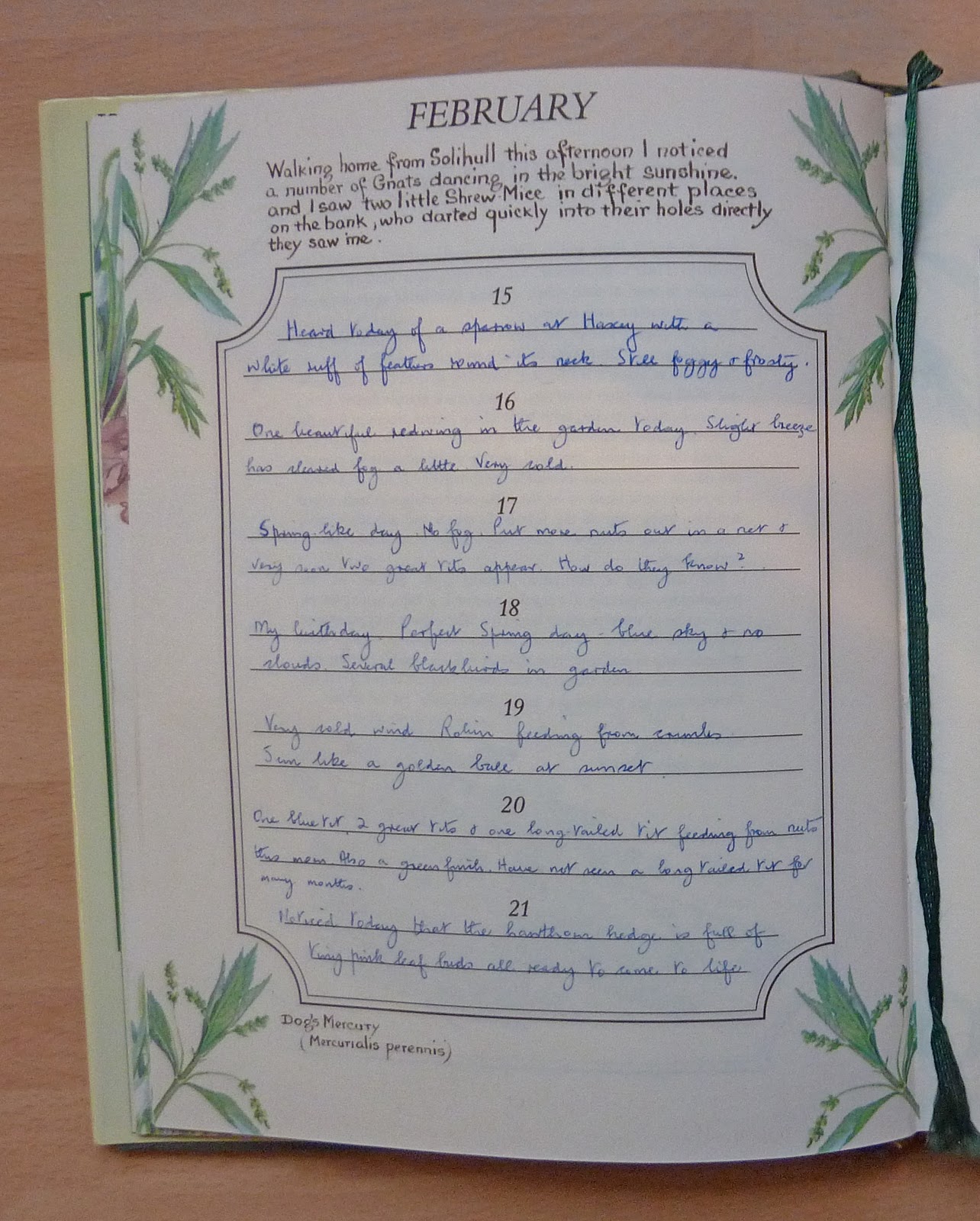
She also used to keep commonplace books, and make scrapbooks of poems, pictures, old magazine and newspaper cuttings. In the late 1970s a facsimile edition of Edith Holden's nature diary for the year 1906 was published in the UK under the title The Country Diary Of An Edwardian Lady. It became an instant bestseller. My mum loved this book. So, when Nature Notes of The Country Dairy Of An Edwardian Lady came out in the early 1980s, I gave her a copy. It's inscribed 'Christmas 1983', and mum filled in the entries for every single day of 1984. Above is a page from the book showing her birthday week (double-click to enlarge). On her birthday, 18 February, she wrote in a neat, tiny hand: My birthday. Perfect Spring day - blue sky & no clouds. Several blackbirds in garden.

Friday, 18 February 2011

Beating The Bounds

Country people call it 'beating the bounds', this ritual walk I try to do each day, religiously tracing the village perimeter.

The late-winter morning is cold and misty. As I walk, I can feel my blood coursing furiously round my body. My booted feet drum the hardened clay. Dull, unaccented, unechoing sounds thud at my ears: the cough of a tractor engine, a dog's dry bark, pigeons clattering from the trees in the grounds of the old manse. I hurry by old cottages of brick and stone, lath and plaster. Bent almost double, I shoot down holly tunnels; climb stiles; unlatch and latch creaking gates.

A startled hare veers across ploughed fields, pounding its signature on the bare earth. A heron, emblem of the distant gravel pit lakes, flaps slowly over me, its wings broad and raggy-ended, pink legs dangling as it drops out of sight beyond a hedgerow. A green plover, an unusual bird round here, with  crested head and black neckband, divebombs two crows above the sillion. Landrover tracks are secret hieroglyphs; and in one puddle a diesel spill is all rainbow.

This ordinary path, this ritual path, is unremarkable. It's just one of a thousand similar paths in the English Midlands. You'd walk it without a thought or  backward glance. But it's my path, this meandering, circumambulatory path; my past, present and future are all bound up in it.  It's my soul's artery, my metaphysical highway, the channel of my own lifeblood. It circulates round the very heart of my personal piece of England.

Thursday, 17 February 2011

The Littlest Birds Sing The Prettiest Songs


I wonder if there are any more fans of the Be Good Tanyas out there? I think this song is so sweet. For some reason Laura Marling's voice from yesterday brought them to mind.

Wednesday, 16 February 2011

Brit Awards

Good to see English folk-rock band Mumford & Sons and indie-folk singer Laura Marling being recognised at the Brit Awards last night ...

Laura Marling - Blackberry Stone

Mumford & Sons - Winter Winds

Sunday, 13 February 2011

Editing: A Dying Art?

Since I've just embarked on a six month proofreading course, I was bound to be interested in Alex Clark's article, The Corrections, featured in yesterday's Guardian Review. He asks the question: Has rigorous line-by-line editing of books been lost ... a casualty of the demands of sales and publicity? His answer seems to be: partially, yes.

Clark rightly praises the skill of the publisher's editor, and recognises that a good editor is the unsung hero of the finished book. Not that the editor should be glorified in any way - the author is the person with the original, creative talent, the one who will be celebrated or reviled by the public and the critics. The editor is merely the midwife in this process, easing the way to the printed book's birth, correcting and improving in as sensitive a manner as possible without ruffling too many of the author's peacock feathers.

He cites some of the great editors of the past - Robert Gottlieb, for instance, who gave a helping hand to Joseph Heller, John le Carré, Toni Morrison and John Cheever; and Diana Athill, who editorially guided VS Naipaul, Norman Mailer and Jean Rhys (and I would say you needed a great deal of skill, tact and diplomacy to edit the copy of these three larger-than-life characters!) He also mentions some of the acclaimed editors of today, such as Ravi Mirchandani at Atlantic Books, Lennie Goodings at Virago, Dan Franklin and Robin Robertson at Jonanathan Cape, Mary Mount at Viking, Sara Holloway at Granta, Nicholas Pearson at Fourth Estaste, Jenny Uglow at Chatto & Windus, Simon Prosser at Hamish Hamilton and Neil Belton at Faber.

However, the task of intelligent and scrupulous editing is shifting more and more into the margins of the publisher's working day as the nature of publishing itself changes. Budgets are being trimmed; book production is becoming increasingly regimented; sales and marketing departments are growing, while copy-editing and proofreading departments are downsizing dramatically (of course this may help me in my own intention of becoming a freelance proofreader). Our general view of how we consider text may be changing too, and what we expect  and demand from it. To quote Clark: While most readers are understandably enraged when they buy a book and then spot spelling, grammar and factual errors, some may feel that other considerations are more important. Given the proliferation of user-generated content of all kinds, and the demand for instant gratification, it's unsurprising that speed and economy are often prioritised over care and quality. (Are there issues here for us as bloggers, I wonder?)

How we buy books, and what we expect from books, has certainly changed. Clark concludes: To buy a book, whether in a physical or virtual bookshop, is to navigate an obstacle course of special offers and money-off deals that are designed to make you buy more, not better; in the case of ebooks, the retailers' first aim is to sell you a device, with hugely discounted books as the bait. Finding out what book you want has also changed; although there is still plenty of high-quality literary criticism available, there is no doubt that there has been a shift away from the painstaking analysis of words and sentences and towards straightforward plot recital and a speedy thumbs up or down. If these peripheral factors are not directly linked to standards of editing, they are surely indicators of the extent to which books have been commodified. The word may still be the thing; but it isn't the only thing.

Friday, 11 February 2011

Genesis Revisited

I was idly considering the word earth in bed last night - as you do - when it suddenly struck me how many other words you could form out of its modest five letters. Well, today one thing led to another ... and resulted in part of Genesis being rewritten using the word earth and twenty-seven other words (highlighted in red) derived from it. Oh, the things one gets up to on a Friday night ...

"In the Beginning was the Word (or, for the more scientific readers amongst you, two words: Big Bang, which generated a great deal of heat and led to the consolidation of our planet Earth billions of years later). God (the Christian or Jewish one, not the one married to Hera) created everything there is, including all the animals - the hart, the hare and the rat for example, not to mention the rhea - and finally the first human being, Adam, or A as He called him in shorthand, for He was a God of few words, and even fewer letters.

A was miserably lonely - even in the lovely garden God had planted for him - so God took pity on him and fashioned out of his rib a companion, whom He named Eve, or E. 'Ta very much, Master!' exclaimed A, mightily pleased. 'She's a woman after my own heart!' - though he didn't really know what a woman was at that time. 'But hear this,' God added. 'Re that tree over there, the tree I call the Tree of the Knowledge of Good and Evil, both of you are expressly forbidden to eat of its fruit, or you'll be out of this garden faster than you can say Beelzebub!' (This was the longest sentence God had ever said and He was exhausted.)

However a snake slithered out of the grass and up to E and somehow persuaded her to eat some of the forbidden fruit for her tea. When she confessed this to her partner, A admonished her. 'Ha!' he said, 'You ate the fruit? I can't hate you for what you did, but for God's sake keep it under your hat!' 'But', E replied bashfully, 'I haven't a hat, or a coat, or even a fig leaf.'

'You will have soon!' said God, suddenly reappearing behind her like a genie from a bottle. The shock startled E, who shed a quick female tear, then artfully tried to cover her private bits. 'You're both out of here double quick,' God boomed, loudly and confidently. He'd found his true voice at last. 'At any rate,' whispered A into E's ear, as they closed the garden gate, 'You did have a brief taste of paradise before starting a lifetime's slog of gruelling births and ungrateful kids and baking fruit pies for dinner.'"      

Wednesday, 9 February 2011

Winter-Weary

Ah come, come quickly, spring!
come and lift us towards our culmination, we myriads;
we who have never flowered, like patient cactuses.
Come and lift us to our end, to blossom, bring us to our summer
we who are winter-weary in the winter of the world.

DH LAWRENCE Craving For Spring


I'm sure there's a surge of spring in the air today . . . or could it just be wishful thinking?


Monday, 7 February 2011

Wandering Ways

Everybody movin’ if they ain’t already there
Everybody got to move somewhere


BOB DYLAN Mississippi


And the wayward wind is a restless wind
A restless wind that yearns to wander
And I was born the next of kin

The next of kin to the wayward wind
 
NEIL YOUNG The Wayward Wind

Thursday, 3 February 2011

Alone But Not Lonely


Hear and attend and listen; for this befell and behappened and became and was, O my Best Beloved, when the Tame animals were wild. The Dog was wild, and the Horse was wild, and the Cow was wild, and the Sheep was wild, and the Pig was wild - as wild as wild could be - and they walked in the Wet Wild Woods by their wild lones. But the wildest of all the wild animals was the Cat. He walked by himself, and all places were alike to him. RUDYARD KIPLING The Cat That Walked By Himself  (Just So Stories)

I prefer walking alone when taking long walks or making long pilgrimages. Why is this? I've been considering the reasons. I'm not anti-social, nor some weird 'loner' (well, perhaps a tiny bit!) I like people. I enjoy conversation. Why would I wish to embark on a long, sometimes scary and hazardous journey, alone? 

Well, first of all, there are some nakedly selfish reasons. The fact is, no matter how entertaining and sympathetic, lovely and beloved your companion, walking with another person over a long stretch of time and distance can become wearisome. I'm being brutally honest here. Alone you have total freedom: to go where you want, when you want, how fast or how slow you want. With a companion - delightful as he or she may be - you have to compromise. Yes - compromise is, of course, essential and right in so many parts of our lives, in our relationships, in our marriages, in our dealings with society. Compromise, give and take, the Middle Way are the oils which lubricate the smooth workings of a successful community, a successful relationship. But isn't it nice just to be totally free for a while, not to compromise, to do exactly as one likes?

Then there's the question of loneliness. People ask me: don't you ever get lonely on your solo trips? The truthful answer is: sometimes, yes! On my last pilgrimage along the Via de la Plata I met hardly any other walkers (no doubt they were all far more sensible than I, and hadn't even dreamt of tackling this route during the wettest Spanish winter in living memory). However I find that serious pangs of loneliness are short-lived. Normally there are other walkers to chat with and accompany for short distances. There are friendly shops and bars and albergues. Usually I feel 'alone' rather than 'lonely'. And that's no bad thing. Facing up to, accepting, enjoying our natural, existential solitude is actually, I think, an important, even necessary thing to do, and prepares us for bleak periods in our life (like times of illness, depression or bereavement) when a state of aloneness is forced upon us rather than deliberately chosen.    

How many of us are completely at ease with our own thoughts, comfortably at home in own own minds and bodies? I know I'm not always in this ideal state. Far from it. So solitary walking gives me the chance to explore a little the murky depths of my own mind, to clear some weeds from the muddy pool of my unconscious, to sort out my ideas and beliefs, to shine a little light into my soul, to reflect on God and the nature of life, death and the universe. And, with luck, to meet up with some interesting people, and enjoy a few beers with them along the Way ...   

Wednesday, 2 February 2011

Dizzying Distance/Difficult Solitude


To speak again of solitude, it becomes ever clearer that in truth there is nothing we can choose or avoid. We are solitary. We can delude ourselves and act as if this were not so. That is all we can do. How much better to realize from the start that that is what we are, and to proceed from there. It can, of course, make us dizzy, for everything our eyes rest upon will be taken from us, no longer is anything near, and what is far is endlessly far.

It is good to be solitary, for solitude is difficult; that something is difficult must be a reason the more for us to do it.


Words by Rainer Maria Rilke. Videos made by The Solitary Walker on a hand-held digital automatic camera while walking the Spanish Via de la Plata in January and February 2010.