A common man marvels at uncommon things. A wise man marvels at the commonplace. CONFUCIUS

Monday, 25 July 2011

Dublin's Fair City: Drugs, Tarts, Rebels, Scholars

What's in a name? Well, quite a lot, actually ...


The General Post Office, Dublin - one of the most famous and iconic buildings in Ireland. This was the rebels' HQ during the Easter Rising of 1916. You can still see the bullet marks made by British troops on the columns outside. MacDonagh and MacBride / And Connolly and Pearse / Now and in time to be, / Wherever green is worn, / Are changed, changed utterly: / A terrible beauty is born. WB YEATS Easter 1916


Near the junction of North Earl Street and O'Connell Street you'll find a jauntily aloof James Joyce, popularly known - and forgive the vernacular - as 'The Prick with the Stick'.

(There are many literary and political statues in Dublin. The monument to Anna Livia - a personification of the river Liffey - is known as 'The Floozie in the Jacuzzi'. The buxom Molly Malone, who wheels her wheelbarrow at the end of Grafton Street, is variously nicknamed 'The Tart with the Cart', 'The Dolly with the Trolley', 'The Trollop with the Scallop', 'The Dish with the Fish' and 'The Flirt with the Skirt'.  And Oscar Wilde, who sits on a large granite boulder in Merrion Square, has of course become 'The Queer with the Leer' or 'The Fag on the Crag'.)

I think it's good these literary figures have been brought down to earth and humanised in this way. And a very Irish thing, I venture. Here in England we tend to worship our artistic gods and goddesses, putting them on pedestals, talking about them in hushed tones, freezing with awe and admiration whenever they enter the room. But in Ireland it would be expected, and indeed entirely natural, to share the craic with Seamus Heaney or Paul Muldoon or Roddy Doyle or Patrick McCabe if we found ourselves  rubbing shoulders with them at the bar.  


Three views of Trinity College, Dublin.


A Henry Moore sculpture on Front Square, Trinity College, Dublin.


The Ha'penny Bridge over the river Liffey. By now you won't be surprised to learn that a nearby statue of two women gossiping on a bench with their shopping is known as 'The Hags with the Bags'.

And, incidentally, the new, needle-like 'Spire of Dublin' - erected at the hub of the city in 2003 - is not generally called by its official name, 'The Monument of Light'. No, it's known colloquially as 'The Spike', 'The Nail in the Pale', 'The Pin in the Bin', 'The Rod to God', 'The Stiletto in the Ghetto', 'The Stiffy at the Liffey', 'The Erection in the Intersection' and 'The Binge Syringe'. But I didn't need to tell you that, did I?

(By the way, we saw drug dealing going on quite openly in shop doorways in O'Connell Street.)

Saturday, 23 July 2011

Drumcliffe: Passing By


St Columba's church, Drumcliffe, lies a few miles north of Sligo, in the shadow of Ben Bulben mountain, and next to a busy main road. WB Yeats's grandfather, John Yeats, was Rector here in the early years of the nineteenth century.


Two carved swans are fixed to the west door of the church. The swan was an imortant symbol for Yeats, signifying the permanence of art and the notion of the ideal - contrasted with the impermanence and the imperfection of life. In his poem The Wild Swans At Coole Yeats reflects upon a constant preoccupation of both writer and artist - the potential, indeed inevitable death of the creative imagination: But now they drift on the still water, / Mysterious, beautiful; / Among what rushes will they build, / By what lake's edge or pool / Delight men's eyes when I awake some day / To find that they have flown away?


In the churchyard you will find this fine old Celtic cross.


Yeats was buried at Drumcliffe, and here is his tombstone, inscribed with that famously enigmatic epitaph: Cast a cold Eye / On Life, on Death. / Horseman, pass by.

What does Yeats have to say to me, then, regarding what lies beyond life and death? I find that he stoically bids me cast a cold eye on both. I do not think he is saying 'Don't engage with life' but rather 'don't look for answers.' I think he is saying 'If you are looking for answers as to what lies beyond life and death, I can't help you. You must look somewhere else. Horseman, pass by.' DERICK BINGHAM The Eye Of The Heart 


In the Yeats Tavern, Drumcliffe, we found a series of affectionately tongue-in-cheek prints about WBY, which amused us at the time. Nine bean-rows will I have there, a hive for the honey-bee, / And live alone in the bee-loud glade. / And I shall have some peace there, for peace comes dropping slow ... WB YEATS The Lake Isle Of Innisfree


Behind the Yeats Lodge B&B, a mist-capped and mystical Ben Bulben crouches in the background, while two satellite dishes and other modern paraphernalia dominate the foreground.


Irish poets, learn your trade,
Sing whatever is well made,
Scorn the sort now growing up
All out of shape from toe to top,
Their unremembering hearts and heads
Base-born products of base beds.


WB YEATS Under Ben Bulben

Wednesday, 20 July 2011

Sligo And Yeats Country

It was somewhere near Matt Molloy's Bar in Westport that I encountered 'Poppy' ...


... and later Seamus Heaney - well his photo - in Hargadon's Bar and Restaurant, Sligo Town ...


Hargadon's has a fine, authentically restored interior ...


After all these heady sensual and intellectual delights, it was a relief to stroll round the wonderfully ordinary, untouristy town of Sligo. Most visitors fail to stop at Sligo in their rush from Galway to Donegal. Which is a pity, as there's much to see. Such as the Yeats Memorial Building, home of the Yeats Society. We spent a very interesting couple of hours in this delightfully old-fashioned place. Upstairs were a few paintings by Yeats's incredibly talented brother, Jack. But most of the time we just walked about, admiring the old bridge ...


... the river Garavogue ...


... the Yeats statue near the Ulster Bank ...


... and the river Garavogue again ...


Not sure about the Glasshouse Hotel, though this is an award winning design ...


Many of Yeats's poems were inspired by features in the Sligo landscape - such as the iconic mountain of Ben Bulben just north of town, and Lough Gill to the south with its Isle of Innisfree ...

Monday, 18 July 2011

Croagh Patrick (3)

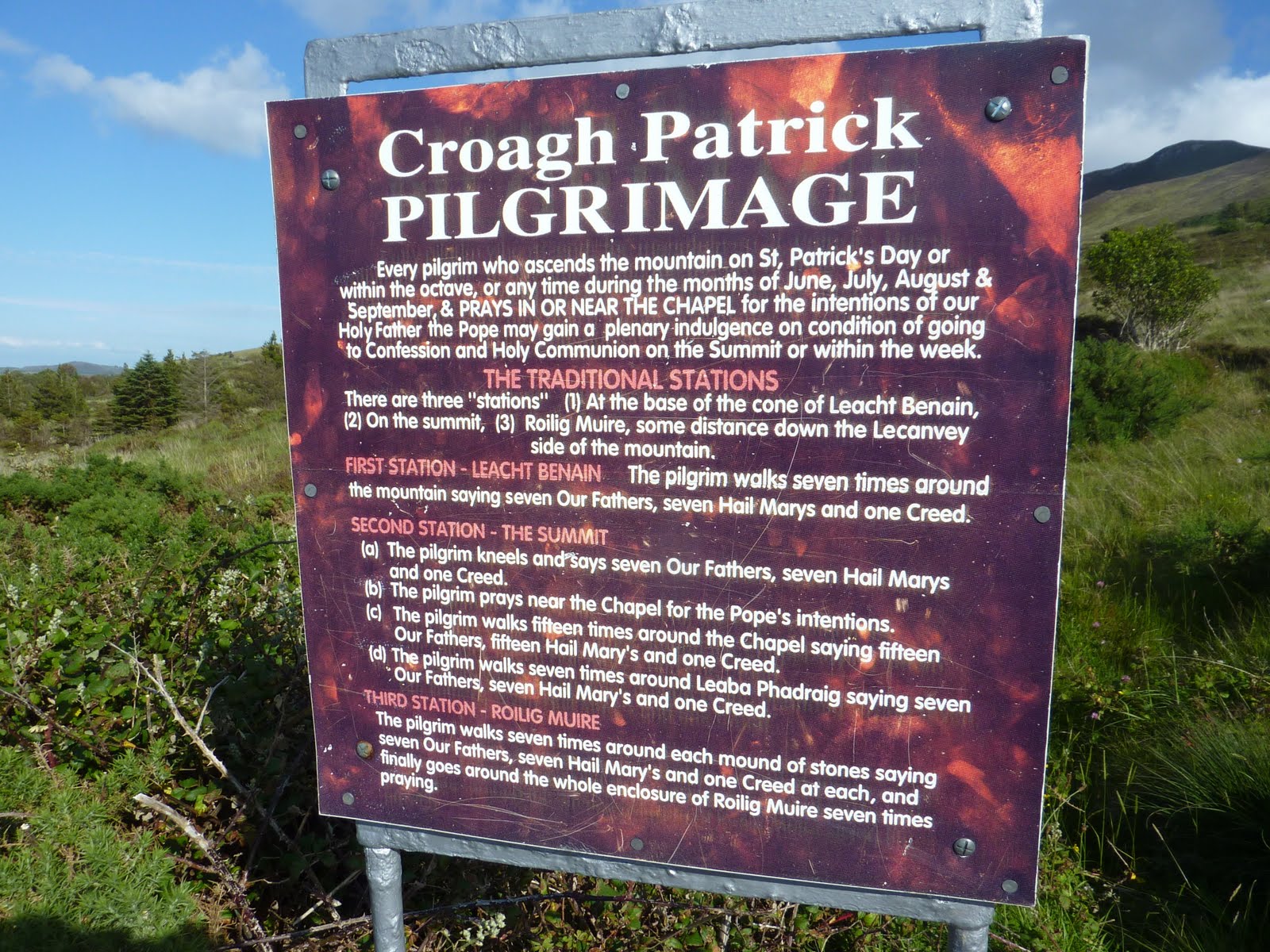
At the summit there's another pilgrimage station ...


... and the supposed site of St Patrick's bed. Even on the Camino I don't think I've ever seen such an uncomfortable looking bed ...


There's also this ruined shelter ...


... and this chapel, sorely in need of a lick of paint. Though, on second thoughts, I'm sure it looks better this way - more in keeping with the weather-beaten landscape ...


Peering down from the stony summit, you can see a mosaic of medieval green fields at the edge of Clew Bay. Forty shades of green ..?


This viewpoint is simply heaven on earth ...


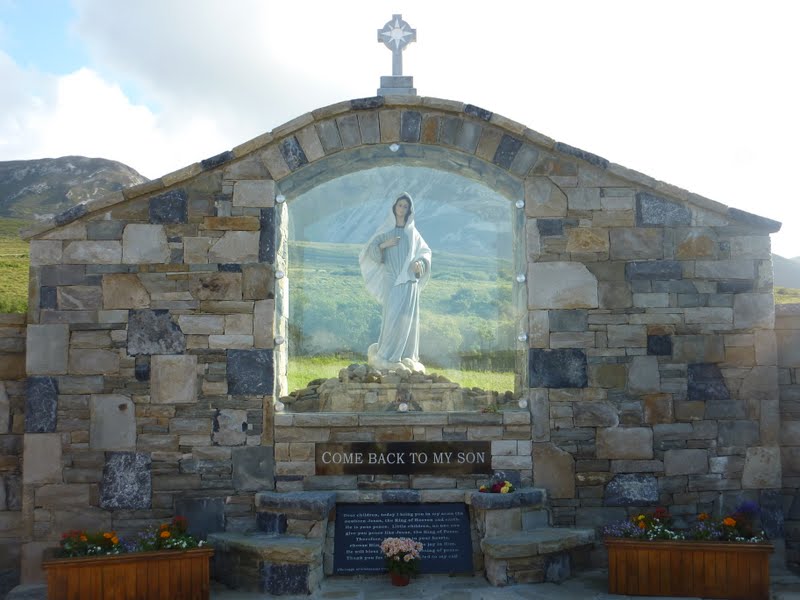
Back at base, here's a shrine to Our Lady Queen of Peace next to the car park ...


Croagh Patrick soars behind the Blessed Virgin ...


Saturday, 16 July 2011

Croagh Patrick (2)

As is the case with so many Christianly annexed sacred sites, Croagh Patrick was held in numinous regard long before the arrival of Christianity. In Celtic times the mountain was believed to be the home of the deity, Crom Dubh. And during the Celtic harvest festival of Lughnasa, traditionally held around 1st August, women would sleep on the summit to encourage fertility.


It's said that St Patrick made the ascent at festival time in 441 AD. He's supposed to have fasted on the top for 40 days and, from there, banished all the snakes and demons from Ireland. It's certainly true there are no snakes in Ireland, but I'm sure there's a more down-to-earth, a more evolutionary or geographical reason ... (No snakes in New Zealand either, Kiwi Nomad!)

On the last Sunday in July, known as 'Reek Sunday' - it's approaching soon if anyone fancies it - tens of thousands of pilgrims make the trek to the summit as an act of penance. Or to scratch a superstitious itch. Or even just to enjoy a good day out. Who knows or cares? I think you can layer the ascent with as many meanings and motives as you wish, and that's wonderful. Myself, I love the religious, mystical, traditional import and history of this shapely peak. But I've nothing against the climb as a good walk either, for, as walks go, it's a very fine one ...


At the foot of the final slog up the loose scree slope of the mountain proper, there's the first of three pilgrimage stations ...


Looking south east towards the Partry mountains. (Note the extensive area of peat digging ...)


It's fabulous high up here, though the path can obviously be a bit of a pilgrim motorway. But I climbed  late in the afternoon, when most walkers and pilgrims were coming down, so most of the time I had the place to myself. Which is bliss, of course, for a Solitary Walker ...


Wow, those views are terrific, don't you think ..?


Friday, 15 July 2011

Bees On Marjoram

Hope and despair.
They do not last.
I know that now.
Depressions come
And go.
And right thoughts feed,
then starve,
like bees on marjoram.


How the bees flock
so briskly at their work,
productive on the pink,
buzzing with intent,
bound to necessity!
So good, so true.

But when the shadows
drop their veil,
and the earth chills,
and the cold, silent
bat's wing of death
brushes the herb garden,
they vanish suddenly,
invisibly,
into the dark gap
between two rays of sun.

Croagh Patrick (1)

Croagh Patrick ('Cruach Phádraig' in Irish, meaning 'St Patrick's Stack', also known as 'The Reek') is Ireland's most sacred mountain. It's 2,507 ft high, and lies 5 miles from Westport in County Mayo. I was lucky enough to enjoy blue skies and calm weather on my pilgrimage to the summit. Pilgrimage? This sounds like a rather long and arduous affair. In fact it took me only 1 hour and 20 minutes to gain the top, and exactly the same length of time to get down. Should pilgrimage be defined solely in terms of vast distances and prodigious feats of endurance? No, of course not ...


... though some pilgrims do choose to ascend barefoot, and sometimes even on their knees ...


Some coach party pilgrims - and others who are old, infirm or have deadlines to meet - may simply reach this statue of St Patrick, close to the foot of the mountain, and go no further. And that's fine.


But, full of energy and high on expectation, I continued quickly up the rocky stream bed ...


Above you could clearly make out the eroded path up to the saddle ...


And what a stunning and expansive view of Clew Bay spread out from behind ...


Wednesday, 13 July 2011

Coming Clean

Love seeketh not itself to please, / Nor for itself hath any care, /  But for another gives its ease, / And builds a Heaven in Hell's despair. WILLIAM BLAKE Songs Of Experience 


Looking back on the softly sloping escarpment of the Lincoln Edge ...


The symbol of the Viking Way is a horned, Viking helmet. (But did you know the Vikings never actually wore horns on their helmets? Yes, folks, it's just another of those myths we all grew up with. Like the one about Father Christmas. Or the one about warts being the mark of the Devil. Or the one about marriages ending happily ever after ...)  


Here the Way approaches Lincoln's South Common. Can you see Lincoln's imposing cathedral on the skyline? This cathedral has been the jumping-off point for many a famous and not-so-famous marriage. For my money, it's one of the finest Gothic buildings in Europe ...


I make my way up Lincoln's quaint and cobblestoned Steep Hill ...


... until the glorious, freshly jet-cleaned cathedral comes into view through the Exchequer Gate arch ...


I take a photo of the writhing, bleached-white figures in the stone frieze on the western facade. This scene depicts the Biblical 'Harrowing of Hell' ...


Tuesday, 12 July 2011

More Stolen Moments On The Viking Way

Since I began walking the Viking Way on 6 May I've now completed about 30 miles - a fifth of its total length. (Actually I must have covered nearly twice that much, since I've been forced to double back to my car on most sections.) I'm doing the trek intermittently throughout the year in sweet snatched hours and blissful stolen moments.

This is the section from Waddington to Coleby on the Lincoln Edge. This pond near Coleby made me think of Thoreau's Walden...


... and these roses reminded me of Gertrude Stein's 'a rose is a rose is a rose is a rose'...


This mock-Roman arch at the entrance to Coleby Hall recalled the times when Roman soldiers used to march along nearby Ermine Street and the Fosse Way on their way to Lincoln (Lindum Colonia)...


... and this moody sky brought to mind our great Lincolnshire poet Tennyson's lines from The Lady Of Shalott: On either side the river lie / Long fields of barley and of rye / That clothe the wold and meet the sky...


Here's the black stump of a ruined windmill tower near Waddington...


... and here the path runs between hedge and cornfield to Coleby church...


The Way is long, though often the miles race by. It can be delightful, and it can be tedious. The weather may be bright or it may be dull; the spirits high and sometimes low. But the Way continues, as it always does...