A common man marvels at uncommon things. A wise man marvels at the commonplace. CONFUCIUS

Thursday, 27 September 2012

Nigella And Me: Tales Of Sex, Drugs, Rock 'N' Roll And Artichokes

I know it's silly, and childish, and bloggish, and inaccurate, and I know it's a game and the choice will be different in the morning — but how about a list of your ten favourite books? Books that have influenced you, delighted you, stunned and startled you, books that have changed your life in some way? They needn't necessarily be literary, or even well-written; they may be books which were important at a much earlier stage of your life and which you wouldn't want to read again. Or they could be books which are so totemic that you have them by your side at all times. I invite you to indulge me and play this game — those who don't comment regularly, or even at all, are very welcome too! I won't hold you to these lists, which should be spontaneously scribbled down off the top of your head. Though I think you may be surprised at how much such a list says about you. Well, here goes — this is mine. Not in any particular order:

1. Georges Duhamel The Life And Adventures Of Salavin
2. Colin Wilson The Outsider
3. Edward Thomas Poems
4. Rainer Maria Rilke Letters To A Young Poet
5. Alfred J. Brown Striding Through Yorkshire
6. Hermann Hesse Steppenwolf
7. Rebecca Solnit Wanderlust
8. John Hillaby Journey Through Britain
9. Iris Murdoch Under The Net
10. Krishnamurti The Penguin Krishnamurti Reader

See — it's easy, isn't it? That only took a minute. Why don't you have a go? 

Oh, and by the way, in case you're wondering about the title of this blog post... I only put it there to attract your attention...

Wednesday, 26 September 2012

Vía de la Plata

That day, as I remember,
there was rain, yes, skyfulls of it,
streams becoming rivers
and all the bridges swept away.

And between each deluge
a thousand birds sang in a thousand holm oaks.
Never had birdsong sounded sweeter
than all those finches, larks and linnets
chorusing an early spring.

And the cranes, what about the cranes?
Hidden at first, then lifting from a field,
cross-shaped, gliding with scarcely a wingbeat,
their clattering calls fainter and fainter.

I followed a full moon to Cañaveral
by a lonely path on a high plateau,
lurching down a gully through the dark,
the batteries of my headtorch failing.

Loud martial music blared —
I don’t know why, or where it came from —
across the town, and then stopped suddenly.
A ghostly silence in the long main street.
Then clamour of voices in Hostal Málaga.

Opening doors, I walked from one
acutely etched experience to
another. The bedroom cold and narrow
as a coffin, the radiator not working
as usual, the cramped bed suited
to some ascetic saint, the dusty curtains
rough and stiff as a hairshirt.

Escaping to the comfort of a bar,
delighting as ever in the role
of the mysterious stranger,
I gazed hawk-like, fooling myself
I saw the meaning behind the meaning
of the bread, the wine, the pork steak
and the fried potatoes, the kind stares
of the drunks on their stools
who never seemed to get drunk
but gawked over their San Miguels
with curiosity and, I felt —
after I’d gulped one or two
large vinos — with love.

Later that night, in my cold
and miserable room, I put my arms
around myself, as if I were
holding a woman, then drifted into dreams
of rain, empty roads, and stepping stones
submerged in rivers and swollen streams.

(The Vía de la Plata is one of the Spanish pilgrimage routes to Santiago de Compostela.)

Tuesday, 25 September 2012

Nigella

Nigella's back! Was I dreaming, or did she really recommend dropping uncooked chips into cold oil the other night? And surely one of her recipes didn't involve frying a clove of garlic topped with a few chilli flakes then dolloping a can of tomatoes and a raw egg on top? Good grief, I've just googled, and find I'm absolutely right. Though I could easily not have been, as I wasn't concentrating on the actual cookery all that much.

Nigella

Oh I beg you open up your pantry door, Nigella,
For I'm helpless and I'm rolling on the floor, Nigella.
Your peaches with whipped cream
Are the best I'm ever seen
And your sticky buns a middle-aged man's dream, Nigella.

Please activate me like a frothy yeast, Nigella.
You'll soon find out if I am man or beast, Nigella.
If you pummel me like dough
Then I'll very nearly know
That you love me just a little bit at least, Nigella.

When I see you standing at the cooking hob, Nigella,
You're sweeter than the corn upon the cob, Nigella.
Forget the boring ninnies
In their shapeless, stripey pinnies —
Your black dress and high heels are just the job, Nigella.

When I watch you drooling over a hot wok, Nigella,
My desire becomes much firmer than a rock, Nigella.
You can wash me, you can dry me,
You can stir me, you can fry me,
You can blitz me and then turn me into stock, Nigella.

I don't care if you serve melons or a fig, Nigella,
Or cabbage with a juicy slice of pig, Nigella,
Or chocolate with pak choi
Or a tasty saveloy —
My appetite would always be this big, Nigella.

So weigh me in your kitchen scales of love, Nigella,
And slip me on just like an oven glove, Nigella.
If you went, what would I do?
(Rachel Khoo is sexy too,
But she isn't as voluptuous as you, Nigella.)

Nigellissima, BBC2

The Little Paris Kitchen: Cooking with Rachel Khoo, BBC2

Sunday, 23 September 2012

Nine Pages

In his brilliant new book, On Poetry, Glyn Maxwell invents an imaginative exercise designed to help the poet put some black marks onto white paper:

Take nine sheets of blank paper and pretend the following things about them:
That the first page is physically hurt by your every word.
That the second page is turned on by every syllable.
That every mark on the third page makes you remember more.
On the fourth, less, like dementia.
That God can only hear you if you're writing on the fifth page.
That only touching the sixth page are you hidden from God.
That every word you write on the seventh prolongs the time from now until the moment you meet that mythical creature known as The One.
That every word you write on the eighth brings that moment closer, yes, but makes your time together shorter.
The ninth page says you have only nine words left in your life.

I was reminded once more of Jack Kerouac's writing tips.

Friday, 21 September 2012

Perhaps A Cloud

A vapour trail, it moved across the moon
as the moon rolled from east to west
at rain-cleansed dusk. A comet’s tail,
a skinny streak of cloud, yet seeming
far too narrow and too vertical.
Trick of the light?

The light was fading fast.
A tapering waterfall
of smoke, it plunged
thinly from the zenith of the sky
to nadir on a mountainous horizon.

Tornado came crazily to mind
until, a slender tower, it drifted east,
flattened then broadened out,
ruffled at the edges, banded
purple and amber like a razor shell,
became diaphanous, almost dissolved —

and all the while the motion of the moon,
the motion of the earth and of the moon.

Find me on Facebook.

Find The Passionate Transitory on Facebook.

Wednesday, 19 September 2012

Facebook


I've now received around thirty poems of real quality which are ready to appear in the first issue of my new poetry journal, The Passionate Transitory. It's free, it's online, and it should be out sometime in October. I'll flag up imminent publication on this blog. There's still plenty of room for more poems if anyone's been holding back! I would love to hear from you. And thanks a million to everyone who's been promoting the magazine.

The Passionate Transitory is now on Facebook, but I must confess I'm a Facebook virgin. If any Facebook adepts out there can help me with a few tips and pointers, I would be truly grateful. How do you get your page known? How do you find other pages? How do you get other poetry fans and poetry sites to interact?

Tuesday, 18 September 2012

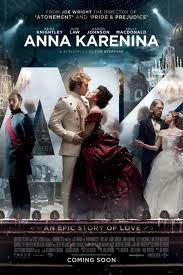
Anna Karenina

A quick surf of the Internet confirms that adaptations of Anna Karenina are as thick on the ground as photos of Kate Middleton's breasts. So why another one? Jo Wright's new film of one of the classics of all classics is yet another unfortunate example of the failure of film to capture the essence of a great novel. Though it's not a tedious or boring film, I'll give it that — the lush and theatrical scenes (it's staged as if it were a play) sweep you  along exuberantly from one extravagant, highly stylised set to the next. It was only twenty minutes or so before the end that I started shuffling and fidgeting. Would that goddamn train never arrive? There'd certainly been plenty of anticipatory whistles and thrusting piston rods over the preceding half-hour.

Now, I've nothing against Kiera Knightley as an actress, though so far in her career I think she's been good rather than great. Here she plays a much shallower, more one-dimensional Anna than the one I remember from the Tolstoy novel, an Anna who is bored with her marriage and ripe for an infatuation. The infatuation happens. She gets brilliant sex for the first time in her life. And then becomes all neurotic — a part Knightley plays well, since it's a part she played in another of her recent films, A Dangerous Method (see my review of it here). I'm afraid I tired of her distorted mouth displaying strings of saliva between her teeth. But, hey, that's film for you! At least you can imagine this when reading the book. If you wish.

Wright adopts the interesting but bizarre technique of filming the novel very stagily, using numerous 'distancing' techniques which seem intent on alienating the audience from the characters. For what reason? Obviously he wanted to come up with a radically different framework — it must have been daunting to compete with all those other interpretations of one of Russia's literary masterpieces. However, this ill-conceived Brechtian approach leaves us up the emotional creek without a paddle. Do we identify with Anna or not? Have we any sympathy at all with Karenin, her husband? And Vronsky is definitely not the sexily handsome, compelling, more well-rounded character I recall from the book — or is my memory playing tricks? In the film he's portrayed as an effete and sometimes cruel dandy.

Monday, 17 September 2012

Easton Walled Gardens

Easton Walled Gardens lie just off the A1 near Colsterworth in Lincolnshire. Easton Hall was demolished in 1951. The revival of its gardens began in 2001. 

The original estate gardens can be traced back four hundred years.


A yew tree tunnel . . . 

. . . leads to this wrought iron gate, beyond which runs the noisy A1 motor route, the only blight on a landscape which US President Franklin D Roosevelt called 'A dream of Nirvana . . . almost too good to be true.' He was spending part of his honeymoon here with his bride, Eleanor. 

Rose is a rose . . .

. . . is a rose is a rose . . .

. . . except when it's a dahlia. We found these dahlias in the cut flower garden, also known as the pickery. 

The flowers attracted many butterflies, including the red admiral and the small tortoiseshell . . .

. . . while other wildlife we encountered was rather more unusual . . .

Thursday, 13 September 2012

How to Write Poems And Get The Girl

Inspired by Jack Kerouac's writing tips as featured recently on Ruth's blog washed stones, I perversely came up with this piece of light verse...

Advice to a Young Poet

Be influenced by, don’t steal or plagiarize.
In poems on love, don’t adulate the eyes.
Extol some far less obvious body part,
e.g. the toenail. That, my friend, is art!

Eschew the sonnet and the villanelle.
They’re hard to write and much harder to sell.
Instead, go for some freeform kind of stuff.
Even light verse like this is good enough.

Don’t dedicate a poem to a coy
mistress or to a marvellous boy,
a nightingale, a cuckoo or an urn.
It’s all been done before, as you shall learn.

Instead, pen odes to cockroaches or cheese,
or phlegm or feet or fungal growth or fleas.
Just shop around in some poetic Primark
and please forget about that bloody skylark.

Don’t give up booze like Raymond Carver. Try
and drink yourself to death. But when you die,
do it in style like Dylan Thomas, who
had so many women begging for a screw

it became almost a sexual pandemic
among the wives of many an academic
or US prof. or lecturer, or worse —
the concubines of poets of crap verse.

Don’t be tied down by too much punctuation,
and never offer any explanation
as to the meaning of your latest work,
or hint at inner demons that may lurk

within your morbid, melancholy soul.
Just keep folks guessing.  If they still cajole
you to reveal your bardic mystery,
invent a glam, romantic history:

how you were orphaned at the age of ten,
abused by nuns, left in an opium den
from dusk till dawn, and how you were reviled
like Baudelaire, De Sade or Oscar Wilde. 

So, in conclusion, hear well what I say.
Be enigmatic. Don’t give much away.
Inscrutability, I think you’ll find,
makes you magnetic to the female kind.

Tuesday, 11 September 2012

Back On The Viking Way

During the spring and summer of 2011 I walked in stages (a few hours here, a few hours there) sixty miles along one of my local, long-distance footpaths: the Viking Way. (For my old posts on this, click here.) It was high time I thought about completing the remaining ninety miles, the section running east of Lincoln across the Witham Valley, then north over the chalk hills of the Lincolnshire Wolds to the Humber Bridge. So yesterday I decided to nibble at another short chunk of the path, and covered the flat, mostly dead straight seven miles from Lincoln City Bus Station to Fiskerton village. The trail follows the trackbed of an old railway line now used by pedestrians and cyclists as a recreational route. Though the afternoon was dull and cloudy, it did not rain, and an invigorating breeze blew over open field and fen.

It was good to be back on the trail. I soon came across the reassuringly familiar Viking's helmet marker.

This is a land of drains and ditches, fen and rough pasture, long horizontals and far horizons. Here a pair of mute swans make their graceful way up a drainage channel. Can you spot Lincoln Cathedral in the distance? Parallel to this ditch . . .

. . . flows the sluggish, navigable River Witham. I took this photo from Five Mile Bridge near Fiskerton.

I passed these scrap metal cow sculptures . . .

. . . near the village of Washingborough, where more swans were gliding downstream in a rare glitter of sunlight . . . 

Monday, 10 September 2012

Tempest

Bob Dylan and his band live in Bologna, 2006. (Image from Wikimedia Commons.)

One minute before the day of the release of Bob Dylan's thirty-fifth studio album, Tempest, listening to the Internet-available taster track and first single, Duquesne Whistle, becomes a sacred act.

Believe in the holy contour of life. JACK KEROUAC Belief And Technique For Modern Prose

Hell is empty, and all the devils are here. SHAKESPEARE The Tempest

We are such stuff / As dreams are made on, and our little life / Is rounded with a sleep. SHAKESPEARE The Tempest

You taught me language, and my profit on't / Is, I know how to curse. SHAKESPEARE The Tempest

I long to hear the story of your life, which must / Take the ear strangely. SHAKESPEARE The Tempest

How beauteous mankind is! O brave new world, / That has such people in it! SHAKESPEARE The Tempest

This thing of darkness I / Acknowledge mine. SHAKESPEARE The Tempest

Be not afeard; the isle is full of noises, / Sounds, and sweet airs, that give delight and hurt not. / Sometimes a thousand twangling instruments / Will hum about mine ears; and sometime voices... SHAKESPEARE The Tempest

Now I will believe / That there are unicorns... SHAKESPEARE The Tempest 

He not busy being born is busy dying. BOB DYLAN It's Alright, Ma (I'm Only Bleeding)

Blackwell

On our last day in the Lake District we visited Blackwell, the Arts & Crafts House.

The view from Blackwell over Lake Windermere and Grizedale Forest towards the Dunnerdale Fells.

Blackwell is one of Britain's finest houses from the turn of the 20th century, and is an icon of Arts & Crafts architecture. The house (designed by MH Baillie-Scott) and its furnishings very much embody the ideas and philosophy of John Ruskin and William Morris (Have nothing in your houses that you do not know to be useful or believe to be beautiful. WILLIAM MORRIS). 

Morning coffee would have been nice sitting on this flower-bordered terrace, but the weather was cold, so we sat inside.

Saturday, 8 September 2012

Portrait Of Kendal

I've long thought Kendal a place where I could easily put down roots. It lies just outside the boundary of the Lake District National Park, so property is cheaper there. It's grittier, more workaday, less touristy than Lakeland honeypot towns like Windermere, Ambleside and Keswick. Its arts and cultural scene is excellent: there's the Kendal Museum, the Museum of Lakeland Life, the Abbot Hall Art Gallery and the Brewery Arts Centre, which offers theatre, dance, cinema, music, exhibitions, bars and cafés. Its geographical location is enviable: the Forest of Bowland, the Yorkshire Dales and the Pennines are quickly reached heading east, while the nearby M6 motorway makes North Wales and Scotland within comfortable driving distance. And, of course, the Lake District itself is on Kendal's doorstep, one of the most stunningly beautiful parts of Britain, and containing some of England's highest peaks.    

The river Kent runs through Kendal.

Dog training on the slopes of Castle Hill.

Kendal Castle. Not that there's much of it left.

The same bit of Kendal Castle, but from the other side.

You can see why Kendal is known as 'The Auld Grey Town'.

Looking towards the fells of The Lake District from the beacon on Castle Hill.

The sun illuminating some Lakeland fells north of town.

Thursday, 6 September 2012

Wordsworth at Hawkshead

This is Hawkshead Grammar School in the English Lake District, founded in 1585 by Edwin Sandys, Archbishop of York. From 1778 until 1787 the Romantic poet William Wordsworth was a pupil here. He learnt Latin, Greek, Mathematics and Knife Skills.

Hawkshead Grammar School.

For boys were allowed to bring knives into school, which they used industriously to carve their names and initials into the oakwood desks. You can see Wordsworth's own initials there, and his brother John's. The schoolmasters did not consider this a problem. They also encouraged the boarders to bet on cock fighting matches. (Knives and wagers? Not things allowed in school today, I fancy.) However, woe to those students who committed such misdemeanours as arriving late for class or missing church on Sunday. For these crimes stiff beatings were administered.

The schoolroom, Hawkshead Grammar School.


The headmaster's study, Hawkshead Grammar School.

While he was at Hawkshead, the young Wordsworth lodged with Ann Tyson and her husband in this cottage — which is now a B&B. 

Ann Tyson's Cottage, Hawkshead.

The earth is all before me. With a heart / Joyous, nor scared at its own liberty, / I look about; and should the chosen guide / Be nothing better than a wandering cloud, / I cannot miss my way. I breathe again! WORDSWORTH The Prelude

Wednesday, 5 September 2012

Camping And Fell Walking

A great recent camping and walking weekend with Dominic from the blog  . . . made out of words. Here was our campsite on Seathwaite Farm at the head of Borrowdale in the Lake District. It's officially the wettest place in England. And, true to form, it was raining. The lump on the right is Seathwaite Fell, which I've climbed before... 


This time, late one damp, Saturday afternoon, we picked our way straight from the campsite up a steep and distinct path by the side of Sour Milk Gill (which roared tumultuously), past a tiny, red-berried rowan tree growing bravely by the torrent...


... to the outlying fell of Green Gable (2628 ft, 801 m) and her big sister Great Gable (2949 ft, 899 m), the seventh highest mountain in the Lake District. This last stretch — in rain, cloud and poor light, and up slippery, rock-strewn slopes — was tough going. But we made it to the top. And realised we only had a couple of hours in which to descend before nightfall. We had head torches but in the end didn't need them, as we made it precipitously, and at times uncomfortably, down Aaron Slack and Styhead Gill just before darkness set in. Though we did need our torches (and gas camping lanterns) to cook the evening meal — which, on this first night, was Dominic's affair: pasta, baked beans, and a packet of Dolmio sauce. No, not Cordon Bleu. But we were very, very hungry...  


Next day we drove to Buttermere and took on Red Pike (2477 ft, 755 m), its rock as red as its name suggests. At the start of the day we'd intended walking the whole western ridge from Red Pike via High Stile and High Crag to Scarth Gap Pass, and thence to Buttermere again, along Buttermere Lake. Alas, we had not reckoned on the weather, and at the top of Red Pike felt cold, wet and tired. So, instead, we decided on an alternative, shorter, easier route via Scale Beck and Scale Force down to the shore of Crummock Water. And, miraculously, for that half day, the sun came out, and all felt sublimely well with the world. The exciting, occasionally scrambly, but perfectly safe walk down Scale Beck was utterly delightful.    


For our final meal on Sunday night I prepared two disparate packs of Uncle Ben's rice — with fresh yellow peppers, tomatoes and hard-boiled eggs. Hardly a marriage made in heaven either. But, do you know, we were absolutely famished again...

PS Thanks and undying appreciation go to Dominic for the indisputable culinary highlight of the trip: his glass cafetière, which gave us wonderful coffee —  a huge treat in a challenging environment!

Monday, 3 September 2012

Today we died a little death

Today we died a little death
That we had died before —
Today we breathed a little breath
Gently — and then one more —

One death — one breath —
One life — one song —
One threnody — one crumb
Of hope containing seed and germ —
A prothalamium.

Buddha

Preparation of sculptural exhibits, Doddington Hall, July 2012.

As if he were listening; stillness, distance.
We hold our breath and cease to hear it.
He is like a star surrounded
by other stars we cannot see.

He is all things. Do we really expect him
to notice us? What need could he have?
If we prostrated ourselves at his feet,
he would remain deep and calm like a cat.

For what threw us down before him
has circled in him for millions of years.
He, who has gone beyond all we can know
and knows what we never will.

Rainer Maria Rilke (Translated by Anita Barrows and Joanna Macy)