Click here for the first post in a new series about personal physical and spiritual transformation on my blog words and silence.
A common man marvels at uncommon things. A wise man marvels at the commonplace. CONFUCIUS
Monday, 28 January 2013
The Energy Of Change And Connection
Energy is eternal delight. WILLIAM BLAKE
No man ever steps in the same river twice, for it's not the same river and he's not the same man. HERACLITUS
A great day for radio and TV yesterday — Aung San Suu Kyi on Desert Island Discs (Radio 4) and Professor Brian Cox's new series on BBC2, Wonders Of Life.
I must confess I've never properly understood the laws of thermodynamics, but Professor Brian Cox explained the first two laws with stunning clarity.
The first law of thermodynamics states that energy is always conserved, that every bit of energy contained in the Big Bang at the creation of the universe is around today but in different forms. The evolution of the universe is simply — or not so simply — the transformation of that energy. Energy is not created or destroyed; it is eternal.
And the second law of thermodynamics states that everything in the universe tends towards decay, disorder and entropy. (So don't worry about things like Venice gradually sinking and disappearing into the lagoon. It's meant to!)
I found this all connected with other stuff I learnt last night on the Radio 4 programme Something Understood. For instance, that in each seven year period of our lives all our body cells completely change and renew themselves. Our characters and personalities aside, we are physically not the same people we were seven years ago.
One thing is certain in this precious life and in this astonishing universe: everything is changing, evolving, being transformed the whole time, and the energy this takes is never lost, just dynamically reshaped and reconfigured.
And all living things are connected, and all share DNA, the blueprint of life — and we human beings still share some of the same DNA code to be found in even the earliest, simplest and most primitive of creatures.
Saturday, 26 January 2013
Quinterview 15
Meet the brilliantly accomplished poet Jenne' R Andrews in The Passionate Transitory's fifteenth quinterview.
![]() |
| Jenne' R Andrews |
Labels:
Jenne R Andrews,
The Passionate Transitory
Friday, 25 January 2013
Thursday, 24 January 2013
Bubble And Squeak
An addendum to my recent post Waste Not, Want Not: I'd completely forgotten about one of the best ways to use up any cooked veg left over from dinner: bubble and squeak! (Worth making for the name alone.)
Mash up the potato with all the other veg and shape into patties (the potato should bind them together — if not, try adding some beaten egg). Fry up with bacon and egg until crispy and brown. Enjoy for breakfast, brunch or lunch with strong coffee. Excellent for hangovers.
Wednesday, 23 January 2013
Rufford Abbey
Rufford Abbey is only half an hour away from here by car. Today we spent the early afternoon in its grounds (and Coach House Café). There were very few other visitors. Just how I like it!
| Carmen strides up Broad Ride towards the abbey. |
| This surviving cloister in the west wing dates from the 12th century, when the abbey was inhabited by Cistercian monks. It became a private country house in the 16th century, was extended and improved in the 18th and 19th centuries, but partly demolished in the 20th century. Now it's owned by English Heritage, and the remains of the house and its extensive grounds are open to the public. |
![]() |
| Rufford Lake was partly frozen over. |
| Espaliers in the abbey garden. |
![]() |
| A lone figure returns down Broad Ride. |
Transforming Snow
![]() |
| Pieter Bruegel the Elder: Hunters in the Snow |
Stepping outside the house into the garden, I found that snow had fallen in the night. It was like entering a new country, a kind of pristine Eden. What had been so plural and so various the day before was now so streamlined and so uniform. The edges of everything had been straightened. The drive, the path, the lawn, the pond, the patio were now one seamless, sparkling field of whiteness. The ridges on the garage roof, the uneven clods of earth in the raised vegetable bed, the cherry tree's crooked tracery of branches — all were obscured, levelled out, smoothed into snowy perfection.
And I thought how wonderful it would be if we could walk outside into the winter and find the uncomfortable bumps and rough contours of our own imperfect characters flattened and rubbed away, erased under a deep white blanket of nothingness, transformed by the clean, sweeping lines of snow, purified in Zen-like simplicity.
![]() |
| Claude Monet: The Magpie |
Tuesday, 22 January 2013
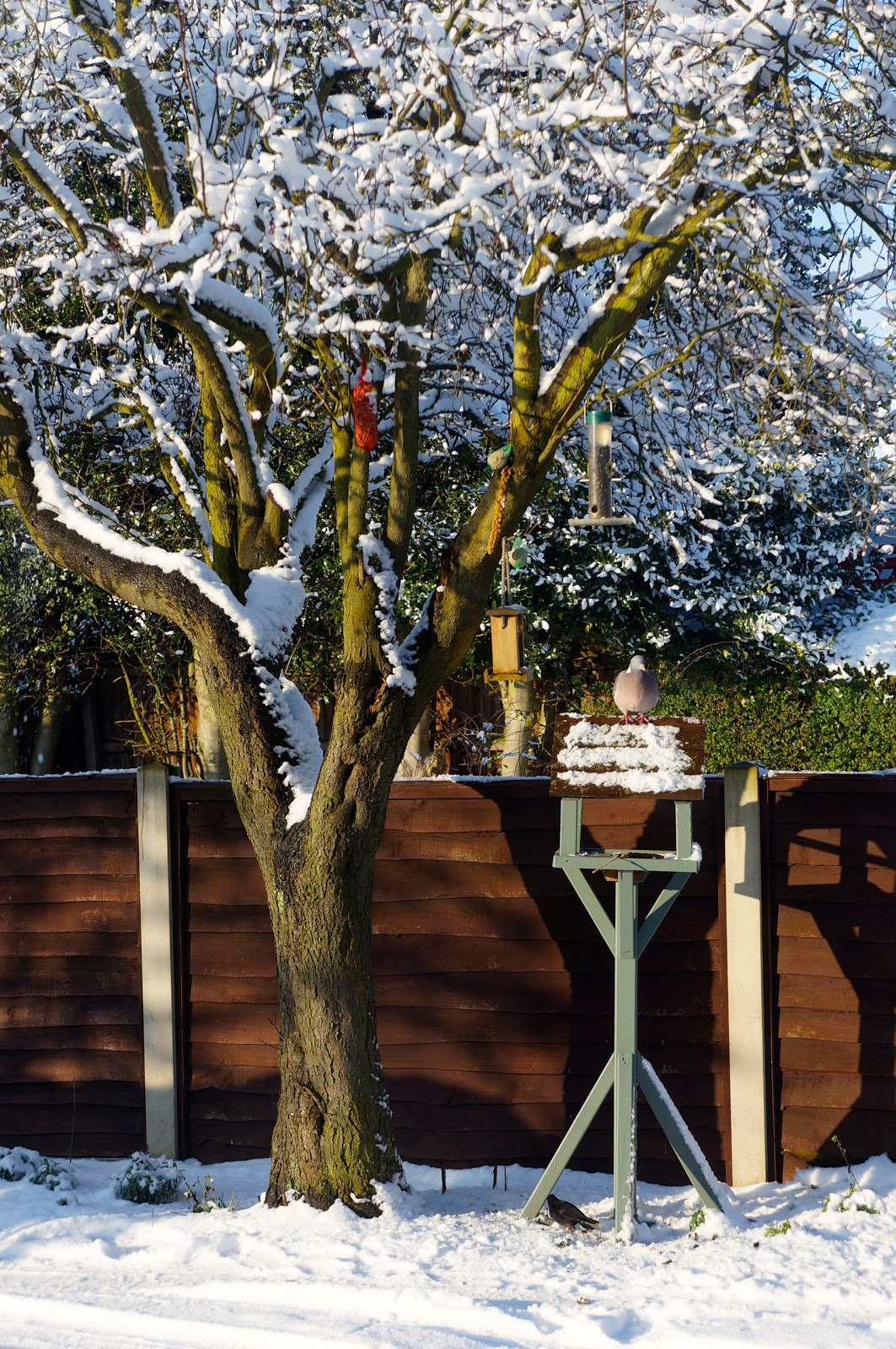
Bird Table And Cherry Tree
Monday, 21 January 2013
Our Personal Narratives
A great short essay by Frank Bures in Poets & Writers magazine: The Secret Lives Of Stories: Rewriting Our Personal Narratives.
Snow
Friday, 18 January 2013
Poets & Writers
Great news — The Passionate Transitory is now listed in the Literary Magazines Database in the online edition of Poets & Writers magazine.
Wednesday, 16 January 2013
Waste Not, Want Not
I hate wasting food — I have a thing about it. I suppose this stems partly from being brought up in a strict and frugal Methodist household during those times of austerity just after the War. My parents spent little money on food, and their diet was simple — but healthy. They grew their own fruit and vegetables, and bartered for other foodstuffs with local farmers. They baked their own bread, cakes and biscuits. Eggs came from their own chickens and milk from their small herd of Jersey cows. Every so often half a pig would mysteriously appear in the chest freezer. Needless to say, every single part was eaten: the tongue, the trotters, the offal. 'Nose to tail' cooking they call it in restaurant circles.
Today, of course, food is more varied, more plentiful and more readily available in our privileged and self-indulgent western world. But I still like to keep a close eye on what I buy — its cost, its value, its provenance. Occasionally you hear stories of families regularly throwing away half the perishable food they buy as they buy too much and leave it to rot in the fridge. The very thought of this fills me with horror! I'm afraid I'm the kind of person who steals the scraps from other people's plates, eats food past its sell-by-date as long as it smells ok, and converts slightly stale or wilted leftovers into new dishes.
So, in this new age of austerity, here are a few tips for recycling those bits and pieces of tired food, and saving money in the process.
1. Old fruit and vegetables can always be used up in soups and curries. Only the other day I found at the bottom of the fridge half a packet of mixed watercress, rocket and spinach leaves which were too droopy for a fresh salad. So I added some frozen peas for bulk, taste and texture, and made a simple soup out of these ingredients — plus an onion, a celery stick, some garlic, milk, stock and seasoning. The colour was a stunning verdant green, and it tasted absolutely delicious. (You can glamorise this soup as much as you want by stirring in some double cream at the end, perhaps with some croutons and chopped chives...)
2. Talking of croutons, we love herby garlic bread here — which we make with a baguette and a mixture of garlic, chopped fresh herbs (basil, parsley), seasoning and olive oil/butter. What to do with any leftovers? Why not dice them up into small squares and toast them in the oven until they are golden? Instant croutons, which can then be frozen and used as and when! You could do this, of course, with any stale bread, or you could make breadcrumbs, which can also be frozen.
3. And since we're on the subject of stale bread, this is an ideal opportunity to make one of the easiest and most scrumptious desserts ever: bread and butter pudding. Spread slices of white bread with butter, cut into small squares and place half into a buttered ovenproof dish. Sprinkle with currants or sultanas and caster sugar. Add the remaining bread, more sugar and a pinch of cinnamon. Finally top with a mixture of two beaten eggs and a pint of milk. Allow the bread to absorb the liquid, then bake in the oven for three-quarters of an hour until set.
Anyone have any more tips and ideas?
Tuesday, 15 January 2013
Quinterview 14
Here's the fourteenth Passionate Transitory quinterview — this time with well-known British poet, novelist, travel writer and journalist Fiona Pitt-Kethley.
| Fiona Pitt-Kethley |
Tuesday, 1 January 2013
New Year
I know I've aired this one before, but it seemed appropriate.
New Year
Poised between past and future
Between alpha and omega
Between failure and fear of failure
I rub the almond that we’d picked,
Unripe, in Agrigento, Sicily. Once plucked
It could not ripen. Hard in my hand
It lodges: a furred, green pebble
Now blemished black. The nutcracker
Had skidded off its hull.
My mind goes back
To that low ridge of broken temples,
Tumbled blocks of stone,
Lintels at crazy angles,
Weeds creviced in the rock,
Wine-dark caverns, olive groves.
At one cave wall we whispered and,
Incredibly, the echo boomed like thunder.
Were the gods displeased?
Or had the gods fled long ago
The lemon gardens of Agrigento,
Lizards flicking the hot stones?
We are not strangers, yet we were
Half-strangers to each other then,
Lovers lost in a stricken city
Of split columns, cracked entablatures.
Just like empires, we decline and fall.
Our glories fade like jasmine flowers,
Our dreams die with the gods,
Our empty promises
Useless as unripe amandolas.
New Year
Poised between past and future
Between alpha and omega
Between failure and fear of failure
I rub the almond that we’d picked,
Unripe, in Agrigento, Sicily. Once plucked
It could not ripen. Hard in my hand
It lodges: a furred, green pebble
Now blemished black. The nutcracker
Had skidded off its hull.
My mind goes back
To that low ridge of broken temples,
Tumbled blocks of stone,
Lintels at crazy angles,
Weeds creviced in the rock,
Wine-dark caverns, olive groves.
At one cave wall we whispered and,
Incredibly, the echo boomed like thunder.
Were the gods displeased?
Or had the gods fled long ago
The lemon gardens of Agrigento,
Lizards flicking the hot stones?
We are not strangers, yet we were
Half-strangers to each other then,
Lovers lost in a stricken city
Of split columns, cracked entablatures.
Just like empires, we decline and fall.
Our glories fade like jasmine flowers,
Our dreams die with the gods,
Our empty promises
Useless as unripe amandolas.
Down In The Flood
New Year's Day, and a walk round the village soon revealed that the floods had not yet receded.
| Many back gardens along Low Street were still under water. |
| The lanes to the river had turned into rivers themselves... |
| ... and the surrounding fields into lakes. |
| There are people who live down here. Were they marooned over Christmas? Quite an attractive idea, I think — as long as the larder is well stocked. |
Subscribe to:
Posts (Atom)