A common man marvels at uncommon things. A wise man marvels at the commonplace. CONFUCIUS
Showing posts with label Jon Kabat-Zinn. Show all posts

Friday, 16 April 2010

Books Which Change Your Life

I like to think of mindfulness simply as the art of conscious living. You don't have to be a Buddhist or a yogi to practice it. In fact, if you know anything about Buddhism, you will know that the most important point is to be yourself and not try to become anything that you are not already. Buddhism is fundamentally about being in touch with your own deepest nature and leting it flow out of you unimpeded. It has to do with waking up and seeing things as they are. In fact, the word 'Buddha' simply means one who has awakened to his or her true nature. JON KABAT-ZINN Wherever You Go, There You Are

That's the last of my quotes from Jon Kabat-Zinn. It's time to move on to other things. My recent readings of his books Coming To Our Senses and Wherever You Go, There You Are came at just the right time in my life and have affected me deeply. It's strange how sometimes exactly the right book is 'gifted' to us at exactly the right moment in our lives - a book which may quickly become a landmark book, influencing us, rescuing us, inspiring us in profound, often life-changing ways.

When I was in my late teens I read The Penguin Krishnamurti Reader and The Second Penguin Krishnamurti Reader and these books fired a life-long interest in Zen Buddhism and were mind-blowing for me at the time. They affected absolutely the way I thought and the way I lived. Other books which have done this to me are Thoreau's Walden, the novels of Hermann Hesse and John Fowles, and (this may surprise you) the novels of Henry Miller. I read all of these writers in my twenties.

I wonder how many of you have totemic books you read at a critical time in your lives - books which altered your mindset? The power of the written word can be truly astonishing.

Only that day dawns to which we are awake. THOREAU

Thursday, 15 April 2010

In Praise Of Non-Doing

There were times when I could not afford to sacrifice the bloom of the present moment to any work, whether of the head or hand. I love a broad margin to my life. Sometimes, in a summer morning, having taken my accustomed bath, I sat in my sunny doorway from sunrise till noon, rapt in a revery, amidst the pines and hickories and sumachs, in undisturbed solitude and stillness, while the birds sang around or flitted noiseless through the house, until by the sun falling in at my west window, or the noise of some traveller's wagon on the distant highway, I was reminded of the lapse of time. I grew in those seasons like corn in the night, and they were far better than any work of the hands would have been. They were not time subtracted from my life, but so much over and above my usual allowance. I realized what the Orientals mean by contemplation and the forsaking of works. For the most part, I minded not how the hours went. The day advanced as if to light some work of mine; it was morning, and lo, now it is evening, and nothing memorable is accomplished. Instead of singing, like the birds, I silently smiled at my incessant good fortune. As the sparrow had its trill, sitting on the hickory before my door, so I had my chuckle or suppressed warble which he might hear out of my nest. THOREAU Walden

(Quoted by Jon-Kabat-Zinn in his book Wherever You Go, There You Are.)

Wednesday, 14 April 2010

The Unfolding Path

In the middle of this road we call life / I found myself in a dark wood / With no clear path through DANTE Inferno

The journey metaphor is used in all cultures to describe life and the quest for meaning. In the East, the word Tao, Chinese for 'Way' or 'Path', carries this meaning. In Buddhism, meditation practice is usually spoken of as a path - the path of mindfulness, the path of right understanding, the path of the wheel of truth (Dharma). Tao and Dharma also mean the way things are, the law that governs all of existence and non-existence. All events, whether we see them on the surface as good or bad, are fundamentally in harmony with the Tao. It is our job to learn to perceive this underlying harmony, and to live and make decisions in accord with it. Yet, frequently, it is not exactly clear what the right way is, which leaves plenty of room for free will and principled action, and also for tension and controversy, to say nothing of getting lost entirely.

When we practice meditation, we are really acknowledging that in this moment, we are on the road of life. The path unfolds in this moment and in every moment while we are alive. Meditation is more rightly thought of as a 'Way' than as a technique. It is a Way of being, a Way of living, a Way of listening, a Way of walking along the path of life and being in harmony with things as they are. This means in part acknowledging that sometimes, often at very crucial times, you really have no idea where you are going or even where the path lies. At the same time, you can very well know something about where you are now (even if it is knowing that you are lost, confused, enraged, or without hope). On the other hand, it often happens that we can become trapped into believing too strongly that we do know where we are going, especially if we are driven by self-serving ambition and we want certain things very badly. There is a blindness that comes from self-furthering agendas that leaves us thinking we know, when actually we don't know as much as we think. JON KABAT-ZINN Wherever You Go, There You Are

Friday, 2 April 2010

Ring Them Bells Of Mindfulness

Tolling for the searching ones, on their speechless, seeking trail / For the lonesome-hearted lovers with too personal a tale / And for each unharmful, gentle soul misplaced inside a jail / And we gazed upon the chimes of freedom flashing BOB DYLAN Chimes Of Freedom

Ring them bells St Catherine from the top of the room / Ring them from the fortress for the lilies that bloom / Oh the lines are long and the fighting is strong / And they're breaking down the distance between right and wrong BOB DYLAN Ring Them Bells

When you gonna wake up and strengthen the things that remain? BOB DYLAN When You Gonna Wake Up?

The poet John Donne said 'never send to know for whom the bell tolls; it tolls for thee.' The bell Donne is referring to is the funeral bell, the bell that reminds us of our brief sojourn in this world. But there is another bell, the bell of mindfulness, that tolls in each moment, inviting us to come to our senses, reminding us that we can wake up to our lives, now, while we have them to live. The bell of mindfulness tolls for thee as well. It tolls for all of us. It tolls in celebration of life and what might be possible were we to hear it in its fullness, were we to wake up. JON KABAT-ZINN Coming To Our Senses

Thursday, 1 April 2010

No News Of The Affairs Of Men

Ryokan (1758-1831) is a Japanese poet of whom I'm very fond. A Buddhist monk, he trained 12 years with a Zen master. When his master died, he set off on a 5 year pilgrimage. Finally, at the age of 40, he settled down in a spartan hut on Mount Kugami and became a hermit for more than 30 years, living in absolute simplicity with very few possessions. This short, simple, yet for me profoundly resonant poem of his is quoted in Jon Kabat-Zinn's book Coming To Our Senses. It's the very essence of Zen:

My hut lies in the middle of a dense forest;
Every year the green ivy grows longer.
No news of the affairs of men,
Only the occasional song of a woodcutter.
The sun shines and I mend my robe.
When the moon comes out, I read Buddhist poems.
I have nothing to report, my friends.
If you want to find the meaning, stop chasing after so many things.


RYOKAN

Tuesday, 30 March 2010

Dwelling In The Possibility Of The Sacred

It's fascinating how words can change their meaning and popularity over time. Society is constantly dynamic, ever changing - changes brought about by the latest political trends and philosophies, by science and technology, by war, by climate, by many other things; changes in fashion, in habits, in lifestyle, in health, in beliefs and opinions, in morals and ethics, and so on. And the language we use necessarily reflects these changes.

For instance, in post-WWII Germany you could no longer comfortably use words like 'Volk' (the people, the mass) or 'Vaterland' (fatherland) and many such 'loaded' words. National Socialism had polluted this vocabulary. The words had become tainted with fascism. And to take another example, this time from the religious field, it's difficult to use with confidence words like 'God', 'Heaven','Covenant', 'Salvation', 'Redemption', 'Absolution', 'Sin', 'Evil' and scores of other 'Christian' words post-Darwin, post-WWI and post-Existentialism.

But these 'religious' words haven't really gone away. It's just that their meaning has changed, as meanings do - and widened, and, to some extent, become secularized. They have lost their capital letters. And that's just fine. Why should the Religious have a monopoly over the religious? Why should my God be better than your god?

Take the word 'sacred'. We tend to associate it with Christian holiness, but that's a very partial view. The word comes from the Latin 'sacrum' which refers to the pre-Christian gods of Ancient Rome and, spatially, was the area around the 'templum' (temple). All religions can share in the sacred - as well as humanists, agnostics, atheists, pagans... all of us. The numinous is available to everybody.

In the book I'm reading at the moment, Coming To Our Senses by Jon Kabat-Zinn, I've just come across this paragraph:

In a lovely appreciation of all that is mysterious and sacred, Emily Dickinson invokes the wholehearted affirmation: 'I dwell in possibility'. Her very next line is 'A fairer house than prose' - which I take to mean the domicile of reasonable, rational, linear, and so often limiting thoughts and opinions. Can we say the same? Can we truly dwell in possibility? In not knowing, but risking anyway? And in this very moment? How does it feel?

Here's the poem he quotes, by the wonderful Emily Dickinson:

:
 I dwell in Possibility

I dwell in Possibilty -
A fairer House than Prose -
More numerous of Windows -
Superior - for Doors -

Of Chambers as the Cedars -
Impregnable of Eye -
And for an Everlasting Roof -
The Gambrels of the Sky -

Of Visitors - the fairest -
For Occupation - This -
The spreading wide of narrow Hands -
To gather Paradise -

Friday, 26 March 2010

Just This! Just This!

In its outward manifestation, meditation appears to involve either stopping, by parking the body in a stillness that suspends activity, or giving oneself over to flowing movement. In either case, it is an embodiment of wise attention, an inward gesture undertaken for the most part in silence, a shift from doing to simply being. It is an act that may at first seem artificial but that we soon discover, if we keep at it, is ultimately one of pure love for the life unfolding within us and around us. From Coming To Our Senses by JON KABAT-ZINN

Of course you can meditate anywhere, but I've always thought long walks and pilgrimages provide a wonderful opportunity for mindfulness and meditation (Pilgrimpace, in much the same way, relates walking to prayer). Away from the demands of job and family, email and cell phone, the ever-accelerating rat race, there's time and space to explore your own mind and face up to who you really are. It's less easy to be distracted from appreciating, fully and with an open heart, the beauty and significance of the present moment. For the present moment - here, here, now here - is all we ever have. But far too often we don't recognize it or inhabit it at all, preoccupied as we are with regrets about the past and anxieties about the future.

Mindfulness is the act of becoming aware of awareness itself, standing back and watching our teeming thoughts (which seem to have a mind of their own) come and go, realizing we are more than our thoughts and ideas, our fears and hopes, our instincts and emotions. By observing and understanding these processes we can free ourselves from their tyranny over us, and be delivered back to our true selves.

First days of spring
the sky is bright blue, the sun huge and warm.
Everything is turning green.
I carry my monk’s bowl and walk to the village
to beg for my daily meal.
The children spot me at the temple gate
and happily crowd around,
dragging at my arms till I stop.
I put my bowl on a white rock,
hang my bag on a branch.
First we braid grasses and play tug-of-war,
then we take turns singing and keeping a kick-ball in the air:
I kick the ball and they sing, they kick and I sing.
Time is forgotten, the hours fly.
People passing by point at me and laugh:
“Why are you acting like such a fool?”
I nod my head and don’t answer.
I could say something, but why?
Do you want to know what’s in my heart?
From the beginning of time: just this! just this!
RYOKAN

Thursday, 25 March 2010

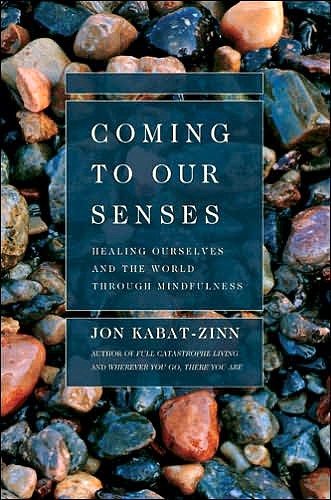
Coming To Our Senses

I haven't read a book in ages. Which is odd for me as I'm a bookaholic. On the Camino I felt like reading hardly anything at all, except my guide book - though, as you know, I was inspired to do a bit of writing. Being bombarded with Spanish all the time could be wearisome - especially since I have no confident grasp of the language. So, for a time, I turned away from the written word, and looked for hidden, unwritten words in outer and inner landscapes, words skulking behind situations and moods, words haunting broken conversations. And often I sank for days into the mire, or the nirvana, of the word-less, which was sometimes scary, and sometimes liberating and peaceful.

But I knew that I would always come back to words, for I love them, and I try to make sense of the world through them. (Though I'm aware, like all instruments of interpretation and perception, words are only a partial way of embracing 'What Is'.) The wonder of words and language is one of our greatest wonders. Words and language make us human.

Needing to engage again with a good, fat book, I picked up Jon Kabat-Zinn's Coming To Our Senses, and I'm very glad I did. There's a saying about the Camino that it doesn't always give you what you want, but it does gives you what you need. Well, I wasn't really sure I wanted to read this book - dammit, it's 600 pages of dense text! - but, sure as hell, I probably do need it right now.

At one time I used to sell a lot of 'Mind, Body and Spirit' titles, various 'alternative', left-field books, and other assorted esoterica to bookshops in the UK, so I've a general, if superficial, knowledge of the subject. In this area it can be difficult locating the diamonds in the dross, separating the charlatans from the real gurus, telling apart those with true spiritual insight from those with just a secular yen to be on Oprah and earn lots of lovely dollars.

Truth to tell, since I came back to England I haven't felt very well for one reason or another. But I feel this might be the very book to banish those post-Camino blues. It's about mindfulness, meditation, Buddhism, awareness, happiness, healing, lovingkindness, yoga, freedom - and anything and everything that's part of the human soma and psyche. Perhaps in reading it I may at last come to some small understanding of my recent, difficult Camino...