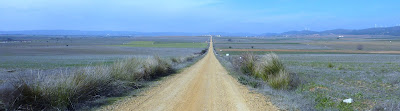
A common man marvels at uncommon things. A wise man marvels at the commonplace. CONFUCIUS
Showing posts with label Rousseau. Show all posts

Monday, 29 September 2014

Day 24: Saint-Loup-Sur-Aujon To Langres

The next day I crossed this motorway . . .

. . . and was glad that my road was a lot quieter. In fact I hardly saw a car for hours. 

I had been on my own for the last few days. Peter and my other companions had gone on ahead during my rest day in Troyes. But I relished the unaccustomed solitude, and realised I had been missing the deeper, reflective, meditative aspects of pilgrimage. I have found you can only really touch this spiritual core when you are alone — a solitary figure moving through a landscape. Enjoyable as companionship is for while, and necessary, it is also valuable to throw yourself back onto complete self-reliance, to test fully your own personal responses and resources. You notice more by yourself, your senses are sharper, and you enter a more receptive, more primeval, more animal-like state.

It was a bright, sunny Sunday morning, and all seemed right with the world. As usual, flowers crowded the roadside verges — thistle, teasel, wild carrot, willowherb — and wayside crosses marked the route. These crosses — constructed of rough, local stone — were much more elegant than previous ones along the path. My feet were not too bad — though the blister was still there — and I delighted in eating nature's free bounty: there were some tart, early blackberries, and I also feasted on sweet, wild mirabelle plums and larger, purple plums from the overhanging branches of orchard trees. The villages were neater in this area, and there were more renovated houses — for instance at St-Ciergues, where I passed some some impressive vegetable gardens.

The Église Notre-Dame de Brévoines just before Langres. This church, which dates from the 12th century, was restored in 2003. It's both simple and beautiful. Just look at those roof beams! It is dedicated to St Renobert, patron saint of domestic animals.

I arrive in Langres in the Haute-Marne department of the Champagne-Ardenne region. Often it's the little details which are more telling than the whole picture.

Langres Cathedral.

The Raising of Lazarus, a polychromatic group in Langres Cathedral.

Langres is built on a limestone promontory, and here's the view north from the town walls — revealing the flattish area of woods, lakes and farmland I'd just walked across. 

Place Diderot in Langres. Diderot (1713-1784), who was born here, and whose bronze statue dominates the square, was a major figure in the French Enlightenment, and a big friend of Jean-Jacques Rousseau, who is one of my own literary and philosophical heroes (the title of this blog was inspired by Rousseau's work in exile, The Reveries of the Solitary Walker). Diderot's monumental opus was his Encyclopédie, ou Dictionnaire Raisonné des Sciences, des Arts et des Métiers (Encyclopaedia, or Systematic Dictionary of the Sciences, Arts and Crafts), published in France between 1751 and 1772.

The prospect from the gîte where I stayed in Langres. Not bad, eh?  Father Touvet, a tall, rather handsome priest with a flashing smile, had rushed out of the cathedral, where he'd been organising an organ concert, to greet me. He'd shown me the simple pilgrim accommodation next to the presbytery where he lived. It was adequate, but very basic, with two mattresses and no fridge, and, what's more, I couldn't get the coffee machine to work (which is a big crisis in Solitary Walker World). However, I did manage to put together a meal from stuff I found in the cupboards — pasta, a can of beans, a tin of tomato paste, a stock cube, two eggs — plus some bread and olives I had in my backpack, and half a bottle of wine a previous pilgrim had left. Later I went to the organ recital in the cathedral. I'm not normally a big fan of the organ, but the sound was just fantastic. Buxterhude, Bach and César Franck reverberated from pillar to pew, from font to flying buttress, from choir to clerestory; at one point I felt as if the cathedral were a huge, medieval spaceship about to take off (probably the effect of the two-day-old wine).

Monday, 10 January 2011

Walking, Art And Nature (10)


Camino, Spain

I think that I cannot preserve my health and spirits, unless I spend four hours a day at least - and it is commonly more than that - sauntering through the woods and over the hills and fields, absolutely free from all worldly engagements. THOREAU Walking

The political philosopher and educationalist Jean-Jacques Rousseau (1712-1778) believed that human beings were inherently good, and that they were only corrupted by the evils of society. He gradually lived an ever simpler life, becoming closer and closer to nature, studying botany, and enjoying the solitary walks he recounted in his ten, classic meditations Reveries Of The Solitary Walker.

Walking, art and nature - these three things are so bound up in Rousseau, and, since his time, have been inextricably linked.  

Camino, Spain

Walking, art and nature. We think of Thoreau's ecstasies in Walden and in his Journals; the mystical outpourings of Richard Jefferies in The Story Of My Heart; William Wordsworth's 'emotion recollected in tranquillity'; the labourer-poet John Clare's walks among the dispossessed pastures of English agricultural history; Gary Syder's Beat and Buddhist mountain treks; Richard Mabey's gentle, literary eco-strolls through the Chilterns and Norfolk; Robert Macfarlane's explorations on foot of Britain's wild places; John Constable walking and painting in Dedham Vale; JMW Turner walking and painting in Europe.    

Camino, Spain

As well as walking in nature being an inspiration for art and literature, walking itself can be an art form in its own right. Richard Long, whom I've written about before, gives walking a totemic resonance through natural artworks created on the walk, or even through the signature of the actual walk itself: its mark, footprint and track across the landscape.
 
Camino, Spain

Sadly (for me at least!) I've reached the end of my ten-part journey through walking country. I hope some of it has been inspirational, or at least informative. Most of all I hope that's it's motivated you to go walking, or, if you're walkers already (which I know many of you are), to go walking even more. It's a land without class, without prejudice, without materialism, without competition, without complication, without compromise, without celebrity culture, without bonds. Rousseau famously wrote at the beginning of The Social Contract: Man is born free, but everywhere he is in chains. Why don't you throw off those chains, and start walking?

Caparra, Via de la Plata, Spain

Here's the Roman arch at Caparra in the Spanish region of Extremadura. I walked under it nearly a year ago on my pilgrimage along the Via de la Plata. Why don't you join me as I step beneath it again, right now? Let's walk together towards those distant hills, that blue horizon. You never know what we might find... 

Caparra, Via de la Plata, Spain

Saturday, 8 January 2011

Walking As A Cultural And Aesthetic Act (8)

Camino, Spain

Nowadays we take it for granted that walking is a laudable pastime and recreational activity. We tend to give a positive nod to the walkers we see: they are taking exercise, they are getting out in the fresh air, they are enjoying being part of nature. All Good Things. It was not always thus.

Up until the late eighteenth century no one walked unless they could help it, unless they were poor and could not afford horse, carriage or coach. And, for the ubiquitous poor, walking was not always a pleasurable pursuit. It was a means to an end, not an end in itself - the practical, indeed the only way to drive cattle and pigs to market, to reach crops grown on feudal agricultural strips, to visit friends and family. Beyond the village, routes were uncertain, if not dangerous. Highwaymen and footpads roamed the highways and byways, and folk in other settlements could be suspicious of, or downright hostile to, strangers. Even as late as 1782 the German minister Carl Moritz, walking across England, found himself abused by innkeepers, and ejected from hostelries where he wished to spend the night. His crime? He was on foot! He wrote: A traveller on foot in this country seems to be considered as a sort of wild man, or an out-of-the-way being, who is stared at, pitied, suspected, and shunned by everybody that meets him.

But, by the early nineteenth century, all of this had changed. Influenced by the philosopher Jean-Jacques Rousseau, who originated the idea of the 'noble savage' living free and uncorrupted in the wild, poets and writers like William Wordsworth and Henry David Thoreau wholeheartedly embraced the cultural, aesthetic and moral value of nature. And, to get close to nature, you had to walk through it. Thoreau's two-year sojourn in a hut by Walden Pond in Concord, Massachusetts, is well known. He wrote: When we walk, we naturally go to the fields and the woods: what would become of us, if we walked only in a garden or a mall?

And Wordsworth - often accompanied by his sister, Dorothy, or fellow Romantics like Coleridge or De Quincey - must have walked tens of thousands of miles during his lifetime. He would regularly cover fifteen or twenty miles a day, and, even when at home in his Lakeland cottage, would stride endlessly up and down the garden in a creative reverie. Walking in nature gave him solace and inspiration, and he would commonly compose his poems while walking, rather than at his desk. To return to Thoreau, Thoreau also wrote: When a traveler asked Wordsworth's servant to show him her master's study, she answered, 'Here is his library, but his study is out of doors.' Wordsworth's masterpiece of a poem, The Prelude, is really just a long walk in words. 

Throughout the nineteenth century, this walking lark really caught on. Tourism was invented - helped by the boom of the railways - and people travelled further, and walked further, to admire and be awestruck at picturesque views, raging cataracts and terrifying mountain scenery. Hikers and climbers started to explore the European Alps and other mountain chains. Souvenirs were manufactured, and cameras began to record it all. The activity of walking also began to appear in the literature of the day. If you read Jane Austen's Pride and Prejudice or Thomas Hardy's Tess of the d'Urbervilles, you'll find they are full of people walking.

Tuesday, 28 December 2010

Walking As Escape And Exercise (1)

Camino, Spain

I have two doctors, my left leg and my right. GEORGE TREVELYAN

I've never been one for sitting around too long. I like to be up and about. As someone once said: We sit at breakfast, we sit on the train on the way to work, we sit at work, we sit at lunch, we sit all afternoon, a hodgepodge of sagging livers, sinking gall bladders, drooping stomachs, compressed intestines, and squashed pelvic organs. And as someone else said: If it weren't for the fact that the TV set and the refrigerator are so far apart, some of us wouldn't get any exercise at all.

Of course I'm sedentary much of the time like many of us. I sit at the computer, I sit at the dining table, I sit and read a book, I sit and watch TV. It's just that I can't sit down for long without getting terrible itchy feet. In fact I don't think we're meant to live overly sedentary lives. I know for a lot of us this is unavoidable at our place of work. That's why it's so important to try and balance things out by using our own two feet as much as we can during our leisure time.

The one thing I can't endure now is sitting for hours and hours in the car. This dates from a time when I used to drive 40,000 miles a year criss-crossing England as a freelance publishers' agent. I just couldn't go back to driving hundreds of miles each day. I have a phobia about it. (Sometimes, when I had a few free hours, I would turn off the motorway and take a walk in the countryside - carrying an umbrella, and dressed in a suit and smart shoes! I must have looked a trifle odd to other walkers passing by in cagoules, waterproof trousers and leather boots. But for me it was a necessary escape valve.)

The other sedentary activity I find difficult is sitting at dinner parties and social gatherings, or in circles of acquaintances or colleagues, and having to make polite conversation for hours on end. I'm not anti-social - but I'm not particularly effusively sociable either. When the boredom sets in and the gossip becomes too much to bear, my feet start tapping and my gaze turns to the world outside beckoning from beyond the window. How I would so love to be running in freedom out there! 

Jean-Jacques Rousseau would have identified with this. In a passage from the Eighth Walk in The Reveries Of The Solitary Walker Rousseau reminds us that, in order to appreciate a walk in nature with all its charms, you must leave behind the disturbance of the vain ideas of the drawing room, the fumes of self-love and the tumult of the world, and social passions and their sad retinue:

I remember perfectly that during my brief moment of prosperity these same solitary walks which are so delightful for me today were insipid and boring. When I was at someone's house in the country, the need to get some exercise and to breathe fresh air often made me go out alone; and sneaking away like a thief, I would go walk about the park or the countryside. But far from finding the happy calm I savor there today, I took along the disturbance of the vain ideas which had preoccupied me in the drawing room. Memory of the company I had left followed me into solitude. The fumes of self-love and the tumult of the world made the freshness of the groves seem dull and troubled the peace of the retreat. I fled deep into the woods in vain; an importunate crowd followed me everywhere and veiled all of nature to me. It is only after having detached myself from social passions and their sad retinue that I have again found nature with all its charms.

As well as being an escape from stress, boredom and social passions and their sad retinue, walking is also excellent for our health and well-being. It reduces the risk of high blood pressure, high cholesterol levels, coronary heart disease, type 2 diabetes and cancer. It keeps joints fluid, and bones and muscles strong. It's also a strong antidote to depression and other mental health problems. And it's actually pleasurable too! These are wonderful benefits from such an easy, innocuous, free and democratic activity. 

Walking is the best possible exercise. THOMAS JEFFERSON

It is remarkable how one's wits are sharpened by physical exercise. PLINY THE YOUNGER

A vigorous five mile walk will do more good for an unhappy but otherwise healthy adult than all the medicine and psychology in the world. PAUL DUDLEY WHITE

Sunday, 11 July 2010

Credo

The title of my blog comes from Jean-Jacques Rousseau's book The Reveries Of The Solitary Walker, a collection of 10 walking soliloquies. It's described in the blurb of my own copy as follows:

First published posthumously in 1782 from an unfinished manuscript, The Reveries of the Solitary Walker continues Rousseau's exploration of the soul in the form of a final meditation on self-understanding and isolation.

In his book Walkers Miles Jebb quotes this passage from Rousseau:

In thinking over the details of my life which are lost to my memory, what I most regret is that I did not keep diaries of my travels. Never did I think so much, exist so vividly, and experience so much, never have I been so much myself - if I may use that expression - as in the journeys I have taken alone and on foot. There is something about walking which stimulates and enlivens my thoughts. When I stay in one place I can hardly think at all; my body has to be on the move to set my mind going. The sight of the countryside, the succession of pleasant views, the open air, a sound appetite, and the good health I gain from walking, the easy atmosphere of an inn, the absence of everything that makes me feel my dependence, of everything that recalls me to my situation - all these serve to free my spirit, to lend a greater boldness to my thinking, to throw me, so to speak, into the vastness of things, so that I can combine them, select them and make them mine as I will, without fear or restraint.

Thus in one short paragraph this blog's credo is encapsulated. (Two other posts explaining the origin of my blog's title are here and here.)

Sunday, 17 May 2009

A Heart That Watches And Receives

Here's an alternative slant on education. (Wordsworth had been strongly influenced by the nature philosophy of Jean-Jacques Rousseau, and had definitely read Rousseau's Émile; or on Education, which was published in 1762. Early in the New Year I posted a 3-part sequence about Rousseau, which starts here.)

The Tables Turned
An Evening Scene on the Same Subject

Up! up! my Friend, and clear your looks;
Why all this toil and trouble?
Up! up! my Friend, and quit your books;
Or surely you'll grow double.

The sun above the mountain's head,
A freshening lustre mellow,
Through all the long green fields has spread,
His first sweet evening yellow.

Books! 'tis a dull and endless strife;
Come, hear the woodland linnet,
How sweet his music! on my life,
There's more of wisdom in it.

And hark! how blithe the throstle sings!
He, too, is no mean preacher;
Come forth into the light of things,
Let Nature be your Teacher.

She has a world of ready wealth,
Our minds and hearts to bless -
Spontaneous wisdom breathed by health,
Truth breathed by cheerfulness.

One impulse from a vernal wood
May teach you more of man,
Of moral evil and of good,
Than all the sages can.

Sweet is the lore which Nature brings;
Our meddling intellect
Mis-shapes the beauteous form of things -
We murder to dissect.

Enough of Science and of Art;
Close up those barren leaves;
Come forth, and bring with you a heart
That watches and receives.


WILLIAM WORDSWORTH

Sunday, 4 January 2009

A Rapturous Calm

In this final extract from The Reveries Of The Solitary Walker Rousseau has improbably been knocked to the ground by a Great Dane dog in his Second Walk, hitting his head forcibly against the pavement. He describes his semi-concussed state like this:

Night was coming on. I perceived the sky, some stars, and a little greenery. This first sensation was a delicious moment. I still had no feeling of myself except as being "over there". I was born into life at that instant, and it seemed to me that I filled all the objects I perceived with my frail existence. Entirely absorbed in the present moment, I remembered nothing; I had no distinct notion of my person nor the least idea of what had just happened to me; I knew neither who I was nor where I was; I felt neither injury, fear, nor worry. I watched my blood flow as I would have watched a brook flow, without even suspecting that this blood belonged to me in any way. I felt a rapturous calm in my whole being; and each time I remember it, I find nothing comparable to it in all the activity of known pleasures.

I find this reaction fascinating. It contains echoes of mystical writing and accounts of "out of body" and "near death" experiences. It brings to mind Colin Wilson's 1st book The Outsider (1956), and later books of his, in which he documents those peak, epiphanic moments we all experience from time to time in our lives. It recalls Aldous Huxley's experiments with mescaline in The Doors Of Perception (1954) and his exploration of the mystical writers in The Perennial Philosophy (1945).
I've written before about this sublime but usually tantalisingly-just-out-of-reach state in my posts Mad, Mystic Moments and Dharmakaya Light.

Illness and injury can definitely under certain circumstances bring about something akin to a state of ecstasy. I experienced this first hand a few years ago when recovering from a particularly virulent virus I caught on a plane flying back from Venice. There was a turning-point day when the virus receded - and I felt an overwhelming, cathartic feeling of immense calm and tranquillity.

Saturday, 3 January 2009

Social Passions

In this passage from the Eighth Walk in The Reveries Of The Solitary Walker Rousseau reminds us that, in order to appreciate a walk in nature with all its charms, you must leave behind the disturbance of the vain ideas of the drawing room, the fumes of self-love and the tumult of the world, and social passions and their sad retinue:
I remember perfectly that during my brief moment of prosperity these same solitary walks which are so delightful for me today were insipid and boring. When I was at someone's house in the country, the need to get some exercise and to breathe fresh air often made me go out alone; and sneaking away like a thief, I would go walk about the park or the countryside. But far from finding the happy calm I savor there today, I took along the disturbance of the vain ideas which had preoccupied me in the drawing room. Memory of the company I had left followed me into solitude. The fumes of self-love and the tumult of the world made the freshness of the groves seem dull and troubled the peace of the retreat. I fled deep into the woods in vain; an importunate crowd followed me everywhere and veiled all of nature to me. It is only after having detached myself from social passions and their sad retinue that I have again found nature with all its charms.
What a lot of truth there is in this! I'm sure we all recognise that feeling of sometimes not being able to shake off the vain cares and idle demands of society when we go for a walk. In society we often find ourselves "performing" and adhering to a rôle, doing what's expected of us. On a solitary walk however we suddenly realise that it's just ourselves and nature. We can go this way or that way in complete freedom. We don't have to impress the rivers, the rocks and the trees. They don't judge us or want anything from us. They are just there. They are simply and magnificently themselves.

Friday, 2 January 2009

Reverie And Reflection

I thought I'd start the New Year with an explanation of my blog's title, The Solitary Walker. I've done this before at the time I began blogging - but I've more readers now, and some of you may have missed it.

The Reveries Of The Solitary Walker was the last, posthumously published work by the great French political philospher Jean-Jacques Rousseau (1712-1778). I suppose Rousseau's most celebrated work is The Social Contract, which contains the famous quotation: Man is born free, but everywhere he is in chains.

With his highly personal Confessions and Reveries, Rousseau is regarded as the founder of modern autobiography. Rousseau himself considered Émile, his book about education, his best book. But after its publication in 1762 the Parliament of Paris issued a warrant for his arrest due to its revolutionary nature. He escaped from France into Switzerland in the nick of time. And it was during this period of exile in Switzerland that he wrote The Reveries Of The Solitary Walker.

The book contains 10 meditative "walks". This short paragraph comes from his Seventh Walk: I have sometimes thought rather deeply, but rarely with pleasure; almost always against my liking, and as though by force. Reverie relaxes and amuses me; reflection tires and saddens me; thinking always was a painful and charmless occupation for me. Sometimes my reveries end in meditation, but more often my meditations end in reverie; and during these wanderings, my soul rambles and glides through the universe on the wings of imagination, in ecstasies which surpass every other enjoyment.

This from one of the greatest philosophers of the European Enlightenment!

(There is one other work entitled The Reveries Of The Solitary Walker - and that is a painting by the surrealist painter René Magritte. I've written briefly about that painting here.)

Tuesday, 28 August 2007

René Magritte

I've just discovered that, apart from Rousseau's Reveries Of The Solitary Walker (which inspired the name of this blog), there's also a picture by the surrealist painter René Magritte (1898-1967) with the same title. Les Reveries Du Promeneur Solitaire (1926) depicts a ghostly white body floating behind a bowler-hatted man who stands beside a river. It's clearly influenced by the nighttime suicide of his mother - she drowned herself in the Belgian Sambre River when Magritte was 14. It's likely that paintings such as this helped him exert some control over the trauma of his unfortunate experience.

Saturday, 14 July 2007

Bastille Day

Today, 14 July, is Bastille Day. The Storming of the Bastille has become known as the symbolic event which heralded The French Revolution (1789-1799). Without Rousseau and his towering work, The Social Contract, claimed Napoleon, the Revolution would not have happened. Liberty, Equality, Fraternity! William Wordsworth was captivated: Bliss was it in that dawn to be alive/But to be young was very heaven! But he soon cooled off when entered on stage Robespierre, The Reign of Terror and The Guillotine. Of course, it's easy to be wise after the event. But we never seem to learn the lessons of history. After Marx then Lenin. After Lenin then Stalin... Saint-Just said: "Nobody can rule without guilt". Take note, Nicolas Sarkozy! Gordon Brown, beware!

Thursday, 12 July 2007

Jean-Jacques Rousseau

I ought to elucidate the title of my blog. Of course it echoes The Reveries Of The Solitary Walker, the last great work of Jean-Jacques Rousseau (1712-1778) which was published in 1782 after his death. It contains 10 "walks" which are really meditations on "Life, The Universe and Everything" Though self-absorbed and at times pessimistic, Rousseau had good reason to be so - exiled by the French Church and State, isolated by society, he fled to Switzerland where he found comfort in solitude and the natural world. History has proved him to be one of the very greatest thinkers and philosophers of the Enlightenment. Here's the first paragraph from his Ninth Walk: Happiness is a permanent condition which does not seem to be made for man here-below. Everything on earth is in constant flux, which permits nothing to take on constant form. Everthing around us changes. We ourselves change, and no one can be assured he will like tomorrow what he likes today. Thus, all our plans for felicity in life are idle fancies. Let us take advantage of mental contentment when it comes; let us keep from driving it away by our own fault. But let us not make any plans to chain it up, for those plans are pure follies. I have seldom seen happy men, perhaps not at all. But I have often seen contented hearts; and of all the objects which have struck me, that is the one which has made me most content. I believe this is a natural consequence of the power my sensations have over my internal feelings. Happiness has no exterior sign; to recognize it, it would be to see into the heart of the happy man. But contentment is read in the eyes, in the bearing, in the lilt of the voice, in the manner of walking, and seems to be transmitted to the one who perceives it. Is there a sweeter enjoyment than to see a whole people give itself up to joy on a holiday and every heart expand in the broad rays of pleasure which pass rapidly, but intensely, through the clouds of life? I think that Rousseau's "contentment" can be seen much of the time in the faces and attitudes of many of the remote walkers one meets and passes...