A common man marvels at uncommon things. A wise man marvels at the commonplace. CONFUCIUS
Showing posts with label Zen. Show all posts

Saturday, 4 June 2016

The Greatness Of Little Things


Those who cannot find the littleness of great things in themselves are apt to overlook the greatness of the little things in others. KAKUZO OKAKURA The Book of Tea

Kakuzo Okakura's elegantly written Book of Tea has been a delightful discovery: it's short, beautifully formed and full of Taoist wisdom. For me it at once became one of those texts we like to think of as 'minor classics'. The mundane yet strangely spiritual act of drinking a bowl of tea is hardly mentioned — indeed, what can one say about such an everyday occurrence? But the history and ritual of the tea ceremony itself, the seer-like qualities of the tea-masters, the uncluttered aesthetic of the tearooms with their sparse and original arrangements of art and flowers, the underlying and unifying principles of Tao and Zen — all these are succinctly and beautifully described.

Okakura echoes Chinese historians in speaking of Taoism as the art of being in the world. He writes: The art of life lies in a constant readjustment to our surroundings. Taoism accepts the mundane as it is and, unlike the Confucians and the Buddhists, tries to find beauty in a world of woe and worry.

He reminds us that the Tao literally means a Path. It has been severally translated as the Way, the Absolute, the Law, Nature, Supreme Reason, the Mode . . . However, the Tao is in the Passage rather than the Path. It is the spirit of Cosmic Change — the eternal growth which returns upon itself to produce new forms. It recoils upon itself like the dragon, the beloved symbol of the Taoists. It folds and unfolds like clouds. What is vital and interesting is the completing not the completion, the imperfect rather than the perfect, the process not the deed.

Zen follows on from and is hugely influenced by Taoist ideas — one idea being the essential importance of the vacuum, of empty space, of the possibility of limitlessness. Japanese art bears out this concept: the suggestive, half-finished nature of many Japanese pen-and-ink drawings invites us to fill in the emptiness with our own emotions and imaginings, to complete mentally the incomplete. And, pursuing the idea of the benefit and necessity of change, Okakura writes that the virility of life and art lay in its possibilities for growth.

For the Taoist the three jewels of life were Pity, Economy and Modesty, which appeals to me immensely. I also like the humility of this: Temper your own brightness to merge into the obscurity of others, though it's very much at odds with the prevailing me-me-me-ness and self-promotion of today's society.

Finally, like Rilke, Okakura recognises the intimate and ever-present connection between dream and reality, between death-in-life and life-in-death: At birth you enter the realm of dreams only to awaken to reality at death. 

Thursday, 12 February 2015

A Different World

Have you considered the possibility
that everything you believe is wrong,
not merely off a bit, but totally wrong,
nothing like things as they really are?
If you’ve done this, you know how durably fragile
those phantoms we hold in our heads are,
those wisps of thought that people die and kill for,
betray lovers for, give up lifelong friendships for.
If you’ve not done this, you probably don’t understand this poem,
or think it’s not even a poem, but a bit of opaque nonsense,
occupying too much of your day’s time,
so you probably should stop reading it here, now.
But if you’ve arrived at this line,
maybe, just maybe, you’re open to that possibility,
the possibility of being absolutely completely wrong,
about everything that matters.
How different the world seems then:
everyone who was your enemy is your friend,
everything you hated, you now love,
and everything you love slips through your fingers like sand.

FEDERICO MORAMARCO

(Thanks to Andy at Pilgrimpace for introducing me to this poem.)

The creation of the universe (Wikimedia Commons)
When you think about it, all things — the universe, the world, all inanimate things, all animate things, ourselves, protozoa, electrons — are governed by the law of cause and effect. It's the way it is. In fact, without this expectation we would feel completely disoriented in a surreal, irrational universe, and would probably go mad. The Big Bang was perhaps the very first cause (though what caused that?) — bringing about every effect there has ever been. Each animal and plant, each rock and stone, each configuration of weather and landscape, each slice of history, geography and geology, each thought, deed and action that exists depends on a network of influence and being influenced, of cause and effect, of cooperation and exploitation, of cost and benefit. Look at the food chain, the carbon cycle, the nitrogen cycle, the movement of the stars, the planets and the seasons. Look at the effects of heredity and environment on human beings, on all living creatures. Look at the now-incontravertible Darwinian theory of natural selection (which led, however, to the sinister phrase 'survival of the fittest'). Look how we constantly use conjunctions such as 'if . . . then', 'because', 'so that', 'since', 'consequently' and 'therefore'. Look at everything.

The reasons for things and the results of things can be simple or complicated: 'A' followed by 'B' prompts 'C'; we predict the sun will rise each morning because of the earth's self-rotation and orbit round the sun; we throw stones into a pond and watch the ripples; the flap of a butterfly's wings in Brazil may set off a tornado in Texas. All our motions — even the most routine duty or automatic gesture — have causes, many of which are hard to trace unless we involve ourselves in continual self-analysis. All our stirrings — even the tiniest movement or most insignificant thought — have consequences, many of which we will never be aware of.

Despite post-Einsteinian and modern speculative physics, most of us believe that life is a temporal progression, a linear track through space forged by cause and effect, action and result. But supposing it isn't always like that? Supposing there's a different way of seeing things? Supposing everything you believe is wrong, / not merely off a bit, but totally wrong, / nothing like things as they really are?

Cambodian buddha (Wikimedia Commons)
It may seem impossible to challenge, to sidestep even for a moment this eternal line of relentlessly falling dominoes. But I believe it can be done if we use certain Zen tricks and techniques, mind sets and meditative practices. In the Four Noble Truths Buddhism shows us the indisputably hard reality of life, i.e. that life is suffering, and that suffering is caused by greed and desire, ignorance and delusion, hatred and the impulse to destroy — and by our attachment to the mental, physical and sensory world replete with all these negativities. In the final two Truths we are taught how to disentangle ourselves, to liberate ourselves from suffering and the causes of suffering by following the Eightfold Path, or Middle Way, as a route to enlightenment or nirvana (no mystical state somewhere 'out there', but a state attainable in the 'here and now', suffused with deep peace, joy and compassion). The Eightfold Path consists of eight 'steps': Right Understanding, Right Intention, Right Speech, Right Action, Right Livelihood, Right Effort, Right Mindfulness, Right Concentration — stages which all cultivate independent thought, a positive attitude, empathy, deep awareness and a kind of 'moral' rectitude.

My point here is that it is in our power to change the cycle of desire (cause) - suffering (effect) -  further desire (an abortive attempt to escape suffering) - further suffering if we break the connection between desire and suffering by eliminating desire. In other words, rather than accepting the inevitability of long-established chains of cause and effect, we can disrupt them — break the links. In this and similar acts we assert individual choice and freedom, free will if you like: things don't have to be this way! (I suppose you could argue philosophically that by asserting this free will you are still using the cause and effect principle, i.e. your free will causes your new state of being, but can you go along with me and just call this semantics? I think you understand the gist of what I'm trying to argue.)

Friday, 30 January 2015

The Apprehension Of The Infinite In Every Moment

Someone once said that God offers man the choice between repose and truth: he can not have both. PETER MATTHIESSEN The Snow Leopard

Image from Wikimedia Commons.
I devoured quite a few Buddhist-flavoured classics in the 1970s — Hesse's Siddhartha, Kerouac's The Dharma Bums, Pirsig's Zen and the Art of Motorcycle Maintenance, The Way of Zen by Alan Watts — but somehow I'd neglected Peter Matthiessen's The Snow Leopard. Having now just finished it, I realise what a treasure I missed: Zen and trekking in one book — just my kind of thing. I agree with John Hillaby who writes on the front cover of my Vintage edition that it's a masterpiece; and also with Jim Harrison's summary on the back cover: A magical book: a kind of lunar paradigm and map of the sacred . . . The book has transcended the usual limits of language. Just so.

The book, taking the form of diary entries from 28 September to 1 December 1973, relates Matthiessen's trip, in the company of biologist George Schaller, to the Dolpo region of Nepal, in search of the Himalayan blue sheep and the secretive snow leopard. They find the sheep, but the snow leopard eludes them (Schaller does have one brief sighting when Matthiessen's not there). Yet it doesn't matter. As Mathiessen's Zen teacher sagely advised him before setting out: expect nothing. And we, as readers, must do the same, for then we will be greatly rewarded. This is no tale of conquering the wilderness and accomplishing arduous feats of mountaineering — though there is austerity and hardship in abundance. This is a story of a man's search for himself and his place within wild nature, a search for immanence in the here and now.

Matthiessen writes gloriously. How easy it would have been to fall into pretentiousness and cliché when describing, say, a sitting meditation on a mountainside; but he manages to blend the mystical and the mundane in such a way that both absorb each other, become one whole. The ineffable is not 'out there' in some transcendent realm — it is right here, among the roguish yet innocent sherpas, the ferocious mastiffs straining at their chains, the filthy-poor Nepali villagers, the meagre buckwheat chapatis, the yak dung. And also, equally, among the Buddhist shrines and relics, the stupas, the prayer flags and prayer walls, the hovels and the monasteries, the high blinding snowfields, the narrow mountain ledges, the stunning Himalayan panoramas. Matthiessen recounts everything no matter how exalted or how lowly, experiences it all as part of the eternal cycle of life, death and rebirth — as natural and meaningful (and meaningless) as the endless rotation of a prayer wheel.

I love Matthiessen's mix of Buddhism, nature writing and walking adventure, and I leave you with an extract from this enlightening, earthy-yet-spiritual book:

I lower my gaze from the snow peaks to the glistening thorns, the snow patches, the lichens. Though I am blind to it, the Truth is near, in the reality of what I sit on — rocks. These hard rocks instruct my bones in what my brain could never grasp in the Heart Sutra, that 'form is emptiness, and emptiness is form' — the Void, the emptiness of blue-black space, contained in everything. Sometimes when I meditate, the big rocks dance.

The secret of the mountains is that the mountains simply exist, as I do myself: the mountains exist simply, which I do not. The mountains have no 'meaning', they are meaning; the mountains are. The sun is round. I ring with life, and the mountains ring, and when I can hear it, there is a ringing that we can share. I understand all this, not in my mind but in my heart, knowing how meaningless it is to try to capture what cannot be expressed, knowing that mere words will remain when I read it all again, another day.

Look how Matthiessen, beautifully and, I think, poetically, and successfully, uses his 'mere words' in order to express the inexpressible! Examples like this abound throughout the book.

The Universe itself is the scripture of Zen, for which religion is no more and no less the apprehension of the infinite in every moment. How wondrous, how mysterious! / I carry fuel, I draw water. PETER MATTHIESSEN The Snow Leopard

Regard as one, this life, the next life, and the life between. JETSUN MILAREPA    

Friday, 5 December 2014

Satori

As regular readers of this blog will know, I'm very interested in Buddhism — Zen Buddhism in particular. This is not the place to go into the fascinating and complex history of Buddhism in India, China and Japan; nor is it the place to explain how DT Suzuki brought his interpretation of Zen to a spiritually-bereft Western world. Suffice to say that, simply put, there are two modes of Zen thought and practice — not mutually exclusive, but interwoven and complementary: one involves study, contemplation, meditation and discipline; the other is the spontaneous, immediate, less intellectual, more intuitive experience of koan and satori. Reflecting back on my recent Camino along the Via Francigena, it occurs to me that my illuminative moments on the banks of the Rhône were an unexpected, unpremeditated satori. Here's my account of it:

It was near to here, on a flower-strewn bank overlooking the river, that I had my picnic lunch: a superb garlic sausage, doux Fontal cheese and pain complet from the Migros supermarket in Aigle, plus a small 20 cl bottle of Aigle les Murailles white wine bought in the castle shop. It was an idyllic place, and, after the meal, I experienced one of those sublime, mystical moments I treasure so much. You never forget such rare, spontaneous events, and they cannot be manufactured or predicted. Suddenly I had a strong conviction that everything was coming together in an almost magical way: my mind, body and soul felt at one with the life I was leading out there on the road — and at one with the universe itself. My practical skills for what they were worth — knife or route-finding or backpacking skills for instance — seemed to merge effortlessly with any emotional and spiritual intelligence I might have; it was an overwhelming, deeply satisfying sense of harmony, control and insight. I have explained it as best I can, but really the experience was beyond words. This intense state lasted for perhaps five minutes, then, when I had packed up and left, the feeling was still there, but more diluted. Here I was, living cheaply and well, each day in the open air and in the heart of nature, like some vagabond or holy tramp, in good health, in good spirits, and as free as a bird . . . Indeed, I was truly fortunate.

Thursday, 3 July 2014

What I See When I Blog


Twelve Zen guidelines pinned above my computer — next to a photo of my sister, Elizabeth (who died of a brain tumour in her late twenties), holding my daughter, Anna.

Tuesday, 13 May 2014

The Pilgrim's Way (10): Tao And The Journey Within

Zen pond.

How many times now
have I crossed over hill crests

with the image

of blossoms leading me on —

toward nothing but white clouds?

FUJIWARA NO SHUNZEI 

Perhaps the truth depends on a walk around the lake.

WALLACE STEVENS

Perhaps the truth depends on a walk around the pond.

THE SOLITARY WALKER

Perhaps the truth depends.

THE SOLITARY WALKER

Perhaps the truth does not depend.

THE SOLITARY WALKER

The longest journey a man must take is the eighteen inches from his head to his heart.

ANON

The longest journey is the journey inward.

DAG HAMMARSKJOLD

We carry within us the wonders we seek without us.

SIR THOMAS BROWNE

But in the end, the journey is all within, isn't it? Perhaps that is why the emotions elude us when we most think they should be present. So much of why we travel is actually to learn about ourselves . . .


Funny that we tend to bracket events with 'beginnings' and 'endings'. Perhaps this is just another illusion. Perhaps everything is fluid and boundless, insuring that our tiny brains will never understand the mysterious concoction of energy that we call 'life'.

GEORGE from Transit Notes

We don't receive wisdom; we must discover it for ourselves after a journey that no one can take for us or spare us.

PROUST

The real voyage of discovery consists not in seeing new landscapes, but in having new eyes. 

PROUST 

Banish learning, discard knowledge: people will gain a hundredfold.

LAO-TZU

Knowing others is intelligent. Knowing yourself is enlightened.

LAO-TZU

We are such stuff / As dreams are made on, and our little life / Is rounded with a sleep. 

PROSPERO

Ain't talkin', just walkin'.

BOB DYLAN

The rest is silence.

HAMLET

The bright road seems dark,
The road forward seems to retreat,
The level road seems rough.

Great TE seems hollow.
Great purity seems sullied.
Pervasive TE seems deficient.
Established TE seems furtive.
Simple truths seem to change.

The great square has no corners.
The great vessel is finished late.
The great sound is scarcely voiced.
The great image has no form.

TAO hides, no name.
Tao yin wu ming

Yet TAO alone gets things done.

LAO-TZU

Meditation on the Far and Near / 'What Is Beyond?' Koan

What is beyond thought, beyond reason, beyond unreason, beyond feeling, beyond emotion, beyond words, beyond music, beyond poetry, beyond art, beyond birds, beasts and flowers, beyond river and rock, beyond hill and valley, beyond plain and mountain, beyond travel, beyond exploration, beyond talking, beyond walking, beyond desire and regret, beyond hope and expectation, beyond pain and pleasure, beyond memory, beyond life, beyond death, beyond silence? If love is beyond these things, what is beyond love? Is TAO beyond and before and within all these things?

THE SOLITARY WALKER

This concludes my exploratory 10-part series 'The Pilgrim's Way'; I hope you enjoyed the journey.

Sunday, 18 December 2011

Banzan In The Butcher's Shop

Do you know the story of Banzan? Before he became a great Zen master, he spent many years in pursuit of enlightenment, but it eluded him. Then, one day, as he was walking in the marketplace, he overheard a conversation between a butcher and his customer. 'Give me the best piece of meat you have,' said the customer. And the butcher replied, 'Every piece of meat I have is the best. There is no piece of meat here that is not the best.' Upon hearing this, Banzan became enlightened. 

I can see you are waiting for some explanation. When you accept what is, every piece of meat — every moment — is the best. That is enlightenment.

ECKHART TOLLE The Power Of Now

I love this story. What I like most about it is the setting: an ordinary, humble butcher's shop. It's not about enlightenment dawning after many months of rigorous meditation under a banyan tree, or after years of wandering and soul searching in the mountains and deserts, or as a result of disciplined study and ascetic practice under a yogi or other spiritual teacher. No, it's about enlightenment dawning suddenly, and when least expected, in a prosaic, everyday setting. To me this has the ring of authenticity. Perhaps we are mistaken in walking so endlessly and so earnestly the caminos of this world in pursuit of spiritual illumination, when we are more likely to find it — if we remain aware, open and receptive — in the moment NOW, in our own ordinary home, in our wilderness back garden, in the local streets and shops of our town or village.

So, when you're at the butcher's this week picking up your Christmas turkey, sausage meat, gammon joint and pork pies, be sure to eavesdrop on the conversations going on around you. You never know, it might be the start of a whole new life.

Thursday, 15 December 2011

Cats And Ducks Are Our Teachers

It's about realising that there are no problems. Only situations.

So do not be concerned with the fruit of your action - just give attention to the action itself. The fruit will come of its own accord.

Your outer journey may contain a million steps; your inner journey only has one: the step you are taking right now. As you become more deeply aware of this one step, you realize that it already contains within itself all the other steps as well as the destination.

True love has no opposite. If your love has an 'opposite', then it is not love but a strong ego-need for a more complete and deeper sense of self, a need that the other person temporarily meets. It is the ego's substitute for salvation, and for a short time it almost does feel like salvation.

A Buddhist monk once told me: 'All I have learned in the twenty years that I have been a monk I can sum up in one sentence: All that arises passes away. This I know.' What he meant, of course, was this: I have learned to offer no resistance to what is; I have learned to allow the present moment to be and to accept the impermanent nature of all things and conditions. Thus have I found peace.

I have lived with several Zen masters - all of them cats. Even ducks have taught me important spiritual lessons. Just watching them is a meditation.

ECKHART TOLLE The Power Of Now

Friday, 7 January 2011

The Zen Of Walking (7)


Camino, Spain

Emptiness is the track on which the centred person moves. TSONG KHAPA

The self may not be something, but neither is it nothing. STEPHEN BATCHELOR Buddhism Without Beliefs

Now forget the schema of yesterday's post, forget the framework and the grand design, forget the concept of the path as riddle, metaphor, labyrinth, truth. Forget the arguments, the reasoning, the justifications, the mental constructs of personality, belief, philosophy. Forget it all. For these are mind-illusions, every one.

It's early morning on the Spanish Camino. There's a smell of fresh coffee wafting from the albergue's kitchen and the sound of pilgrims stirring. There's a CD gently playing - opera, I think, Verdi or Puccini - and the trickle of showers and the murmuration of a dozen different languages being spoken. Bring your body, bring your mind fresh to the table, a tabula rasa, fresh from sleep, cleansed of plaguing negative thoughts and emotions. Accept what is, embrace the here and now: the flies buzzing, the hungover hospitalero, the friendly Dutch girl, the serious German, the shy Norwegian, the voluble Italian, the awful coffee, the cheap biscuits. This is it. This is all there ever is. The here and now.

Forget the journey. And the destination. Forget yourself. (What is yourself, anyway?) Forget all those crippling, uncontrollable thoughts and emotions which arise, unbidden, and flood your mind for most of the time. Actually - don't forget them. But watch them come and go, observe them rise into your consciousness,  then subside. Study them with a certain casualness, detachment, even humour. Are they really so important after all? All those regrets, longings, disappointments, loves and hates, feelings of anger and resentment, ambitions, perceptions of failure, grand designs? They come and they go, like dandelion seed in the wind, like driftwood on the river.

The fact is that our real, our most profound journey of discovery - of the world and of the self - is not a real journey at all, as we normally understand the term, involving movement and direction. It's a journey into immediacy and nearness, into the here and now. To make this journey is not actually so difficult, but we need to realise three things, as Steve Hagen says in his book Buddhism Plain And Simple: First, you must truly realize that life is fleeting. Next you must understand that you are already complete, worthy, whole. Finally, you must see that you are your own refuge, your own sanctuary, your own salvation.

The journey starts and ends in us. We may not yet know it, but we have already arrived at our destination. We are already enlightened, if we could only unblock our vision. Santiago, Rome, Jerusalem, Chimayo, Mecca, Uluru. These are just pegs upon which to hang our walk, our pilgrimage; to give us some intellectual and emotional satisfaction, some idea of achievement, some physical, tangible goal, some credence for our mythical walking stories. The real destination is the here and now. Now, now and now. Always now. Right here. And right now.

Monday, 6 September 2010

A Matter Of Taste

See me, feel me, touch me, heal me. THE WHO Tommy

Unusually for me I feel a little under the weather. I woke up in Plymouth last Thursday, the final day of my south west coast walk, with a sore throat. At home later that evening the boringly familiar symptoms of the common cold made their unwelcome appearance: coughing, sneezing, headache, a general feeling of lassitude and a complete lack of sympathy from anyone else in the house. Nothing unusual there, you might think. What is he complaining about?

Well, actually I'm rarely ill, and the last time I was unwell - the only time since I began blogging over three years ago - was also when I'd just returned from a long hike. (I blogged about it here.) Could there be a connection? Any theories, anyone? Myself, I believe that multi-week trekking can be hard work, and can be stressful, even if we don't fully realise it when we're transported by the strangeness, the beauty and the freedom of it all; and this, plus the sudden, depressing jolt back into routine reality when the trip's over and done, can trigger an adverse reaction. (Then again it's probably simply down to the prosaic germs of a virus - there are always hundreds going around, especially at this time of year.)

However the real point of this post is not to gripe about a minor ailment affecting millions at the moment, or even to crave a smidgen of sympathy from cyber-buddies. No, the motivation behind the piece is to say: let's all be gratefully aware every minute of the day for our five senses of sight, sound, touch, taste and smell - and the sixth 'sense' of our mind, which coordinates them all! Because of my cold I've temporarily lost two of these - the interlinked senses of taste and smell - and I miss them acutely. The savour of food and drink, the scent of a late summer breeze in piney woods, the bitter tang of woodsmoke, the redolence of herbs, the taste of tarragon chicken, lamb with rosemary, garlic-roasted vegetables - all these things are lost to me. Why is it we often seem to need to lose things - our health, our senses - before we can really appreciate what we have and take for granted?

(Awareness going out to all those who have either temporarily or permanently lost the use of either one or more of their senses.)

(Zen exercise: try to imagine what it must be like without first one, then two, then three etc, then finally all your senses.)

(Nowadays we recognise many more senses than the traditional five senses: eg the sense of pain, of balance, of motion and acceleration, of time, of temperature, of direction etc.)

Wednesday, 30 June 2010

Suddenly Summer

Sunday's wildflower walk took in the countryside east of the village. My walk yesterday covered the western side. In fact it was the same walk I did here and here. But what a difference three months make. The countryside had been completely transformed by the green burgeoning of summer. It was like walking through an utterly different landscape. In the middle of May I'd left a cold, drab England for Sicily. Returning to England a few weeks later I'd been ambushed by the loveliness, the luxuriance of a late springtime. There'd been buckets of rain and big dollops of sunshine in my absence, which had spurred the season into sudden, flowering growth. This all-sensory shock remained with me. From nowhere it was suddenly summer.

When I'd walked this way in April I'd practised a Zen exercise by rotating my five senses - sight, sound, smell, touch, taste - and focusing hyper-consciously on each one in turn. This time it struck me that my wildflower experiment was simply a more refined variation on this: I was concentrating on one object of vision only - looking exclusively at the wildflower channel, you might say. And what riches this narrowed, concentrated vison brought! It's extraordinary how much we miss without this kind of conscious, focused gaze. I'd never have guessed I would have found a staggering 75 different species of wildflower before taking Sunday's dedicated stroll.

Yesterday's walk added a further six flowers to the list: wild carrot, common knapweed, common sorel, self-heal, ground-ivy, shepherd's purse. But there weren't as many wildflowers here compared with Sunday - for I was crossing farmed fields and cultivated ground. It demonstrated to me quite clearly how the roadside verges and hedged backcountry lanes to the east were a much safer haven for a wide variety of wildflowers than this monocultured farmland. It wasn't until I reached the untouched grassland around the old gravel-pit lakes that the flowers became more abundant: bird's-foot-trefoil, ox-eye daisy, hogweed, hemlock, tufted vetch, dog rose, creeping thistle, meadow buttercup, poppy, clover, mallow.

By the lakes I stopped, relaxed and looked about, shifting my intense mono-vision to a broader field of view. A goldfinch trilled its liquid, silvery song from the top of a bush. A yellowhammer - a common bird hereabouts - repeated its 'little-bit-of-bread-and-no-cheese' mantra and flew from the hedge, a blaze of yellow amid the green. Iridescent blue damselflies darted among the docks and sorels. And a large emperor dragonfly rested motionless in the grass at my feet, its abdomen electric blue with a dark, central stripe, its thorax apple-green.

Gradually I became aware of more birdlife all around me - a grasshopper warbler whirring out its montone song, sounding for all the world like an angler's ratcheted fishing reel, a pheasant sqawking in the undergrowth, a crow caw-cawing in the distance...

And for that minute a blackbird sang
Close by, and round him, mistier,
Farther and farther, all the birds
Of Oxfordshire and Gloucestershire.

EDWARD THOMAS Adlestrop

Friday, 16 April 2010

Books Which Change Your Life

I like to think of mindfulness simply as the art of conscious living. You don't have to be a Buddhist or a yogi to practice it. In fact, if you know anything about Buddhism, you will know that the most important point is to be yourself and not try to become anything that you are not already. Buddhism is fundamentally about being in touch with your own deepest nature and leting it flow out of you unimpeded. It has to do with waking up and seeing things as they are. In fact, the word 'Buddha' simply means one who has awakened to his or her true nature. JON KABAT-ZINN Wherever You Go, There You Are

That's the last of my quotes from Jon Kabat-Zinn. It's time to move on to other things. My recent readings of his books Coming To Our Senses and Wherever You Go, There You Are came at just the right time in my life and have affected me deeply. It's strange how sometimes exactly the right book is 'gifted' to us at exactly the right moment in our lives - a book which may quickly become a landmark book, influencing us, rescuing us, inspiring us in profound, often life-changing ways.

When I was in my late teens I read The Penguin Krishnamurti Reader and The Second Penguin Krishnamurti Reader and these books fired a life-long interest in Zen Buddhism and were mind-blowing for me at the time. They affected absolutely the way I thought and the way I lived. Other books which have done this to me are Thoreau's Walden, the novels of Hermann Hesse and John Fowles, and (this may surprise you) the novels of Henry Miller. I read all of these writers in my twenties.

I wonder how many of you have totemic books you read at a critical time in your lives - books which altered your mindset? The power of the written word can be truly astonishing.

Only that day dawns to which we are awake. THOREAU

Friday, 2 April 2010

Ring Them Bells Of Mindfulness

Tolling for the searching ones, on their speechless, seeking trail / For the lonesome-hearted lovers with too personal a tale / And for each unharmful, gentle soul misplaced inside a jail / And we gazed upon the chimes of freedom flashing BOB DYLAN Chimes Of Freedom

Ring them bells St Catherine from the top of the room / Ring them from the fortress for the lilies that bloom / Oh the lines are long and the fighting is strong / And they're breaking down the distance between right and wrong BOB DYLAN Ring Them Bells

When you gonna wake up and strengthen the things that remain? BOB DYLAN When You Gonna Wake Up?

The poet John Donne said 'never send to know for whom the bell tolls; it tolls for thee.' The bell Donne is referring to is the funeral bell, the bell that reminds us of our brief sojourn in this world. But there is another bell, the bell of mindfulness, that tolls in each moment, inviting us to come to our senses, reminding us that we can wake up to our lives, now, while we have them to live. The bell of mindfulness tolls for thee as well. It tolls for all of us. It tolls in celebration of life and what might be possible were we to hear it in its fullness, were we to wake up. JON KABAT-ZINN Coming To Our Senses

Thursday, 1 April 2010

No News Of The Affairs Of Men

Ryokan (1758-1831) is a Japanese poet of whom I'm very fond. A Buddhist monk, he trained 12 years with a Zen master. When his master died, he set off on a 5 year pilgrimage. Finally, at the age of 40, he settled down in a spartan hut on Mount Kugami and became a hermit for more than 30 years, living in absolute simplicity with very few possessions. This short, simple, yet for me profoundly resonant poem of his is quoted in Jon Kabat-Zinn's book Coming To Our Senses. It's the very essence of Zen:

My hut lies in the middle of a dense forest;
Every year the green ivy grows longer.
No news of the affairs of men,
Only the occasional song of a woodcutter.
The sun shines and I mend my robe.
When the moon comes out, I read Buddhist poems.
I have nothing to report, my friends.
If you want to find the meaning, stop chasing after so many things.


RYOKAN

Monday, 29 March 2010

Liberation From The Self

The true value of a human being is determined primarily by the measure and the sense in which he has attained liberation from the self. ALBERT EINSTEIN

A human being is part of the whole, called by us 'Universe', a part limited in time and space. He experiences himself, his thoughts and feelings as something separated from the rest - a kind of optical delusion of his consciousness. This delusion is a kind of prison for us, restricting us to our personal desires and to affection for a few persons nearest to us. Out task must be to free ourselves from this prison by widening our circle of compassion to embrace all living creatures and the whole of nature in its beauty. Nobody is able to achieve this completely, but the striving for such achievement is in itself a part of the liberation, and a foundation for inner security. ALBERT EINSTEIN

Sunday, 28 March 2010

Your One Wild And Precious Life

Two poems about awareness and mindfulness, and the amazing possibilities of the present moment in our sensory world...

You Reading This, Be Ready

Starting here, what do you want to remember?
How sunlight creeps along a shining floor?
What scent of old wood hovers, what softened
sound from outside fills the air?

Will you ever bring a better gift for the world
than the breathing respect that you carry
wherever you go right now? Are you waiting
for time to show you some better thoughts?

When you turn around, starting here, lift this
new glimpse that you found; carry into evening
all that you want from this day. This interval you spent
reading or hearing this, keep it for life -

What can anyone give you greater than now,
starting here, right in this room, when you turn around?

WILLIAM STAFFORD

The Summer Day

Who made the world?
Who made the swan, and the black bear?
Who made the grasshopper?
This grasshopper, I mean - the one who has flung herself out of the grass,
the one who is eating sugar out of my hand,
who is moving her jaws back and forth instead of up and down -
who is gazing around with her enormous and complicated eyes.
Now she lifts her pale forearms and thoroughly washes her face.
Now she snaps her wings open, and floats away.
I don't know exactly what a prayer is.
I do know how to pay attention, how to fall down
into the grass, how to kneel down in the grass,
how to be idle and blessed, how to stroll through the fields,
which is what I have been doing all day.
Tell me, what else should I have done?
Doesn't everything die at last, and too soon?
Tell me, what is it you plan to do
with your one wild and precious life?


MARY OLIVER

I like the way Mary Oliver considers 'awareness', or close attention, as a kind of secular 'prayer'.

Both poems end with a question, which is a wake-up call to all of us.

Can we awaken our minds and senses to what the 'now' has to offer?

How do we really want to spend our lives - our precious lives, our only lives?

Friday, 26 March 2010

Just This! Just This!

In its outward manifestation, meditation appears to involve either stopping, by parking the body in a stillness that suspends activity, or giving oneself over to flowing movement. In either case, it is an embodiment of wise attention, an inward gesture undertaken for the most part in silence, a shift from doing to simply being. It is an act that may at first seem artificial but that we soon discover, if we keep at it, is ultimately one of pure love for the life unfolding within us and around us. From Coming To Our Senses by JON KABAT-ZINN

Of course you can meditate anywhere, but I've always thought long walks and pilgrimages provide a wonderful opportunity for mindfulness and meditation (Pilgrimpace, in much the same way, relates walking to prayer). Away from the demands of job and family, email and cell phone, the ever-accelerating rat race, there's time and space to explore your own mind and face up to who you really are. It's less easy to be distracted from appreciating, fully and with an open heart, the beauty and significance of the present moment. For the present moment - here, here, now here - is all we ever have. But far too often we don't recognize it or inhabit it at all, preoccupied as we are with regrets about the past and anxieties about the future.

Mindfulness is the act of becoming aware of awareness itself, standing back and watching our teeming thoughts (which seem to have a mind of their own) come and go, realizing we are more than our thoughts and ideas, our fears and hopes, our instincts and emotions. By observing and understanding these processes we can free ourselves from their tyranny over us, and be delivered back to our true selves.

First days of spring
the sky is bright blue, the sun huge and warm.
Everything is turning green.
I carry my monk’s bowl and walk to the village
to beg for my daily meal.
The children spot me at the temple gate
and happily crowd around,
dragging at my arms till I stop.
I put my bowl on a white rock,
hang my bag on a branch.
First we braid grasses and play tug-of-war,
then we take turns singing and keeping a kick-ball in the air:
I kick the ball and they sing, they kick and I sing.
Time is forgotten, the hours fly.
People passing by point at me and laugh:
“Why are you acting like such a fool?”
I nod my head and don’t answer.
I could say something, but why?
Do you want to know what’s in my heart?
From the beginning of time: just this! just this!
RYOKAN

Thursday, 25 March 2010

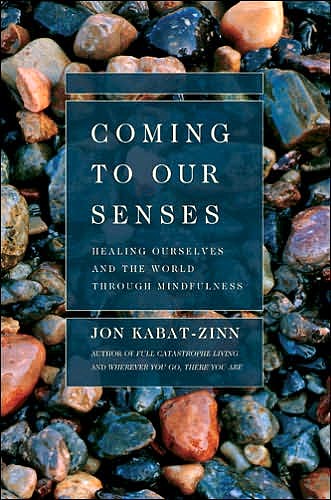
Coming To Our Senses

I haven't read a book in ages. Which is odd for me as I'm a bookaholic. On the Camino I felt like reading hardly anything at all, except my guide book - though, as you know, I was inspired to do a bit of writing. Being bombarded with Spanish all the time could be wearisome - especially since I have no confident grasp of the language. So, for a time, I turned away from the written word, and looked for hidden, unwritten words in outer and inner landscapes, words skulking behind situations and moods, words haunting broken conversations. And often I sank for days into the mire, or the nirvana, of the word-less, which was sometimes scary, and sometimes liberating and peaceful.

But I knew that I would always come back to words, for I love them, and I try to make sense of the world through them. (Though I'm aware, like all instruments of interpretation and perception, words are only a partial way of embracing 'What Is'.) The wonder of words and language is one of our greatest wonders. Words and language make us human.

Needing to engage again with a good, fat book, I picked up Jon Kabat-Zinn's Coming To Our Senses, and I'm very glad I did. There's a saying about the Camino that it doesn't always give you what you want, but it does gives you what you need. Well, I wasn't really sure I wanted to read this book - dammit, it's 600 pages of dense text! - but, sure as hell, I probably do need it right now.

At one time I used to sell a lot of 'Mind, Body and Spirit' titles, various 'alternative', left-field books, and other assorted esoterica to bookshops in the UK, so I've a general, if superficial, knowledge of the subject. In this area it can be difficult locating the diamonds in the dross, separating the charlatans from the real gurus, telling apart those with true spiritual insight from those with just a secular yen to be on Oprah and earn lots of lovely dollars.

Truth to tell, since I came back to England I haven't felt very well for one reason or another. But I feel this might be the very book to banish those post-Camino blues. It's about mindfulness, meditation, Buddhism, awareness, happiness, healing, lovingkindness, yoga, freedom - and anything and everything that's part of the human soma and psyche. Perhaps in reading it I may at last come to some small understanding of my recent, difficult Camino...

Thursday, 15 January 2009

Right Relationship

Forest Wisdom has just been musing in his blog about whether we can ever fully get to know and understand another person - online or offline - and this has provoked a fascinating string of comments.

I don't think we ever can. To do that we must be that other person. And we can't be that because we are uniquely ourselves. It's an inescapable fact of human life that we are isolated one from another within our own physical bodies and within our own private minds. However this existential state need not be a depressing thing. For we do have relationships.

I thought I'd turn to see what one of my favourite philosophical and spiritual thinkers, Krishnamurti, had to say on the subject of Relationship and Isolation. In The Problems Of Living he writes that Life is relationship, which is expressed through contact with things, with people and with ideas. In understanding relationship we shall have capacity to meet life fully, adequately... Relationship, surely, is the mirror in which you discover yourself. Without relationship you are not; to be is to be related; to be related is existence.

Examining our relationships, Krishnamurti recognises that many of our relationships are isolating because they are based on a desire for power and self-gratification, whether individually, racially or nationally:

Now if we examine our life, our relationship with another, we shall see that it is a process of isolation. We are really not concerned with another; though we talk a great deal about it, actually we are not concerned. We are related to someone only so long as that relationship gives us a refuge, so long as it satisfies us. But the moment there is a disturbance in the relationship which produces discomfort in ourselves, we discard that relationship. In other words, there is a relationship only so long as we are gratified. This may sound harsh, but if you really examine your life very closely you will see it is a fact; and to avoid a fact is to live in ignorance, which can never produce right relationship. If we look into our lives and observe relationship, we see that it is a process of building resistance against each other, a wall over which we look and observe the other; but we always retain the wall and remain behind it, whether it be a psychological wall, a material wall, an economic wall, or a national wall.

After forcing us to consider these uncomfortable truths, Krishnamurti then asks: Can one live in the world without the desire for power, for position, for authority? and replies to his own question like this: Obviously one can. One does it when one does not identify oneself with something greater (my italics). This identification with something greater - the party, the country, the race, the religion, God - is the search for power. Because you in yourself are empty, dull, weak, you like to identify yourself with something greater. That desire to identify yourself with something greater is the desire for power.

He concludes: Relationship is a process of self-revelation, and, without knowing oneself, the ways of one's own mind and heart, merely to establish an outward order, a system, a cunning formula has very little meaning. What is important is to understand oneself in relationship with another. Then relationship becomes not a process of isolation but a movement in which you discover your own motives, your own thoughts, your own pursuits; and that very discovery is the beginning of liberation, the beginning of transformation.

You may think we're deviating a long way from talk about how one individual can communicate with and get to know another individual, to ideas about power struggles and religious, national and political identity. But relationship is relationship, and we're talking essentially about the same relationship here - the individual one-to-one personal relationship being a microcosm of all the other more global, more abstract relationships.

The technique Krishnamurti uses in the above "argument" is typical of his reasoning; and, I think, typical of certain kind of Buddhist mode of thought.

I've written about relationship before in my post We Are Stardust, We Are Golden.

Thursday, 18 December 2008

Piute Creek


With all this very interesting talk about Gary Snyder and wilderness in some parts of the blogworld at present (http://www.canoeinthemist.blogspot.com/), I thought I might post here one of my very favourite Snyder poems, Piute Creek, which is taken from Riprap, his 1st book of poetry published in 1959 (the title poem Riprap is also very fine).


Piute Creek

One granite ridge
A tree, would be enough
Or even a rock, a small creek,
A bark shred in a pool.
Hill beyond hill, folded and twisted
Tough trees crammed
In thin stone fractures
A huge moon on it all, is too much.
The mind wanders. A million
Summers, night air still and the rocks
Warm. Sky over endless mountains.
All the junk that goes with being human
Drops away, hard rock wavers
Even the heavy present seems to fail
This bubble of a heart.
Words and books
Like a small creek off a high ledge
Gone in the dry air.


A clear, attentive mind
Has no meaning but that
Which sees is truly seen.
No one loves rock, yet we are here.
Night chills. A flick
In the moonlight
Slips into Juniper shadow:
Back there unseen
Cold proud eyes
Of Cougar or Coyote
Watch me rise and go.

I think this is a wonderful poem. I don't want to do a critical analysis; suffice to say, Snyder's life-long preoccupations with Zen Buddhism, wilderness and mankind's ambiguous relationship with nature are pervasive. The line All the junk that goes with being human/Drops away... is just fantastic. (You experience floatingly that drop from rock to creek in a brilliantly effective enjambement.) I've found some of Snyder's other poetry collections rather more challenging - with their personal obliquities and beatnik flow - but Riprap, this 1st collection, remains a small, radiantly shining jewel in the pantheon of American 20th century literature.

(Another of my posts on Gary Snyder - which includes his poem Riprap - is here.)