Wednesday, 31 March 2010
No Hay Camino
Tuesday, 30 March 2010
Dwelling In The Possibility Of The Sacred
For instance, in post-WWII Germany you could no longer comfortably use words like 'Volk' (the people, the mass) or 'Vaterland' (fatherland) and many such 'loaded' words. National Socialism had polluted this vocabulary. The words had become tainted with fascism. And to take another example, this time from the religious field, it's difficult to use with confidence words like 'God', 'Heaven','Covenant', 'Salvation', 'Redemption', 'Absolution', 'Sin', 'Evil' and scores of other 'Christian' words post-Darwin, post-WWI and post-Existentialism.
But these 'religious' words haven't really gone away. It's just that their meaning has changed, as meanings do - and widened, and, to some extent, become secularized. They have lost their capital letters. And that's just fine. Why should the Religious have a monopoly over the religious? Why should my God be better than your god?
Take the word 'sacred'. We tend to associate it with Christian holiness, but that's a very partial view. The word comes from the Latin 'sacrum' which refers to the pre-Christian gods of Ancient Rome and, spatially, was the area around the 'templum' (temple). All religions can share in the sacred - as well as humanists, agnostics, atheists, pagans... all of us. The numinous is available to everybody.
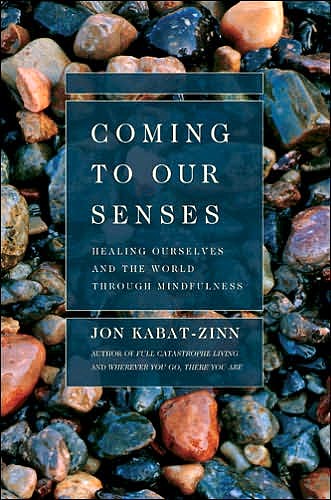
In the book I'm reading at the moment, Coming To Our Senses by Jon Kabat-Zinn, I've just come across this paragraph:
In a lovely appreciation of all that is mysterious and sacred, Emily Dickinson invokes the wholehearted affirmation: 'I dwell in possibility'. Her very next line is 'A fairer house than prose' - which I take to mean the domicile of reasonable, rational, linear, and so often limiting thoughts and opinions. Can we say the same? Can we truly dwell in possibility? In not knowing, but risking anyway? And in this very moment? How does it feel?
Here's the poem he quotes, by the wonderful Emily Dickinson:
:
I dwell in Possibility
I dwell in Possibilty -
A fairer House than Prose -
More numerous of Windows -
Superior - for Doors -
Of Chambers as the Cedars -
Impregnable of Eye -
And for an Everlasting Roof -
The Gambrels of the Sky -
Of Visitors - the fairest -
For Occupation - This -
The spreading wide of narrow Hands -
To gather Paradise -
Monday, 29 March 2010
Liberation From The Self
A human being is part of the whole, called by us 'Universe', a part limited in time and space. He experiences himself, his thoughts and feelings as something separated from the rest - a kind of optical delusion of his consciousness. This delusion is a kind of prison for us, restricting us to our personal desires and to affection for a few persons nearest to us. Out task must be to free ourselves from this prison by widening our circle of compassion to embrace all living creatures and the whole of nature in its beauty. Nobody is able to achieve this completely, but the striving for such achievement is in itself a part of the liberation, and a foundation for inner security. ALBERT EINSTEIN
Sunday, 28 March 2010
Your One Wild And Precious Life
You Reading This, Be Ready
Starting here, what do you want to remember?
How sunlight creeps along a shining floor?
What scent of old wood hovers, what softened
sound from outside fills the air?
Will you ever bring a better gift for the world
than the breathing respect that you carry
wherever you go right now? Are you waiting
for time to show you some better thoughts?
When you turn around, starting here, lift this
new glimpse that you found; carry into evening
all that you want from this day. This interval you spent
reading or hearing this, keep it for life -
What can anyone give you greater than now,
starting here, right in this room, when you turn around?
WILLIAM STAFFORD
The Summer Day
Who made the world?
Who made the swan, and the black bear?
Who made the grasshopper?
This grasshopper, I mean - the one who has flung herself out of the grass,
the one who is eating sugar out of my hand,
who is moving her jaws back and forth instead of up and down -
who is gazing around with her enormous and complicated eyes.
Now she lifts her pale forearms and thoroughly washes her face.
Now she snaps her wings open, and floats away.
I don't know exactly what a prayer is.
I do know how to pay attention, how to fall down
into the grass, how to kneel down in the grass,
how to be idle and blessed, how to stroll through the fields,
which is what I have been doing all day.
Tell me, what else should I have done?
Doesn't everything die at last, and too soon?
Tell me, what is it you plan to do
with your one wild and precious life?
MARY OLIVER
I like the way Mary Oliver considers 'awareness', or close attention, as a kind of secular 'prayer'.
Both poems end with a question, which is a wake-up call to all of us.
Can we awaken our minds and senses to what the 'now' has to offer?
How do we really want to spend our lives - our precious lives, our only lives?
Saturday, 27 March 2010
Camino People (4)
It was mid-afternoon, and I'd arrived in the large village of Castilblanco de los Arroyos - a typical Andalusian 'white village' of low, shuttered, whitewashed houses and a sandy, central plaza bordered with bitter orange trees. The day had generally been a good one. Although the last few km had been road walking, before that I'd followed an old medieval drove road, or cañada, for 12 km. In places it had been very wet and muddy underfoot, but the tricky conditions kept me on my toes (so to speak) and I enjoyed the challenge.
At first the route led through orange plantations and olive groves. Some farmers were spraying the trees - you could smell the chemicals. There were lots of shooters about - I think after partridges, rabbits and hares - and I felt very exposed as I ran the gamut of this noisy fusillade. But eventually I left the gunfire behind, and entered a lovely, undulating, rocky area of holm oaks and cistus.
Perching on a rock, I had a bite of lunch, and looked over the reddish rocks onto wild acres of rough pastureland scattered with oak trees and grazed by ponies. A few early flowers were pushing through. In a few months these fields would be a riot of spring colour. I thought how exhausting this route would be in the baking summer heat - there was little shade - and was glad it was wintertime (little did I know then how cold and wet it would become). I meditated on the small details of nature close by me: the stones, the rocks, the cactuses, the cistus bushes, the odd insect which had emerged too soon. For some brief moments all was completely well with the world, and everything was as it should be in the order of things.
At the entrance to Castilblanco was a petrol station, and from there I retrieved the key to the refugio. There was no heating, but it was perfectly clean and comfortable. I unrolled my sleeping bag on one of the bunk beds and sorted out my pack. And then I did the very stupid thing I mentioned above. I placed my glasses on a chair, took a shower, came out the shower, dried myself - then sat down heavily on the chair. The spectacles were in pieces. The lenses were OK, but the frame was shattered. What to do? I panicked. I couldn't see properly without them. I had no other pair. I was in a village miles from anywhere. I tried to explain my predicament to the guy in the petrol station. 'Was there an opticians, un óptico, in the village?' I asked him, without much hope. 'Yes', he assured me. 'There's one in the pharmacy, which opens at 6 pm.'
I was lucky. The pharmacist-optician was incredibly helpful and kind. Within an hour she'd helped me choose a new frame, ground the lenses to size, and fitted the lenses - all the while serving a constant stream of customers waiting for prescriptions. (I think she must have made up the prescriptions herself, too, for I saw no other staff.) Each one she treated with the same unhurried courtesy, efficiency and respect. And she spoke excellent English (she'd lived in the US for several years) - the only person I met along the whole Vía de la Plata who spoke English with any degree of fluency.
I thanked her, and called her a 'trail angel'. 'Without you, I'd have had to return home!' I exclaimed. I wonder what the chances were of finding, in a village in Andalusia, an optician with the facility to grind lenses on the spot (most opticians are not able do this and send them away - a process which might take a week or more) - and, furthermore, could speak perfect English? Not high, I think. She laughed and wished me a warm 'Buen Camino!' 'There are usually ways and means of solving any problem!' she pronounced, smiling, as I left. 'Ways and means...'
(The photo shows the church in Castilblanco de los Arroyos.)
Friday, 26 March 2010
Just This! Just This!
Of course you can meditate anywhere, but I've always thought long walks and pilgrimages provide a wonderful opportunity for mindfulness and meditation (Pilgrimpace, in much the same way, relates walking to prayer). Away from the demands of job and family, email and cell phone, the ever-accelerating rat race, there's time and space to explore your own mind and face up to who you really are. It's less easy to be distracted from appreciating, fully and with an open heart, the beauty and significance of the present moment. For the present moment - here, here, now here - is all we ever have. But far too often we don't recognize it or inhabit it at all, preoccupied as we are with regrets about the past and anxieties about the future.
Mindfulness is the act of becoming aware of awareness itself, standing back and watching our teeming thoughts (which seem to have a mind of their own) come and go, realizing we are more than our thoughts and ideas, our fears and hopes, our instincts and emotions. By observing and understanding these processes we can free ourselves from their tyranny over us, and be delivered back to our true selves.
First days of spring
the sky is bright blue, the sun huge and warm.
Everything is turning green.
I carry my monk’s bowl and walk to the village
to beg for my daily meal.
The children spot me at the temple gate
and happily crowd around,
dragging at my arms till I stop.
I put my bowl on a white rock,
hang my bag on a branch.
First we braid grasses and play tug-of-war,
then we take turns singing and keeping a kick-ball in the air:
I kick the ball and they sing, they kick and I sing.
Time is forgotten, the hours fly.
People passing by point at me and laugh:
“Why are you acting like such a fool?”
I nod my head and don’t answer.
I could say something, but why?
Do you want to know what’s in my heart?
From the beginning of time: just this! just this! RYOKAN
Thursday, 25 March 2010
Coming To Our Senses
I haven't read a book in ages. Which is odd for me as I'm a bookaholic. On the Camino I felt like reading hardly anything at all, except my guide book - though, as you know, I was inspired to do a bit of writing. Being bombarded with Spanish all the time could be wearisome - especially since I have no confident grasp of the language. So, for a time, I turned away from the written word, and looked for hidden, unwritten words in outer and inner landscapes, words skulking behind situations and moods, words haunting broken conversations. And often I sank for days into the mire, or the nirvana, of the word-less, which was sometimes scary, and sometimes liberating and peaceful.But I knew that I would always come back to words, for I love them, and I try to make sense of the world through them. (Though I'm aware, like all instruments of interpretation and perception, words are only a partial way of embracing 'What Is'.) The wonder of words and language is one of our greatest wonders. Words and language make us human.
Needing to engage again with a good, fat book, I picked up Jon Kabat-Zinn's Coming To Our Senses, and I'm very glad I did. There's a saying about the Camino that it doesn't always give you what you want, but it does gives you what you need. Well, I wasn't really sure I wanted to read this book - dammit, it's 600 pages of dense text! - but, sure as hell, I probably do need it right now.
At one time I used to sell a lot of 'Mind, Body and Spirit' titles, various 'alternative', left-field books, and other assorted esoterica to bookshops in the UK, so I've a general, if superficial, knowledge of the subject. In this area it can be difficult locating the diamonds in the dross, separating the charlatans from the real gurus, telling apart those with true spiritual insight from those with just a secular yen to be on Oprah and earn lots of lovely dollars.
Truth to tell, since I came back to England I haven't felt very well for one reason or another. But I feel this might be the very book to banish those post-Camino blues. It's about mindfulness, meditation, Buddhism, awareness, happiness, healing, lovingkindness, yoga, freedom - and anything and everything that's part of the human soma and psyche. Perhaps in reading it I may at last come to some small understanding of my recent, difficult Camino...
Wednesday, 24 March 2010
Camino People (3)
Later I found a groovy new bar - with gorgeous, soft red wine de la casa, and tapas to-die-for. The girl behind the bar was the owner of the place, and she was as welcoming as sunshine, smiling and open as summer sunflowers, black-haired and beautiful. She beckoned a regular customer from Barcelona to join me. We talked about this and that, about the Camino, the weather, the town of Zafra - and how it was just like a miniature version of Seville.
And later still, when I came to pay, she told me my Catalan friend - who had left some minutes before - had paid for me. I expressed my gratitude and astonishment. She winked, with an amused look on her face. 'Es España!' she beamed.
Tuesday, 23 March 2010
Camino People (2)
Then I didn't know what to do. Outside it was cold, wet and windy. Nothing was happening on the streets. Except paper bags blowing around and the big cross shaking slightly in the wind. Inside it was warmer. But not that much. So I burrowed into my sleeping bag and had a lie-down. This is ridiculous! I told myself. In your sleeping bag at 6 o'clock? So I had a shower, read a book, and tried to write a poem. The priest had invited me to dinner at 9. The minutes seemed to crawl by. Finally at 9.30 the teacher knocked at my door. 'Dinner!'
I joined them all at table in the priest's cosy living/dining room - the architect, the priest, the teacher. And the cook. A fire blazed in a huge open fireplace in one corner. On the table was a platter of beetroot and asparagus, some freshly-made fried eggs, a big bowl of home-made chips, a bottle of wine, a jug of water. 'Help yourself! Tuck in!' All men together. Arms on the table. Smoke between courses. Smoke between mouthfuls! The architect, the priest, the teacher, the cook. And now the pilgrim. (Sounds like that Peter Greenaway film. What was it called? The Cook, The Thief, The Wife And Her Lover? But no wives here. For tonight, this was an exclusively male preserve.)
The cook was wild and extraordinary. He reminded me of a younger version of Father Jack Hackett from the TV comedy series Father Ted. We spoke in a weird hybrid of Spanish, English, French and German. The cook had spent 20 years as a barman serving drinks to the tourists on the Costa Brava. 'Never again!' He fetched some huge chunks of pig meat, which the priest threw on the grill above the hot embers of the fire. It was soon ready. We gorged on the succulent pork and gnawed on the bones. Later we drank strong, black coffee, and the priest disappeared - to reappear with a strong, colourless alcohol in a plastic Coke bottle. We drank. A great evening. A memorable evening. And so to bed...
The next morning I breakfasted with the priest. Melon, oranges, a meat pasty, yoghurt, café con leche. He gave me some fruit and the rest of the meat pasty for my packed lunch. He enquired if I wanted, perhaps, to return as a voluntary hospitalero? He asked for no money. It was free to stay there. (But I left 12 euros in the donation box.) He showed me the rest of the house, the renovations, the old wooden cart which was being restored and repainted. He was a kind man, a good man. A very good man. And an intellectual man. His shelves were full of religious books, historical books, books about Don Quixote. Then I stepped outside into the damp, foggy air, and set off once more along the Camino...
It had been yet another unrepeatable, unforgettable night on the Vía de la Plata...
(My photo shows the priest on the left and the cook on the right.)
Monday, 22 March 2010
Saturday, 20 March 2010
Have You Prayed
When the wind
turns and asks, in my father’s voice,
Have you prayed?
I know three things. One:
I’m never finished answering to the dead.
Two: A man is four winds and three fires.
And the four winds are his father’s voice,
his mother’s voice . . .
Or maybe he’s seven winds and ten fires.
And the fires are seeing, hearing, touching,
dreaming, thinking . . .
Or is he the breath of God?
When the wind turns traveler
and asks, in my father’s voice, Have you prayed?
I remember three things.
One: A father’s love
is milk and sugar,
two-thirds worry, two-thirds grief, and what’s left over
is trimmed and leavened to make the bread
the dead and the living share.
And patience? That’s to endure
the terrible leavening and kneading.
And wisdom? That’s my father’s face in sleep.
When the wind
asks, Have you prayed?
I know it’s only me
reminding myself
a flower is one station between
earth’s wish and earth’s rapture, and blood
was fire, salt, and breath long before
it quickened any wand or branch, any limb
that woke speaking. It’s just me
in the gowns of the wind,
or my father through me, asking,
Have you found your refuge yet?
asking, Are you happy?
Strange. A troubled father. A happy son.
The wind with a voice. And me talking to no one.
I was so moved by this poem by Li-Young Lee which Loren Webster quoted in a recent post - that I thought I'd copy it here.
I suppose this poem has a particular resonance for me right now since my father (a formidably religious man) died just over a year ago, and my brother-in-law (a father of four) just a few days ago. And I, as a father, am having difficulties with the 'role' at the moment. As fathers often do...
Tuesday, 16 March 2010
Camino People (1)
I love walking. For me it's a near perfect activity. I've found places and seen things while walking you would never, ever find or see if journeying by car - or even by bike. I feel privileged. But, as well as the landscape (which may be beautiful or scarred, mundane or marvellous - it's all part of the Camino), there are the people populating that landscape, and this is the most important thing of all...
It must be said that the people along the Camino are a pretty amazing bunch. OK, as in life generally, they're not all kind and friendly and helpful. But many of them are. You'd be amazed how many times when you're lost at some crossroads, with no scallop shell or yellow arrow in sight, a 4 x 4 pulls up in a cloud of dust (you may not have seen any other vehicle for hours) and someone jumps out and indicates the right way. Not only that, but that someone often wants to know all about you, where you've come from, where you're going, and leaves you with a pat on the back and a warm 'Welcome to Spain, peregrino!'
In any remote pueblo, if you're dithering before two turnings, wondering which way's the exit from the village, you can bet your life shutters will rattle, and some incredibly old Spanish lady will silently gesticulate, and point out the correct path. It happens all the time...
The people along the Camino are its very heart and soul. Here are a few of them I met on my recent trip. This is the indomitable Elena from the Bar Ruta de la Plata in Carcaboso...
Women rule the bars in Spain. While the bar owner is smoking, chatting and playing cards, his wife will be dashing hither and thither, carrying four glasses in each hand, multi-tasking like mad, yet still managing to greet every customer, control any boisterous drinkers, heat up some tapas in the microwave, sell some lottery tickets, switch on the cigarette machine with the zapper, and bang down 20 saucers - with spoons and sugar sachets - on the counter, in preparation for the next wave of coffee addicts...
On Sunday 31 January I entered Carcaboso's Bar Ruta de la Plata completely exhausted. I summoned what little Spanish I could muster, and asked about rooms and prices and all sorts of ridiculous things that for some reason seemed important to me at the time. Elena's son, who helped run the bar, inspected me with amusement. 'Tranquilo!' he said. 'Tranquilo!' he repeated, as he helped me off with my backpack. He placed a beer, and some nuts and sunflower seeds, in front of me. 'Tranquilo! Tranquilo!' Later they found me a room, and showed me where I could eat, and Elena spent half an hour drawing a map of the next day's route, and in the morning she made me a lovely packed lunch...
And this is Mañuela, the hospitalera at the private albergue in Calzada de Béjar. I was the only pilgrim there, but she spent ages lighting and tending to a wood burning stove (though it was still freezing in the dormitory), and later preparing a meal from scratch - simple chicken soup, then a tortilla de patatas, but all home-made and delicious...
And here's Mari Carmen de la Iglesia from the new Casa Rural (called VII Carreras) in San Pedro de Rozados, one of the nicest places I stayed. The welcome was warm. The tapas at the bar were tasty - spiced black sausage (morcilla), tortilla, croquetas... The rooms were superb - all individual, with hot showers and radiators (made a change from all the nights I'd shivered in my sleeping bag in the freezing cold), a smart tiled floor, a comfortable bed. As soon as I arrived Mari Carmen asked me if I wanted any washing done - which she did free of charge in her washing machine. And later I had excellent fish soup... (Chicken soup? Now fish soup? Do pilgrims drink soup all the time? Well... yes! Camino lovers will know what I mean...)
Finally, here's pilgrim Agustin, the master chef from Sunday's post, king of the chorizo, sovereign of the sausage, prince of the pork fat...
Monday, 15 March 2010
When In Doubt, Blame The Weather!
Which is interesting. Because, in some ways, you might at first think my other two Caminos were more testing - with a heavier backpack, ill-fitting boots, and steeper, more numerous ascents and descents. This time my pack was lighter, my boots were comfortable and problem-free (though they did let in water and started to come apart towards the end), and the terrain was relatively flat.
I think the difficulty lay in the time of year at which I walked. (I had no choice but to go in January and February, by the way.) My first two Caminos were done in the autumn/early wintertime. There was very little rain, and the days were bright and sunny - perhaps cold to start with, but often warming up late morning, particularly in the French sections.
On this Camino I walked through a Spain that was undergoing one of its worst winters for years. Rain had drenched the land, making some tracks waterlogged and some streams impassable. It's tiring to concentrate hour after hour just on where to put your feet. And, apart from a few mild days in Andalusia at the beginning of the trail, it was cold. It grew colder and colder the further north I travelled. There were days of blue skies, as my videos show - but it gradually got colder, and wetter, and foggier, and windier, the nearer I approached Galicia.
What finally did it for me was overnight snow at Padornelo - which meant 20 miles of road walking to the next hostal, as the path was blocked. And even the road was no easy option. I was slipping and sliding in the slush. At one point a Guardia Civil police car stopped and asked if I was OK. And did I want a lift? Naturally, I refused!
Right, they're the negative bits out of the way. Let's get on to the positive bits. I think you're going to be surprised, for I had some truly heart-warming experiences...
Sunday, 14 March 2010
Food And Love
There are two relentless, unignorable animal hungers in our lives, and one of them's to have our stomachs filled. (The other one is the irrepressible, primeval desire - to go ballroom dancing! I joke, of course...)
Food can be a joyous thing. But it's not actually about fancy restaurants, complicated recipes, complex, diverse or expensive ingredients, culinary knowledge, technique and skill, dinner party one-upmanship, celebrity chefs in hot competition with each other. No, it's not about these things at all.
Occasionally I've eaten in a posh restaurant or two - when I worked in publishing - and sometimes they're good, but often they can be disappointing. If I was paying for myself, I'd rather spend the money elsewhere. Also, it can sometimes seem rather obscene to be sitting there debating whether you want the pan-fried pigeon or the pancetta-wrapped tuna - when much of the world is struggling to survive on seeds and roots.
No, at heart, mealtimes aren't really about food, are they? Food's the peg to hang them on - but really they're much more about sharing, companionship and conversation. They're certainly not about competition.
The value of food is nothing to do with money. It's nothing to do with the food's scarcity, or complexity, or diversity, or subtlety. It's simply to do with the love that's been put into preparing it. And that's all. Really it is.
A few weeks ago, in the albergue at Tábara, a Spanish pilgrim called Agustin I'd met insisted on making us both a meal. We shopped for the food together. It was fun. Later he fried, in very hot oil, chunks of chorizo and salted belly pork, then added a tomate frito sauce from a carton (Why can't we get this in the UK? Perhaps we can and I just haven't noticed). We accompanied it with heaps of al dente spaghetti and a bottle of red wine. And it was one the best meals I've ever had in my life.
Love and companionship...
Saturday, 13 March 2010
If Love Came In Colours, Then I'd Choose This One For You

Blues of dawn, are dimmed by comparison.
When I hand you this bunch of cornflowers
The only other color in the room
Illumines your eyes as you arrange them.
They are the blue reflection of whatever
Moves in you, serene as cool water tipped
Into crystal, oddly enough the willing bride
To a cloudy head of melancholy
So deeply blue it could prove musical.
This is the blue John Lee Hooker’s gravelly
Voice in the sundown field was looking for.
This is the unrequited dream of an iris.
Ice blue, spruce blue, little periwinkle blue—
Nothing else that dies is exactly so blue.
Friday, 12 March 2010
Chicken With Spelt
Yesterday I roasted a chicken with spelt (you could also use pearl barley) as the 'stuffing' and it was really tasty. I love roast chicken anyway, and, like many of us, have cooked it with all sorts of herbs and stuffings. It seems to accommodate many different herby, sharp and citrus-y flavours - sage, thyme, basil, parsley, oregano, tarragon, rosemary, lemon, garlic... (And that's without even considering the spicy and fruity ways of treating chicken in Africa, the Middle East and the Far East...) But this recipe's a little different.
Toast in a small frying pan 1 tsp of cumin seeds and 1 tsp caraway seeds for a minute or two to bring out the flavour, than grind them up in a pestle and mortar (oh, the aroma!) Heat up some olive oil in a larger pan and sauté a chopped onion, then after 10 minutes add a chopped up clove of garlic, sauté for a couple of minutes, then add the spices you've just ground plus 150 gm of spelt (or pearl barley) grains. Stir well. Pour in 500 ml of chicken stock, bring to the boil, then reduce the heat and simmer until the liquid is absorbed and the grains are soft (20-30 min). Yes, this is just like a risotto, but with spelt instead of rice... (Obviously, keep topping up with a little water if the mixture's getting too dry before it's properly cooked.) Finally, off the heat, stir in some chopped up dates or dried apricots, the zest and juice of a lemon, a heap of chopped fresh parsley, some chopped and toasted walnuts if you like (I didn't use these as they were unbelievably expensive), and some salt and pepper.
Stuff the cavity of a free-range chicken two-thirds full of this mixture, and roast in your usual way. (My own method was to pull the legs slightly away from the main body of the chicken - to aid the cooking process - and then to rub the breast and legs with butter, salt and pepper. I wrapped in foil, and roasted in a medium-hot oven - occasionally basting the chicken with the buttery, chicken juices to keep it moist. Just before it was cooked, I opened up the foil and turned up the heat, so that the skin became nice and brown and crispy.)
Reheat the remainder of the cooked spelt and serve with the chicken. You could accompany this quite strong-and-nutty tasting dish with a few roasted vegetables, I suppose. Or perhaps some unfussy al dente green beans all on their own. Myself, I prepared just a simple, green salad...
After my last post on home-made stock, I really couldn't let you or myself down, so this morning I approached the stock-making process with messianic zeal. To the chicken carcass and all the leftover chicken bits I added: onion, carrot, celery, leek, garlic, peppercorns, parsley, bay leaf, rosemary, thyme... It's simmering away as I write this, and smells absolutely delicious...
Wednesday, 10 March 2010
Taking Stock
I've done it myself twice over the past few days. Returning from Spain the cupboard was bare, the fridge and freezer empty. I made a nourishing, winter-warming chorizo, chickpea and lentil soup to remind me of Spain. It was fine, but nothing like the proper Spanish version. The reason? I used chicken stock cubes rather than authentic chicken stock, so the flavour of the liquid was bland and lacking in any real depth. The Spanish would never dream of using stock cubes. They always have a stock pot on the go. So convenient for their Menú del Día. First course: soup. Ladle some chicken stock into a bowl. Add some pasta or noodles. Hey presto!
Yesterday I cooked braised lamb's liver and onions with other assorted vegetables. A lovely dish. One of my favourites. But I didn't have any proper meat stock, so again I used the easy method. And once more the meal was slightly disappointing. The liver, the onions, the veg - all fine, beautifully cooked and tasty. But the liquid tasted synthetic. It was too strong and too uniform.
Enough is enough. Stock cubes are off my shopping list from now on. They're full of gunk anyway - such as the the 'flavour enhancer' monosodium glutamate (MSG) and other synthetic ingredients. And they're way too salty. I'm going back to making my own stock. It's not difficult, and it's very satisfying. I strongly believe, along with bread-making, it's at the core of all real home cooking.
You just simmer fish or meat bones (along with any leftover bits of fish or meat) in water with vegetables, and perhaps some herbs. (You may need to skim off a little fat from time to time.) And that's just about it. You can freeze it later in different-sized portions. It's a way of life. Instead of chucking away all those Sunday dinner leftovers, it should be second nature to throw them in the stock pot. The result is tasty and nutritious, with no artificial ingredients. You, yourself, are in complete control of what goes into it.
If the tone of this is slightly hectoring, it's because I'm admonishing myself. I really must change my whole cookery lifestyle. I made a loaf of bread the other day which turned out very well. Now I'm going to revolutionize my attitude to stock. It's very exciting! I'll let you know how I get on...
Tuesday, 9 March 2010
Cornflower Blue
was the song on the tape,
Cornflower Blue
on that lost weekend,
that last weekend.
Cornflower Blue.
As we pushed you round
the Harlestone Circular
through the bluebell wood
to the gingerbread house,
walkers were too polite
or too embarrassed
to stare at your wheelchair
bumping and lurching
along the rutted track.
The countryside
wasn't made for it.
Later you sat bolt upright in your bed,
eyes transfixed in a laser beam stare.
You couldn't speak.
Your brain tumour had seen to that.
For us, wine and cigarettes
dulled the pain.
We went to bed,
laughing loudly
to prevent us crying.
A week later
in a phone box with my dad
we heard that you had died.
Suddenly
my dad seemed older
and smaller.
We went back to the Norfolk cottage
and told my mother, who wrung her hands,
looking, beyond the cows,
at some point in the middle distance,
stoical to the end.
But my gaze swivelled up,
away from the flint farms and mucky lanes,
into the big sky above
hanging like a blue lantern.
Cornflower blue, oh cornflower blue.
Yes, it was cornflower blue.
Sunday, 7 March 2010
Leaps In The Dark
Then gradually it dawned on me that some sort of intellectual pride held me back from the only possible conclusion.
It is not enough to seek and care; to pay lip service to all manner of ideals. Real witness is what counts. Why is it so difficult?
It is something to do with leaps in the dark. Recognising that truth is hidden. But transformation towards truth is something else. It is practice and diligence as Lama Jigmé said.
Referring to belief and faith Thomas Merton wrote, 'We do not see first and then act; we act, then see.'
From On Pilgrimage: A Time To Seek (1991) by JENNIFER LASH
(My photo shows the late 12th century figure of Saint James, the centrepiece of the Pórtico de la Gloria, welcoming pilgrims to the Cathedral of Santiago de Compostela.)
A Glass Of Rainwater, Please!
By the way, if you visit YouTube, and search for 'spanishmeseta', you'll be able to see the larger, slightly sharper YouTube versions of my last 3 Vía de la Plata videos...
And, also by the way, I've just made a hearty chorizo, chickpea and lentil soup. You don't think I might be yearning again for Spain already, do you..?
Saturday, 6 March 2010
The Birth Of An Archetype
From On Pilgrimage: A Time To Seek (1991) by JENNIFER LASH
Salamanca to A Gudiña (2)
I have reworked this as the previous version flipped through at too frenetic a pace! Hope this is an improvement.
Friday, 5 March 2010
A Passion For Birds


Thursday, 4 March 2010
Wednesday, 3 March 2010
The Rain In Spain
The weather forecast for this whole last week was uniformly awful for much of Spain. The country is in the grips of one of its worst winters for years. It had been deluged with rain in December and much of January - particularly in the south - and now this was continuing throughout February. Snowfall had been unusually heavy in the north, and it had even snowed in parts of the south which never normally see any snow. There had been bad storms and flooding in places like Cádiz, Jerez and the Canaries. Bridges had collapsed. Motorways had been shut for a while. Homes had been destroyed. The mighty Guadalquiver river had burst its banks east of Seville.
It was through such saturated countryside that I walked, so it was never easy from the start. Twice early on I had to turn back from rivers which were unfordable and seek an alternative route by road. I would spend a large part of each day just concentrating on the path before me - avoiding the deep, muddy bits where I'd sink in up to my ankles, skirting huge pools by clinging precariously onto the barbed wire fences or stone walls which edged the track. (Read Rebekah Scott on the Spanish weather here and here.)
So, in A Gudiña, I took a train to Ourense, and looked out over the lovely Galician countryside from the railway carriage window - little bright green fields enclosed by stone walls, densely forested hills. And rain. Lots of it! I spent a night in Ourense...
Here's my last scallop shell - set in a stone slab in the Plaza del Obradoiro, the impressive square which lies at the foot of the cathedral steps. I'd walked 800 km from Seville to A Gudiña over 40 days. That's an average of 20 km a day (though 7 of these days were for rest and exploration - when I'd stayed an extra day or 2 in historic cities such as Mérida or Cáceres, Salamanca or Zamora. I'm very glad I did this. It's not good to rush on all the time.) So my actual walking average - over 33 proper walking days - was just over 24 km a day. My walking speed averaged out at about 4 km an hour (5 km an hour if the going was good and I felt like pushing on; 3 km an hour if I was taking lots of photographs and felt like sauntering and stopping to look at things.)
Tuesday, 2 March 2010
Monday, 1 March 2010
Mérida to Baños de Montemayor
Have posted this via YouTube as I was finding it difficult posting it direct from Windows Live Movie Maker.