A common man marvels at uncommon things. A wise man marvels at the commonplace. CONFUCIUS
Showing posts with label South West Coast Path. Show all posts

Sunday, 16 December 2012

South West Coast Path. Day 19: Corfe Castle To South Haven Point

I'd heard that the chain ferry from South Haven Point at the end of the trail to Sandbanks on the other side of Poole Harbour was having its biennial refit. This was a shame, as I'd intended taking the ferry, sleeping overnight in Poole, then catching the train at Poole's main line station to London and thence to home. I didn't want to arrive at a non-existent ferry at the end of the day miles from anywhere and with nowhere to go. So I had to form quickly an alternative plan. From Corfe I would walk a cross-country route to South Haven Point, arrive around midday, trace the Coast Path 'backwards' as far as Swanage, stop there the night, and next morning catch a bus to Wareham, which also has a railway station on the main London line. And this is exactly what I did.   

A steel sculpture marks the end of the Coast Path at South Haven Point. The design is a pair of sails mounted on a compass, and the silhouettes depict scenes from the trail. My backpack and walking poles are resting against the sculpture.

The ferry slipway at South Haven Point. No ferry, of course. Sandbanks, on the opposite bank, is, unbelievably, one of the most expensive places in the world to buy property.

Still no ferry. One could wait a long time.

I set out for Swanage along the lonely shoreline of Shell Bay.

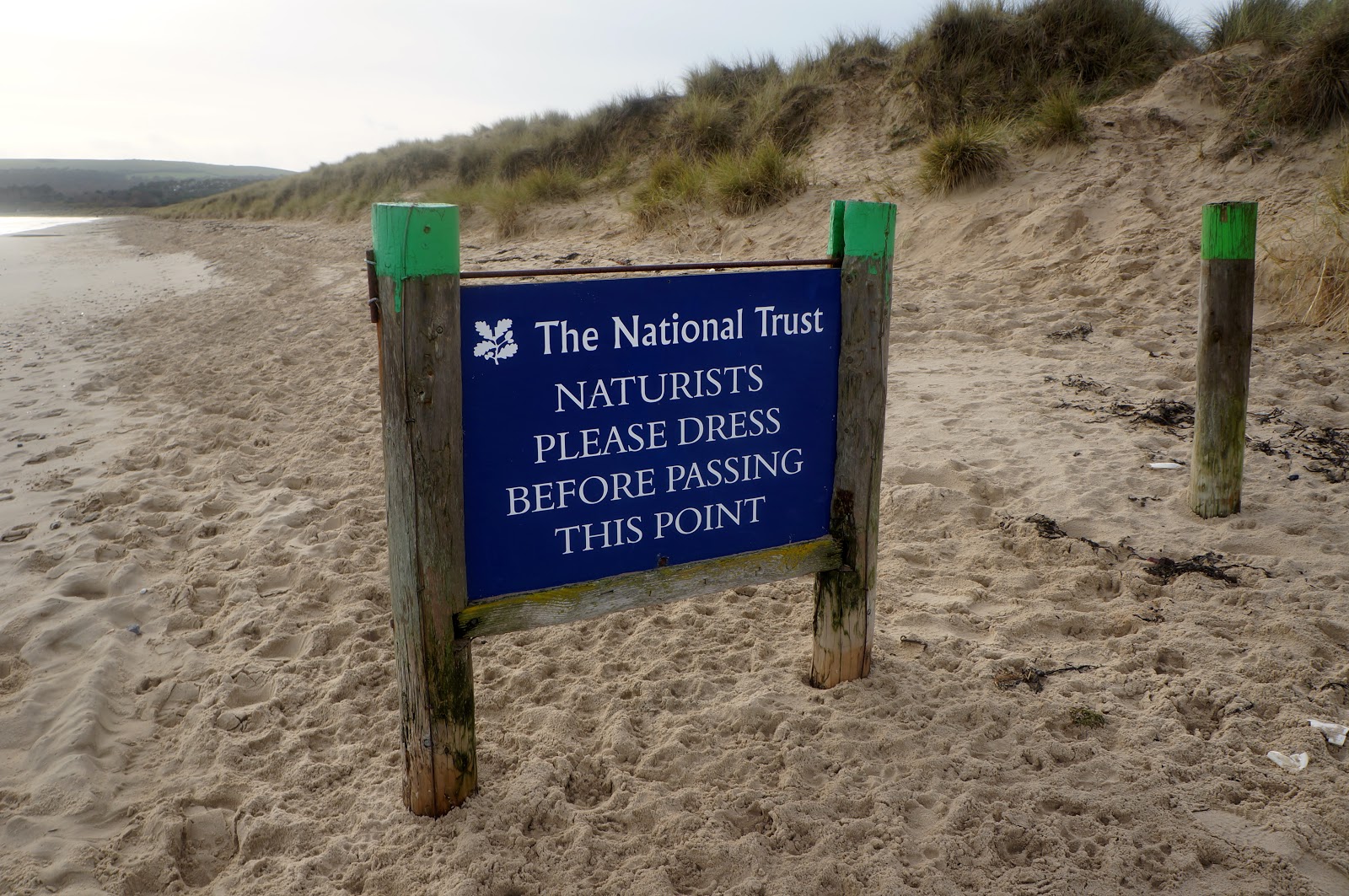
As you can see, hundreds of naturists thronged the strand at Studland Bay. There were bits of bodies dangling and bouncing all over the place. I didn't know where to look.

Thank goodness I soon reached the covered-up part of the beach. Here women in skimpy bikinis frolicked in the surf, men waddled to the sea's edge — their bellies protruding hairily over tight bathing trunks — and children built castles in the sand. Only joking. Apart from one well-wrapped couple and their dog I was the only person there. 

I passed the Old Harry pinnacles and stacks on The Foreland.

And no, I wasn't daring enough to brave this narrow, airy ridge. I rounded the corner and Swanage came into view (much nicer than Weymouth). The next day I boarded the Wareham bus and began my journey home. I had now walked the whole 620 miles of the South West Coast Path — the first 400 miles more than 2 years ago, and the last 220 miles over the past 19 days.

South West Coast Path. Day 18: Lulworth Cove To Corfe Castle

Another day of fine weather and splendid scenery. And another strenuous one — by 10.30 am I'd already climbed three steep cliffs. 

The path passed through the Lulworth Military Range, an active firing range for tanks and other armoured vehicles, owned by the Ministry of Defence. By a sheer piece of luck it was a Sunday, and the Range Walks are open to the public most weekends (but not most weekdays). Had the gates been shut and the red flags flying, I'd have had to make a considerable detour inland. Note the triangular sign on the fence: 'DANGER UNEXPLODED SHELLS KEEP OUT'. 

And just in case there was any doubt...

You must stick to the path at all times, though I very foolishly strayed off it slightly to take this photo of a destroyed tank (is that a rocket launcher at the front?)

Part of the tank firing range is on the right of the picture, and if you enlarge it you can just make out other destroyed tanks dotted here and there. 

Worbarrow Bay,


For a long time I'd wanted to visit the village of Tyneham which lies at the heart of this military area. It had been commandeered by the Army in the 1940s and its residents evacuated. Now it's a ghost village frozen in time. Here's the old telephone box...

... and here's the drinking fountain. Above the tap is a quote from the Gospel of John: 'Whosoever drinketh of this water shall thirst again: but whosoever drinketh of the water that I shall give him shall never thirst...' It really amused me that a modern sign had been attached to the stonework warning: 'Do not drink'! On the left of the fountain you can see the shadow of the Solitary Walker.

St Mary's Church, Tyneham.

In total 252 people were displaced from the village, and the last person to leave pinned this notice on the church door: 'Please treat the church and houses with care; we have given up our homes where many of us lived for generations to help win the war to keep men free. We shall return one day and thank you for treating the village kindly.' They were never allowed back, and Tyneham remains in the hands of the military to this day.

I'd deviated from the coast to see Tyneham and was way behind schedule. I rejoined the path... 

... but realised I'd have to quit the path again as soon as I could to reach my accommodation in Corfe Castle before nightfall. Corfe lay a few miles inland, so at Kimmeridge Bay I headed up a quiet road towards Kimmeridge village.   

Thatched cottages in Kimmeridge. I followed a network of minor roads and country lanes, and by mid-afternoon had arrived in Church Knowle, where I had a pint at the New Inn. It was very busy with late Sunday diners. All in all, a very friendly and appealing pub.

 Corfe Castle was in sight, attractively situated in a gap in the Purbeck Hills. Actually I'd already spotted the castle from five miles away, and it had guided me like a beacon. Corfe is attractive, but spoilt by the main road which runs through it. The very moment I found my B&B — the welcoming Alford House in East Street — the rain started to patter down. I'd been free of rain for a while, so I suppose I couldn't complain.  

Saturday, 15 December 2012

South West Coast Path. Day 17: Weymouth To Lulworth Cove

Looking back at Weymouth across Weymouth Bay. I did not especially like Weymouth when I arrived (it seemed too big and busy and tatty round the edges), but it took on a warmer glow later that evening from the plush interior of a sea front Chinese restaurant. Perhaps it was something to do with the comforting sizzling beef, the noodles and the wine?   

What a glorious day it was —  one of the best days weather-wise of the whole journey. The sea was blue, the sky was blue and the sun hardly stopped shining. It was cold, but, hey, this was December 1st!  

Apart from the beautiful Somerset coast, and Cornwall's remote Lizard peninsula, this was some of the best scenery on the whole coastal path. The Dorset-shire downlands swept in waves before me like an endless, natural switchback. And just look at those white cliffs! 

'Two roads diverged in a yellow wood and sorry I could not travel both...' Or, in this case, two roads diverged in a yellow field. Resisting a compulsive itch to head for the intriguingly-named Scratchy Bottom, I turned right for Lulworth Cove. I wonder what I missed? Ants in my pants?

Wonderful cliffscape. See that steep path I've just come down? Well, I'm now half-way up the other side. Up and down, up and down — the theme of the trip. 

I surveyed the next staggering vista and groaned at the prospect of yet another punishing slope. Note the single sea stack on the bottom-right.

A better view of that chalk pinnacle.

This is the rock arch of Durdle Door, one of the most well-known geological features in England...

... and this is the lovely St Oswald's Bay...

... and this is the equally stunning, scallop-shaped Lulworth Cove in the late afternoon sun. I sensed another fine day was in store.

South West Coast Path. Day 16: Abbotsbury To Weymouth

Leaving Abbotsbury, I spotted the isolated chapel of St Catherine on a hilltop. Abbotsbury is famous for its Swannery, established by Benedictine monks in the 1040s, who farmed the swans for food. Now it's a tourist destination, and the swans are pampered and protected. Therefore swanburgers are most definitely off the menu in the Swannery café, and you have to make do with Cornish pasties and Devonshire cream teas.  

For much of the day the path ran alongside the Fleet lagoon. Even though it was generally flat walking, I found the going tedious and difficult. The rain all summer plus the recent downpours had turned many sections of the path into quagmires, and I seemed to spend many exhausting hours slip sliding in the mud.

I love this photo of the Fleet lagoon, as it's so typical of the day's experience: a lake of gunmetal grey, an overcast sky, an occasional, fleeting shaft of sunlight and a vast emptiness. 

The lagoon was a haven for birds — apart from thousands of swans, I saw gulls, cormorants, oystercatchers and many flocks of noisy brent geese. These are migratory birds, flying here for the winter from Canada, Greenland and Scandinavia.

Abandoned boat on a lonely shore.

At one field gate I had to clamber awkwardly over a barbed wire fence and ford a swollen stream via a fallen tree in order to avoid sinking up to my knees in a mire churned up by droves of cattle. Eventually, tiring of this, I took a shortcut to Weymouth by sneaking up through a caravan site, then following suburban roads into town. Not as pretty a route, to be sure — but at least I didn't have to think continually about where to put my feet, and my boots could dry off a bit.

Friday, 14 December 2012

South West Coast Path. Day 15: Chideock To Abbotsbury

The day dawned bright and cold with a slight frost. After an excellent breakfast at Rose Cottage in Chideock, I strode down to the shoreline. Here I'm on Seatown beach looking back at yesterday's route over Golden Cap.   

The tiny settlement of Seatown was almost deserted.

Although the wind had dropped, there was still a biting, northerly breeze on the cliff tops. I tackled several steep ups and downs...

... before descending to Eype's Mouth, where I noticed the obligatory caravan park. In fact it was hard to miss.

The next place was the undistinguished West Bay, which used to be Bridport's harbour (Bridport is a Dorset market town situated just inland on the river Brit). I suddenly realised I'd been in Dorset since Lyme Regis without knowing it.

I'd already passed three caravan parks, and now came to the daily golf course. The only thing missing was a military firing range. The green path zigzagged up a final cliff edge... 

... then levelled out on the approach to Chesil Bank. There are my backpack and walking poles resting against the National Trust sign.

Chesil Bank is a shingle beach 18 miles long, 700 ft wide and 50 ft high. It divides a conservation area of reed beds and brackish lagoons on the one side from the sea on the other. On the skyline you can see the Isle of Portland — not actually a true island as it's joined to the mainland by a stony spit carrying a road. Some of you may recall that this is the setting for Ian McEwan's novel, On Chesil Beach.

Evidence of the recent storms and flooding. The path alongside the shingle bank was very muddy, and sometimes completely submerged, so I was forced to walk on the pebbles instead, which was extremely hard work. 

The walkways through the nature reserve... 

... had disappeared under a foot or more of rainwater...

Thursday, 13 December 2012

South West Coast Path. Day 14: Lyme Regis to Chideock

After a comfortable night at The Albany Guest House, Lyme Regis, I climbed a hill, crossed a golf course, then followed the road down to Charmouth. Charmouth is famous for its fossils. This is the view looking west along Charmouth beach.  

And this is the view looking east, where most of the fossils can be found. 

Because of the varying weather and tides, the beach changes continuously, and new fossils see the light every day.

Part of a rather impressive ammonite.

And here's my own little ammonite I found in the sand and put in my pocket. It actually measures only 1cm across.

After spending an hour or two fossil hunting on the beach I walked on to Golden Cap, the highest point on England's southern coast. This is the view back towards Charmouth.  

And this is the trig pillar on the summit of Golden Cap. Later I spent the night with Mick and Sue at their delightful Rose Cottage B&B in Chideock. I'd heard that the best place to eat was the George Inn. It did not disappoint. I ordered the pub's legendary 'Chideock Egg' as a starter (a Scotch egg with chorizo), followed by hake in parsley sauce with boiled potatoes and vegetables.